Every growing online brand hits the same wall. The packing table is full, the label printer jams, and someone asks, “Should we just outsource this?” I wanted to know what that choice really involves, so I compared doing it yourself against 3PL fulfillment services and read up on what a third-party logistics company actually takes on.
Quick disclosure: I haven’t used any provider’s services. This is research, plus a made-up scenario I used to test my thinking.
The Scenario I Kept Coming Back To
Picture a California brand selling coffee gear online. The founder and two part-timers pack orders from a rented unit. At 20 orders a day it works fine. Then a newsletter feature brings a surge, and half the week disappears into boxes.
Nothing is broken, exactly. But the owner has quietly become a full-time packer. That’s usually the signal to compare options honestly.
What Doing It Yourself Really Looks Like
In-house fulfillment gives you control. You see every box, set every process, and fix mistakes the same afternoon. For an early-stage brand, that’s worth a lot.
The costs are easier to miss. Space, shelving, packing supplies, shipping software, carrier accounts, and above all your own hours. Fulfillment operations, meaning the daily work of receiving, storing, picking, packing, and shipping, get more tangled with every new product and sales channel.
What Outsourcing Means
Logistics outsourcing means a third-party provider handles part of your logistics. Part, not all. With 3PL fulfillment services, that part is receiving your products, storing them, then picking, packing, and shipping each order.
E-commerce fulfillment services are the same idea built around online sales: many small parcels, each going to a different customer, usually on a tight timeline. I wouldn’t say outsourcing always costs less. That depends on your volume, product size, and what you spend today.
How the Two Compare
From my reading, in-house wins on control and outsourcing wins on room to grow. When a busy season hits, a provider can often absorb it without you hiring and leasing more space, while an in-house team has to stretch. Outsourcing can also give you your time back for product and marketing.
Risk cuts both ways, though. A weak provider can hurt you, and so can an overstretched team of three. Neither option is safe by default.
DTC and B2B Change the Answer
This is where I nearly made a wrong assumption. DTC fulfillment covers individual consumer orders: lots of small parcels, handled quickly. B2B fulfillment covers wholesale and retailer orders, with bigger quantities, pallets, and delivery rules the retailer sets.
A mostly online brand and one supplying retailers may land on different answers. If you do both, ask any provider how each flow is run. This guide on scaling with e-commerce fulfillment helped me think through the online side.
Words That Get Blurred
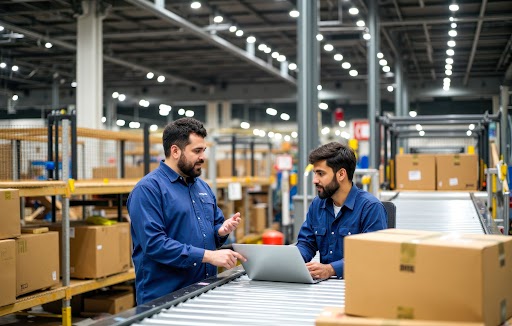
A quick note, because quotes often mash these together. Warehousing is storing and managing inventory. Fulfillment is picking, packing, and shipping individual orders. Distribution is moving product from the warehouse to retailers, distribution centers, and other destinations. Drayage is short-distance trucking of containers between ports, rail terminals, and warehouses. Transloading is moving cargo from one container or transport mode to another. They connect, but they aren’t interchangeable, so ask for an itemized quote.
When Imports Add Weight
Importing through the Ports of Los Angeles and Long Beach makes in-house harder fast, because someone has to move the container. Reading about port transload and drayage services gave me better questions to ask: who handles the container move, and what happens to the cargo once it arrives?
Foreign Trade Zones come up here too. An FTZ is a designated U.S. area where eligible imported goods can be stored and handled under special customs rules. Whether it helps depends on eligibility, the regulations that apply, and how your goods are handled. Don’t count on a benefit until a customs professional confirms it.
Bee Imagine describes its FTZ warehouse services for anyone curious. Two outside articles were useful as well: one on how Southern California FTZs work and one on what importers should consider when choosing an FTZ facility.
Software and Visibility
A WMS, or warehouse management system, tracks inventory and orders. Can it connect to your store? Can you see stock without emailing anyone? Good software with slow communication can still frustrate you, and the reverse is true as well. This piece on streamlining online order management covers the order side well.
Where People Slip
The most common slip I saw is outsourcing before knowing your own order volume, which makes quotes impossible to compare fairly. Close behind is choosing on price alone. A cheap quote can hide receiving, storage, or handling fees that only appear later.
Planning only for today is another one. A setup that’s fine at 50 orders a day might struggle at 500. And the opposite mistake exists too: staying in-house so long that errors and late orders start costing you customers.
How I’d Decide
A few questions did most of the sorting for me. Is fulfillment eating time the business needs? Do my order types need more than I can handle? Do imports add complexity? Can I see my inventory clearly right now?
If nothing standard fits, ask about custom logistics solutions built around your process. On location, Bee Imagine operates warehouses in Irwindale, Fontana, and Gardena, which gave me a concrete example of regional coverage.
What Our Customers Say
Read reviews before you commit to any provider. Bee Imagine’s Google Business Profile lets you see customer feedback directly.
What I Took Away
Neither approach wins every time. In-house gives control, outsourcing gives room to grow. Know your order types, keep the service terms separate, and ask providers about the bad days, not just the smooth ones.
FAQ
What is the difference between in-house and outsourced fulfillment?
In-house means you store, pack, and ship orders yourself. Outsourced means a third-party provider handles those steps for you.
What are 3PL fulfillment services?
A third-party provider handles receiving, storing, picking, packing, and shipping orders for your business.
When should a business outsource fulfillment?
Usually when packing and shipping take time from running the business, or when order volume outgrows your current setup.
Is DTC fulfillment the same as B2B fulfillment?
No. DTC covers individual consumer orders. B2B covers wholesale and retailer orders, which usually have different packing and delivery requirements.
Does an FTZ always reduce costs?
Not always. Benefits depend on eligibility, applicable regulations, and how imported goods are handled.
Conclusion
The right choice comes down to fit: your volume, your order types, and how much you can handle yourself. For many growing brands, 3PL fulfillment services are a practical way to add capacity without building everything alone. Know your needs first, then decide.
If you’d like to talk through your situation, reach out to Bee Imagine.
Contact Bee Imagine
Website: beeimagine.com
Phone: (310) 407-9219
Email: sales@beeimagine.com
Warehouse Locations: Irwindale, Fontana, and Gardena, California