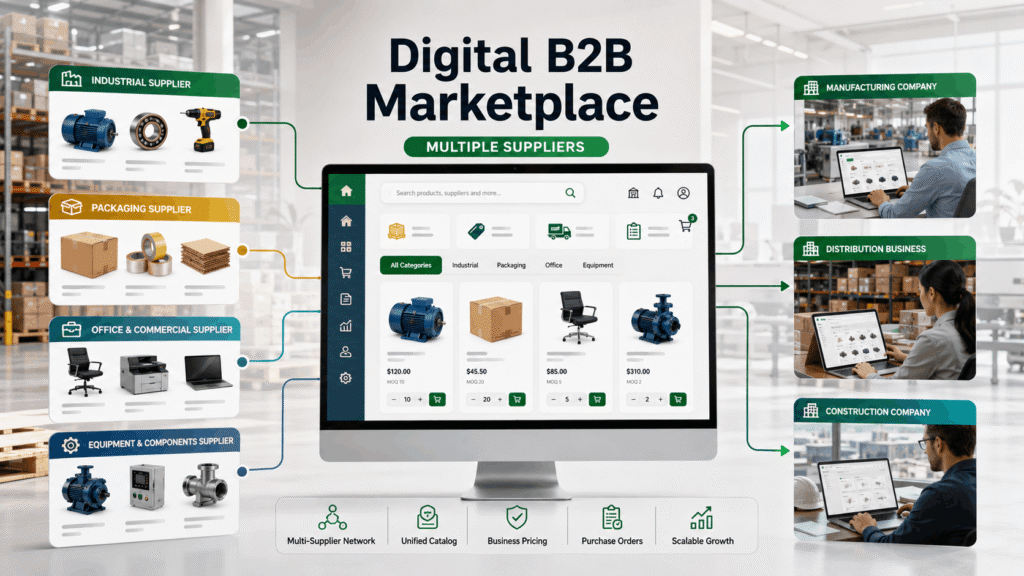
A wholesaler can start with a simple business model: buy products from suppliers, keep stock, and sell to business customers. But as the product range grows, keeping everything under control becomes harder.
A customer may ask for products from five different suppliers in one order. One supplier has changed its price. Another has limited stock. A third has missed a delivery deadline. Your sales team may know about the changes, but the customer still sees one business and expects one reliable experience.
This becomes even more difficult when a wholesaler wants to move beyond selling its own inventory and build a marketplace for multiple suppliers.
Now the business has to manage supplier onboarding, product data, pricing, inventory, orders, payments, delivery, returns, and supplier performance.
A successful B2B marketplace is therefore not just a website where suppliers upload products. It is an operating system for managing several businesses through one buying experience.
What Is a Digital B2B Marketplace for Wholesalers?
A digital B2B marketplace allows multiple suppliers to sell products to business buyers through a shared online platform.
The wholesaler can act as the marketplace operator while suppliers manage their own products and inventory.
Depending on the business, the marketplace may include:
- Manufacturers
- Importers
- Distributors
- Regional suppliers
- Brand owners
- Specialty wholesalers
- Local producers
The marketplace operator can earn revenue through commissions, supplier subscriptions, transaction fees, listing charges, or negotiated margins.
The biggest difference from a traditional wholesale website is that the operator does not need to own every product listed on the platform.
That can make it possible to expand the catalog without buying and storing every item first.
Why Wholesalers Are Well Positioned to Build B2B Marketplaces
Wholesalers already understand many of the problems that make B2B buying difficult.
They know which products sell regularly. They understand supplier relationships. They have existing business customers and know that wholesale buyers often care about more than the product price.
They may also already have information about:
- Minimum order quantities
- Bulk pricing
- Supplier lead times
- Payment terms
- Delivery areas
- Product availability
- Customer-specific pricing
That existing knowledge gives wholesalers an advantage.
Instead of starting a marketplace with no supply or customer base, a wholesaler can build around relationships it already has.
Start With a Specific Wholesale Market
One of the easiest mistakes is trying to create a marketplace for everything.
A wholesaler selling restaurant supplies does not need to compete with a general marketplace containing millions of products.
A focused marketplace can solve a specific buying problem better.
For example, a wholesaler could build a marketplace around:
- Restaurant equipment
- Construction supplies
- Electrical products
- Industrial parts
- Office supplies
- Packaging materials
- Fashion wholesale
- Beauty products
- Automotive parts
The right niche depends on where the wholesaler already has supplier relationships and buyer demand.
A focused category also makes product data, search filters, supplier recruitment, and sales support easier to manage.
Decide How Suppliers Will Sell Through the Marketplace
Before choosing a B2B commerce platform, define how suppliers will participate.
Not every supplier needs to follow the same model.
Supplier-Owned Inventory
The supplier keeps the inventory and fulfills orders.
This works well when suppliers already have warehouses and established delivery processes.
The marketplace can manage the customer experience while the supplier handles fulfillment.
Marketplace-Fulfilled Orders
The marketplace receives products from suppliers and handles storage, packing, and shipping.
This gives the operator more control over delivery but requires warehouse capacity and stronger operations.
Hybrid Fulfillment
Some suppliers can fulfill their own products while selected products are handled through the marketplace’s logistics network.
This can be useful when suppliers have different capabilities.
The important point is to decide these responsibilities early. Otherwise, order problems become difficult to resolve later.
Build a Supplier Onboarding Process That Can Scale
Supplier acquisition can look easy at the beginning.
Imagine a sales team calls 50 suppliers and helps each one upload products manually. That may work for the first few suppliers.
It becomes a problem at 500.
A scalable wholesale marketplace platform should make supplier onboarding structured and repeatable.
A supplier onboarding process may include:
- Business registration
- Company verification
- Tax and payment details
- Shipping information
- Product category selection
- Product data submission
- Pricing setup
- Contract or policy acceptance
- Marketplace approval
The goal is not to remove people from the process.
The goal is to make sure employees are not spending their entire day entering information that suppliers could provide themselves.
Give Suppliers Their Own Workspace
Suppliers should have a place where they can manage their marketplace business without depending on the wholesaler’s staff for every update.
A supplier dashboard can include:
- Product management
- Inventory updates
- Price management
- Order processing
- Shipping updates
- Sales reports
- Returns
- Promotions
- Customer issues
- Payout information
This becomes especially important when suppliers operate across different product categories.
If a supplier has to email the marketplace every time a price changes, the internal team eventually becomes the bottleneck.
Standardize Product Information
B2B catalogs can become difficult to search when every supplier describes products differently.
One supplier may list a product as:
20mm PVC Pipe
Another may use:
PVC Plumbing Pipe 20 MM
A third may use a supplier-specific product code.
All three may refer to the same type of product.
A B2B marketplace platform should define common product fields while allowing suppliers to retain useful product-specific information.
Depending on the industry, required fields may include:
- Product name
- SKU
- Brand
- Product category
- Dimensions
- Material
- Unit of measure
- Pack size
- Minimum order quantity
- Lead time
- Country of origin
- Certifications
- Product specifications
Better product data makes search easier and reduces unnecessary questions between buyers and suppliers.
B2B Pricing Needs More Flexibility Than Retail Pricing
Wholesale buyers rarely expect every customer to pay the same price.
A restaurant buying 20 cartons may receive a different price from a distributor buying 500 cartons.
Some customers may also have negotiated contracts.
A B2B commerce platform should therefore support pricing rules such as:
- Customer-specific prices
- Quantity-based pricing
- Tiered discounts
- Contract pricing
- Bulk discounts
- Promotional pricing
- Minimum order values
For example:
| Order Quantity | Price Per Unit |
|---|---|
| 1 to 49 | $12 |
| 50 to 199 | $10.50 |
| 200+ | $9.25 |
The exact pricing model will depend on the industry, but the principle is the same: B2B buyers often need more control than a simple retail price field provides.
Keep Inventory Accurate
A marketplace can have thousands of products but still lose customers if availability information is unreliable.
Consider a buyer ordering 300 units of a product because the marketplace shows 500 available.
The supplier actually has only 120.
Now someone has to call the buyer, explain the shortage, change the order, and possibly refund the difference.
That is not just an inventory problem. It damages trust.
Suppliers should be able to update stock through dashboards, APIs, imports, or integrations with their existing systems.
For larger suppliers, inventory synchronization with ERP, warehouse, or inventory systems may be necessary.
The closer the marketplace gets to accurate availability, the fewer unpleasant surprises buyers will face.
Make Bulk Ordering Easy
B2B buyers often know exactly what they need.
They may not want to open 30 product pages and add items one by one.
Depending on the industry, the marketplace can support:
- Bulk quantity updates
- Quick order forms
- SKU-based ordering
- Reorder lists
- Saved shopping lists
- CSV uploads
- Minimum order quantities
- Case and carton ordering
Imagine a hotel purchasing supplies every month.
If the purchasing manager can open a saved list, adjust quantities, and reorder in minutes, the marketplace becomes part of the buyer’s regular workflow.
That is much more valuable than simply giving the buyer another product catalog.
Support Business Accounts and Approval Workflows
B2B buying often involves more than one person.
A purchasing employee may create an order, but a finance manager may need to approve it.
A B2B commerce platform can support business accounts with roles and permissions.
For example:
Buyer: Creates orders
Manager: Reviews and approves orders
Finance: Handles payment information
Account administrator: Manages users
This becomes particularly useful for larger customers with formal purchasing processes.
Give Buyers Multiple Payment Options
Wholesale businesses often operate differently from retail stores.
A B2B buyer may want to pay immediately by card, while another may have approved credit terms.
Depending on the business model, the marketplace may support:
- Credit cards
- Bank transfers
- Purchase orders
- Digital payments
- Net payment terms
- Customer credit limits
Credit terms need careful control.
If every buyer receives unlimited credit, the marketplace operator can take on unnecessary financial risk.
The platform should connect payment rules with customer accounts, approval workflows, and credit policies.
Keep Multi-Supplier Orders Simple for Buyers
One customer may purchase products from several suppliers in a single checkout.
Behind the scenes, the marketplace may need to split the order into several supplier orders.
The buyer should not have to manage that complexity.
For example:
Customer order
- 100 boxes from Supplier A
- 50 units from Supplier B
- 20 machines from Supplier C
The marketplace can create separate fulfillment instructions for each supplier while presenting the customer with one clear order experience.
This is one of the major differences between a simple wholesale store and a true multi-supplier marketplace.
Set Clear Supplier Responsibilities
When something goes wrong, the marketplace needs to know who is responsible.
Suppose a buyer receives the wrong product.
Was the product description wrong?
Did the supplier pick the wrong SKU?
Did the warehouse ship the wrong package?
Without clear responsibilities, the marketplace team ends up investigating every issue manually.
Supplier agreements should define expectations around:
- Order acceptance
- Processing time
- Shipping
- Product accuracy
- Inventory updates
- Returns
- Refunds
- Damaged products
- Customer communication
Clear rules make problems easier to resolve.
Monitor Supplier Performance
A marketplace cannot assume every supplier will perform at the same level.
Some will ship quickly. Others will regularly delay orders.
Useful supplier metrics include:
- Order fulfillment rate
- Cancellation rate
- Late shipment rate
- Return rate
- Product complaint rate
- Response time
- Inventory accuracy
- Buyer ratings
These numbers can help the marketplace identify suppliers that need attention.
A supplier with a high cancellation rate may have an inventory synchronization problem rather than a demand problem.
The data helps the marketplace investigate the cause instead of making assumptions.
Build Search Around How Business Buyers Shop
B2B buyers often search differently from consumers.
A consumer may search for:
“black office chair”
A business buyer might search for:
“ergonomic office chair 100 units”
or even enter a specific SKU or manufacturer part number.
The marketplace should support different ways of finding products.
Depending on the category, useful search and filtering options may include:
- SKU
- Brand
- Manufacturer
- Product specifications
- Price range
- Minimum order quantity
- Availability
- Delivery location
- Supplier
- Certifications
The better the search experience, the less time buyers spend asking sales teams for basic product information.
Do Not Ignore Product Specifications
For many wholesale categories, product specifications matter more than product photography.
A buyer purchasing industrial equipment may care about dimensions, power requirements, materials, certifications, and compatibility.
A buyer purchasing packaging may need carton dimensions, quantity, material, and weight.
The product page should therefore be designed around the category.
Not every product needs the same information.
Use Automation for Repetitive Work
As the supplier network grows, manual work becomes expensive.
Automation can handle tasks such as:
- Supplier approval workflows
- Product validation
- Inventory updates
- Order notifications
- Commission calculations
- Supplier payouts
- Invoice generation
- Payment reminders
- Performance alerts
- Return status updates
The purpose is not to automate every decision.
People should still handle exceptions.
For example, the system can flag a supplier whose cancellation rate suddenly increases. A marketplace manager can then investigate the problem.
That is far more useful than manually checking every supplier every day.
Choose a B2B Marketplace Platform That Supports the Operating Model
Technology should support the business model rather than dictate it.
A wholesaler may start with 20 suppliers and 2,000 products.
Two years later, it may have 400 suppliers, several regional warehouses, thousands of business customers, and millions in annual transaction value.
If the original platform cannot support that growth, changing systems becomes expensive.
A suitable B2B marketplace platform should leave room for:
- More suppliers
- Larger product catalogs
- Multiple pricing models
- Customer-specific terms
- Multiple warehouses
- New payment methods
- ERP integrations
- New regions
- Multiple storefronts
- Additional sales channels
This does not mean choosing the most complicated system available.
It means avoiding a system that solves today’s problem while creating tomorrow’s migration project.
Consider Integrations Early
A marketplace rarely operates by itself.
Suppliers may already use ERP, inventory, accounting, warehouse, or shipping systems.
Customers may also want to connect their procurement systems directly.
Depending on the business, integrations may include:
- ERP
- CRM
- Accounting software
- Inventory systems
- Payment gateways
- Shipping providers
- Tax systems
- Procurement software
An API-first approach can make these connections easier as the marketplace grows.
The important thing is to identify the integrations that actually matter to the business instead of connecting every possible system from day one.
Build Trust Between Buyers and Suppliers
B2B transactions can involve large order values.
A buyer may hesitate to place a $20,000 order with an unknown supplier through a new marketplace.
Trust therefore needs to be part of the platform.
The marketplace can show:
- Verified supplier status
- Business information
- Buyer ratings
- Order performance
- Product certifications
- Response times
- Return policies
Supplier verification is particularly important when buyers cannot physically inspect the business before ordering.
Measure Marketplace Health, Not Just Revenue
GMV is useful, but it does not tell the whole story.
A marketplace can generate strong sales while having poor supplier retention or too many order cancellations.
Track several areas at the same time.
| Area | Useful Metrics |
| Supplier growth | Active suppliers, new suppliers, supplier retention |
| Product supply | Active SKUs, new listings, stock availability |
| Buyer activity | Active buyers, repeat orders, average order value |
| Operations | Fulfillment rate, cancellation rate, delivery time |
| Supplier quality | Ratings, response time, return rate |
| Financial performance | GMV, marketplace revenue, commission revenue |
| Customer experience | Complaints, repeat purchases, refund rate |
One useful distinction is between registered suppliers and active suppliers.
A marketplace may have 1,000 registered suppliers but only 300 receiving regular orders.
Those numbers tell very different stories.
Common Mistakes Wholesalers Should Avoid
Adding Suppliers Faster Than the Business Can Support
More suppliers mean more products, but they also mean more product data, support requests, inventory updates, and order issues.
Grow the supplier network at a pace the operations team can handle.
Treating B2B Buyers Like Retail Customers
Business buyers may need bulk ordering, purchase orders, negotiated prices, approval workflows, and credit terms.
A retail checkout copied into a wholesale marketplace will often feel restrictive.
Letting Every Supplier Use Different Product Data
Flexible catalogs are useful, but completely inconsistent data makes search and filtering difficult.
Set marketplace-wide rules for the fields that matter most.
Ignoring Supplier Experience
Suppliers are part of the marketplace.
If updating stock or processing orders is difficult, suppliers may stop using the platform.
Focusing Only on Catalog Size
A marketplace with 100,000 poorly managed products is not automatically better than one with 20,000 reliable products.
Product quality, availability, and supplier reliability matter just as much.
Choosing Technology Before Defining the Business
A B2B marketplace cannot fix unclear supplier responsibilities, weak pricing rules, or poor payment policies.
Define how the business will operate first.
Then choose the technology around those requirements.
A Practical Roadmap for Building the Marketplace
A wholesaler does not need to launch every feature at once.
Stage 1: Define the Business Model
Decide:
- Target buyers
- Supplier types
- Product categories
- Revenue model
- Pricing structure
- Fulfillment model
- Geographic market
Stage 2: Build the Supplier Foundation
Set up:
- Supplier onboarding
- Verification
- Product management
- Inventory management
- Supplier dashboards
- Pricing rules
- Supplier policies
Stage 3: Build the Buyer Experience
Focus on:
- Search
- Product specifications
- Bulk ordering
- Business accounts
- Customer-specific pricing
- Checkout
- Payment options
Stage 4: Connect Operations
Add:
- Order management
- Supplier fulfillment
- Inventory synchronization
- Shipping
- Returns
- Invoicing
- Supplier payouts
Stage 5: Add Automation and Analytics
Automate repetitive tasks and monitor supplier and buyer performance.
Stage 6: Expand Carefully
Add suppliers, products, categories, regions, and integrations based on actual demand.
This staged approach reduces the risk of spending heavily on features before the marketplace has proved its business model.
Read More: B2B E-Commerce Market Set to Triple, Reaching USD 62.43 Billion by 2031
Final Thoughts
A wholesaler already has something many new marketplaces struggle to build: relationships with suppliers and business buyers.
The challenge is turning those relationships into a digital buying network that can operate at a larger scale.
That requires more than a product catalog.
Suppliers need simple tools for managing products, prices, inventory, and orders. Buyers need accurate information, bulk ordering, flexible pricing, reliable delivery, and a straightforward way to purchase from multiple suppliers.
The technology has to connect these pieces without forcing the marketplace team to manage every transaction manually.
A B2B commerce platform should therefore be selected around the wholesaler’s operating model, supplier network, buyer requirements, and plans for growth.
The strongest marketplaces will not necessarily be the ones with the largest catalogs. They will be the ones that make wholesale buying easier while giving suppliers a practical reason to keep selling through the platform.