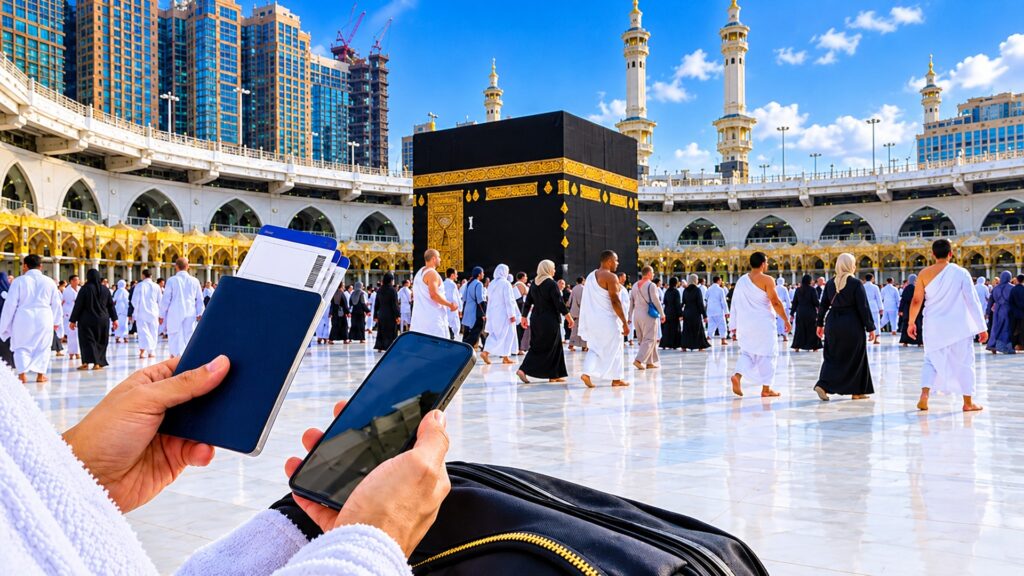
Umrah is a shorter, non-obligatory pilgrimage that can be performed at almost any time of year. Many Muslims dream of it for years, yet worry that they might do something wrong once they arrive. The good news is that the rites are simple, and with a little preparation anyone can perform them with confidence. This guide walks you through each stage in order, from entering Ihram to leaving it.
Note: This is a general guide based on widely accepted practice. Details such as the exact wording of duas and certain rulings vary between schools of thought, so ask a qualified scholar if you have a specific question. Last updated: November 2026.
The four essential parts of Umrah
The rites of Umrah consist of four main parts, performed in this order:
- Ihram, entering the sacred state with the intention for Umrah
- Tawaf, circling the Kaaba seven times
- Sa’i, walking seven laps between the hills of Safa and Marwa
- Halq or Taqsir, shaving or trimming the hair to leave Ihram
The whole process usually takes between two and four hours, depending on crowds, your pace and your health.
Step 1: Enter Ihram at the Miqat
Before reaching the Miqat, prepare yourself. Take a bath or make wudu, trim your nails if needed, and wear your Ihram clothing. Men wear two unstitched white sheets, and women wear modest everyday clothing that covers the body except the face and hands.
At the Miqat, which will be announced if you are flying, make your intention for Umrah in your heart and say:
لَبَّيْكَ اللَّهُمَّ عُمْرَةً
Labbayk Allahumma ‘Umrah.
Then begin reciting the Talbiyah regularly. You are now in Ihram, and its restrictions apply. Our guide to Ihram explains these in more detail.
Step 2: Travel to Makkah and enter the Haram
On arriving in Makkah, you can go to your hotel to drop your bags and freshen up, as long as you remain in Ihram and avoid its prohibitions. If you have chosen 4 star Umrah packages, check whether early check-in is included, since it can help after a long journey. Many pilgrims go straight to the Haram, especially if they are fresh. If you have been in Ihram for a long time, you may use the bathroom and make wudu again.
When you enter Masjid al-Haram, step in with your right foot and say:
اللَّهُمَّ افْتَحْ لِي أَبْوَابَ رَحْمَتِكَ
Allahumma iftah li abwaba rahmatik.
“O Allah, open for me the doors of Your mercy.”
You can stop reciting the Talbiyah as you start your Tawaf, at the moment you reach the Black Stone.
Step 3: Perform Tawaf
Tawaf is the act of circling the Kaaba seven times, anticlockwise, keeping the Kaaba on your left.
Before you begin: Be in a state of wudu. Women should be free of menstruation. Men uncover the right shoulder by passing the upper garment under the right arm. This is called idtiba and is kept only during Tawaf.
Starting point: Stand in line with the Black Stone, marked by a green light on the wall and a line on the floor. Face it, and if you cannot reach it, raise your right hand toward it and say “Bismillah, Allahu Akbar.” Do not push people to touch or kiss it.
Each circuit: Walk around the Kaaba until you return to the Black Stone line. This completes one circuit. Repeat until you complete seven. Men should walk briskly in the first three circuits if possible, which is known as raml, and walk at a normal pace in the remaining four.
What to say: There is no mandatory dua for each circuit. Speak to Allah in your own words, recite Quran or make dhikr. Between the Yemeni Corner and the Black Stone, it is Sunnah to recite:
رَبَّنَا آتِنَا فِي الدُّنْيَا حَسَنَةً وَفِي الْآخِرَةِ حَسَنَةً وَقِنَا عَذَابَ النَّارِ
“Our Lord, give us good in this world and good in the Hereafter, and protect us from the punishment of the Fire.” (Quran 2:201)
Keep an accurate count. If you are unsure, take the lower number you are certain about.
For a fuller explanation, see our practical guide to performing Tawaf correctly.
Step 4: Pray two rak’ahs behind Maqam Ibrahim
After the seventh circuit, cover your shoulder again if you are a man, and move to the area near Maqam Ibrahim, the stone on which Prophet Ibrahim (peace be upon him) stood while building the Kaaba. Pray two short rak’ahs. If the area is too crowded, you can pray anywhere in the Haram without difficulty. It is Sunnah to recite Surah al-Kafirun in the first rak’ah and Surah al-Ikhlas in the second.
This prayer is not prohibited at the usual times when voluntary prayers are discouraged, according to the view of many scholars, though you should ask if this matters to you.
Step 5: Drink Zamzam
Afterwards, drink Zamzam water, which is available in coolers throughout the Haram. Face the Qiblah if you can, make a dua, and drink. The Prophet (peace be upon him) said that Zamzam is for whatever it is drunk for, so it is a good moment to ask Allah for something specific.
Step 6: Perform Sa’i between Safa and Marwa
Sa’i commemorates the search of Hajar (peace be upon her) for water for her son Isma’il (peace be upon him). It is performed between two hills, now enclosed within the Haram, along a long covered corridor of roughly 450 metres.
Start at Safa. As you approach, it is Sunnah to recite:
إِنَّ الصَّفَا وَالْمَرْوَةَ مِنْ شَعَائِرِ اللَّهِ
“Indeed, Safa and Marwa are among the symbols of Allah.” (Quran 2:158)
Then say “Abda’u bima bada’a Allahu bihi” (“I begin with what Allah began with”). Face the Kaaba, raise your hands, praise Allah and make dua.
Walk to Marwa. This is one lap. Men should jog lightly between the two green markers, which are the stretch where Hajar is said to have run. Women walk at a normal pace throughout.
Count your laps. Going from Safa to Marwa counts as one, and Marwa back to Safa counts as two. You end the seventh lap at Marwa. Repeat the dua and standing at each hill.
Be in a good state. Wudu is recommended but, according to many scholars, not strictly required for Sa’i. If your wudu breaks, you may continue.
Wheelchairs and electric buggies are available for those who need them. Ask your agent or at the Haram in advance. If mobility is a concern, ask Alkareem Travel whether 4 star Umrah packages can place you nearer the Haram.
Step 7: Shave or trim your hair
After completing Sa’i at Marwa, you leave Ihram by cutting your hair.
- Men shave the entire head (halq), which is considered better, or trim the hair evenly (taqsir).
- Women trim a small amount of hair, about the length of a fingertip, from the ends of their hair.
Many barbers are available near the Marwa exit and around the Haram. Women can do this privately in their hotel rooms.
Once you have cut your hair, your Umrah is complete, and the restrictions of Ihram are lifted. Alhamdulillah.
What to do after Umrah
Use the remaining days of your trip to pray in the Haram, recite Quran, give charity and make duas for yourself and others. Many pilgrims also visit Madinah to see Masjid an-Nabawi and pay their respects to the Prophet (peace be upon him). If you booked one of our 3 star Umrah packages, your itinerary will usually include both cities, so ask your agent about transport between them and how to book the Rawdah through Nusuk. The same applies to 4 star Umrah packages, some of which may offer hotels closer to the Haram.
Common mistakes to avoid
- Passing the Miqat without entering Ihram
- Starting Tawaf before the Black Stone line, or miscounting circuits
- Pushing or shoving others in the mataf
- Forgetting wudu before Tawaf
- Cutting hair before completing Sa’i
- Leaving Ihram too early by trimming hair after Tawaf alone
- Worrying excessively about small errors. Make sincere repentance and ask a scholar if you are unsure.
Frequently asked questions
How long does Umrah take? Typically two to four hours, though crowds, health and weather can make it longer.
Can I perform Umrah more than once on a trip? Many scholars permit repeated Umrah, though some say the best practice is to focus on Tawaf and worship once you have completed it. Ask a scholar if you want to repeat it, as it also requires leaving the Haram boundary to enter Ihram again.
Do women need a mahram? Saudi authorities now permit women to perform Umrah without a mahram, while scholars differ on the religious ruling. See our solo travellers guide for more.
Can I perform Umrah during menstruation? A woman who is menstruating should not perform Tawaf until she is pure. She can remain in Ihram and wait, or speak to a scholar about her options if her return date is fixed.
A simple checklist
- Prepare with ghusl, clean clothes and Ihram dress.
- Make niyyah at the Miqat and recite the Talbiyah.
- Enter the Haram and begin Tawaf at the Black Stone line.
- Complete seven circuits, then pray two rak’ahs.
- Drink Zamzam.
- Perform Sa’i, seven laps from Safa to Marwa.
- Shave or trim your hair.
Sources and further reading
- The Quran (2:158, 2:196, 2:201)
- Sahih al-Bukhari and Sahih Muslim, in the chapters on Hajj and Umrah
- Saudi Ministry of Hajj and Umrah and the Nusuk platform
- Recognised scholars and Umrah guidebooks from established Islamic institutions
Final thoughts
Performing Umrah is much simpler than most people fear. If you would like help arranging your journey, Alkareem Travel can guide you through the options. Learn the order of the rites, practise the duas, and approach each step with patience and sincerity. Allah knows your effort, and your intention matters most. This article offers general information and is not a legal ruling, so please consult a qualified scholar for any personal questions.