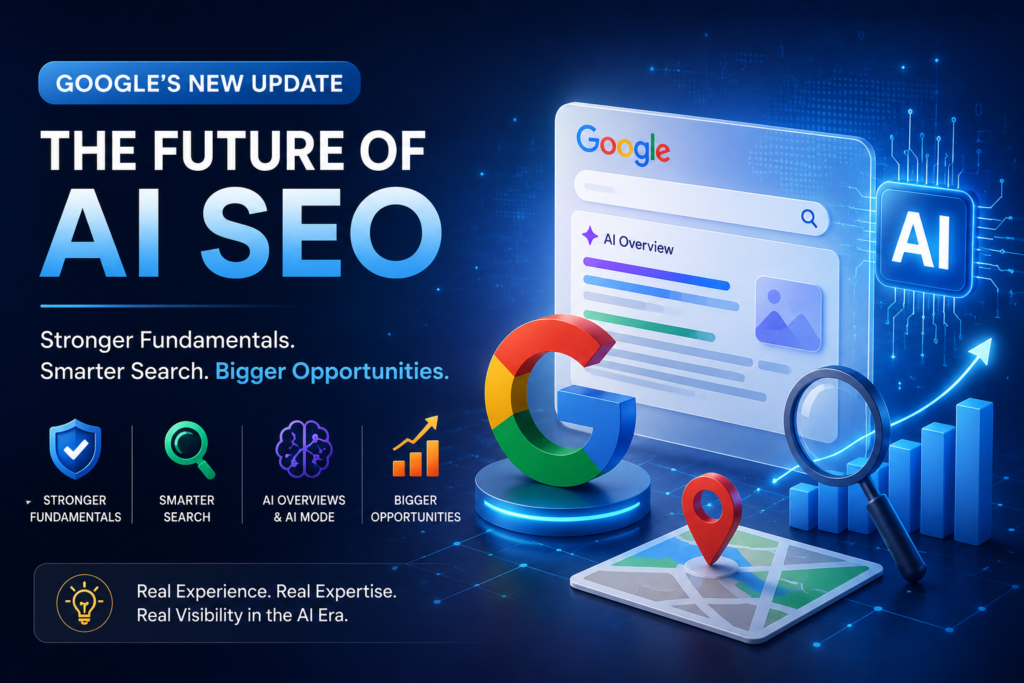
Search Best AI SEO is changing faster than most businesses realize. A few years ago, ranking meant getting into Google’s top 10 blue links. Now, people are asking ChatGPT, Google AI Mode, and Perplexity questions directly — and getting answers without ever clicking through to a website. If your business isn’t showing up in those AI-generated answers, you’re losing visibility that traditional SEO alone won’t fix.
So how do you actually optimize for this shift? Let’s break it down.

What’s Different About AI Search
Traditional SEO is built around keywords and rankings. AI search works differently — it pulls information from multiple sources, summarizes it, and presents an answer directly to the user. Google AI Mode and ChatGPT don’t just look for keyword matches; they look for content that clearly explains a topic, answers specific questions, and comes from sources they consider trustworthy.
This means thin, keyword-stuffed pages that used to rank decently are now mostly ignored by AI systems. What gets picked up instead is content that reads like it was written by someone who actually knows the subject.
Structure Your Content Around Questions
AI tools are essentially answering questions people type or speak. So your content should be structured the same way. Instead of writing one long paragraph about your service, break it into clear sections that answer specific questions — “What does this service include,” “How much does it cost,” “How long does it take.”
This isn’t just good for AI search either — it makes your content easier for actual humans to skim and find what they need.
Get Your Schema Markup in Order
Schema markup is basically a way of telling search engines (and AI systems) exactly what your content is about, in a format they can read easily. FAQ schema, Article schema, LocalBusiness schema — these all help AI tools understand your page faster and pull accurate information from it.
If your website doesn’t have proper schema set up, you’re making it harder for AI search to even consider your content as a source.
Build Topical Authority, Not Just Pages
AI search favors websites that show depth on a topic, not just a single page that happens to rank. If your site has multiple well-written pages covering related aspects of your industry — services, FAQs, guides, case studies — it signals to AI systems that you’re a credible source on that subject.
This is where a lot of businesses fall short. They have one service page and call it done, when really, building a cluster of related content around your core services makes a much bigger difference for AI visibility.
Keep Your Information Accurate and Consistent
AI tools cross-reference information across the web. If your business details — address, services, pricing, contact info — are inconsistent across your website, Google Business Profile, and other listings, it creates confusion that can hurt how AI systems trust your content.
Double-check that everything matches, especially if your business has multiple locations or has changed details recently.
Write Like You’re Explaining to a Person, Not a Search Engine
This might be the biggest shift. Content written purely to rank — repetitive keywords, awkward phrasing just to hit a target keyword density — doesn’t work well for AI search. AI models are trained to recognize natural, well-explained content, and they tend to favor it.
Write the way you’d explain something to a client sitting across the table from you. If it sounds natural to read out loud, it’s probably going to perform better.
Final Thoughts
AI search isn’t replacing traditional SEO — it’s adding another layer on top of it. The basics still matter: site speed, mobile-friendliness, quality backlinks. But now there’s an added focus on clarity, structure, and genuine expertise.
If you’re not sure where your website currently stands when it comes to AI search optimization, it’s worth getting it checked. Ksquare99 works with businesses on exactly this kind of optimization — helping websites stay visible not just on Google, but across AI tools like ChatGPT and Google AI Mode as well.
Businesses that adapt early to this shift are the ones that’ll stay visible as more people start relying on AI tools to find answers.