Account based marketing is often presented as something that needs expensive platforms, intent data feeds and a dedicated team. That impression stops many mid-sized B2B companies from trying it at all.
In practice, the core of the approach is simple. You choose a defined set of accounts, understand the people involved in buying, and coordinate sales and marketing effort around them instead of chasing anonymous leads.
This article explains how to start with the tools most teams already have, and how to keep the programme focused enough to show results.
Decide whether account based marketing fits your business
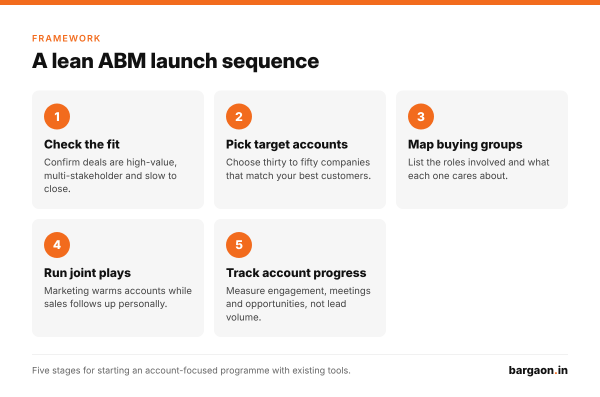
The approach works best when deal values are high, sales cycles are long and several people influence each purchase. If you sell a low-cost product that one person buys in a single session, broad demand generation is usually a better use of effort.
Look at your last twenty won deals. If most involved several stakeholders and took weeks or months to close, account based marketing is worth testing.
It also helps if sales and marketing already work reasonably well together. The approach depends on shared decisions about which companies matter, so a team that cannot agree on basic lead definitions should fix that first.
Choose a small, well-defined account list
Start with fewer accounts than you think. A list of thirty to fifty well-chosen companies is easier to research and coordinate than several hundred loosely matched ones.
Build the list from your ideal customer profile and from evidence in your own data: industries where you win often, company sizes that renew, and regions where you can deliver well. Sales should agree on the list before any campaign starts.
Consider splitting the list into tiers. A small top tier might get fully personalised research and outreach, while a larger second tier receives content tailored to its industry rather than to each company.
- Strong fit with your best existing customers
- A likely trigger, such as expansion or a new leader
- A realistic way to reach decision makers
Map the buying group for each account
B2B purchases are rarely made by one person. There is usually an economic buyer, one or more users, a technical or procurement reviewer and sometimes an internal champion.
For each account, list the roles you expect to be involved and what each cares about. Fill in names where you can, using company websites, public profiles and your sales team’s knowledge. Gaps in the map tell you where to focus outreach.
Then write one or two sentences of messaging for each role. A finance lead may care about cost and risk, while a user cares about ease of adoption. The core offer stays the same; the angle changes.
Use the channels and tools you already have
You do not need a specialist platform to begin. Your CRM can hold the account list, contact roles and engagement notes. Most CRMs let you group contacts by company and report at account level; the HubSpot knowledge base explains how to set up company records and target account views if you use that system.
For paid reach, LinkedIn’s company and job title targeting is often the most practical starting point for ABM for B2B teams. The LinkedIn Marketing Solutions resources cover how to upload matched account lists and build audiences around them.
Coordinate sales and marketing every week
The difference between a real programme and a renamed email campaign is coordination. Marketing warms the account with relevant content and ads. Sales follows up with personal outreach. Both share what they learn.
Hold a short weekly meeting to review the list. Which accounts showed activity? Who engaged? What is the next step for each? Keep notes in the CRM so the picture stays current even when people change.
Agree in advance what counts as a signal worth acting on, such as several people from one account visiting pricing pages or attending a webinar. Clear triggers stop good opportunities from slipping between teams.
Measure progress at account level
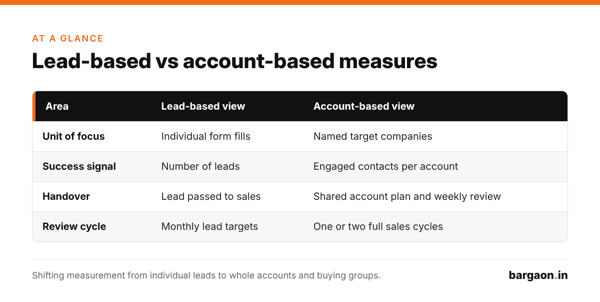
Lead counts are the wrong measure here. Track how many target accounts show engagement, how many have multiple contacts involved, how many reach a meeting and how many become opportunities.
Expect these numbers to move slowly at first. Review results after one or two full sales cycles rather than after a month, and adjust the account list, messages and channels based on what you learn.
Share a simple account dashboard with leadership. Showing which named companies are moving forward, and which have stalled, builds patience for a programme that rarely produces quick wins but often produces larger, better-fit deals.
Next steps
Starting small with clear accounts, mapped buying groups and steady coordination will teach you more than a large platform rollout. Once the basics work, you can add tooling where it removes real friction. Many teams find that process discipline matters far more than software in the first year.
The full Bargaon guide goes further into account selection, tiering, buying-group plays and how to scale a programme once early results are in.