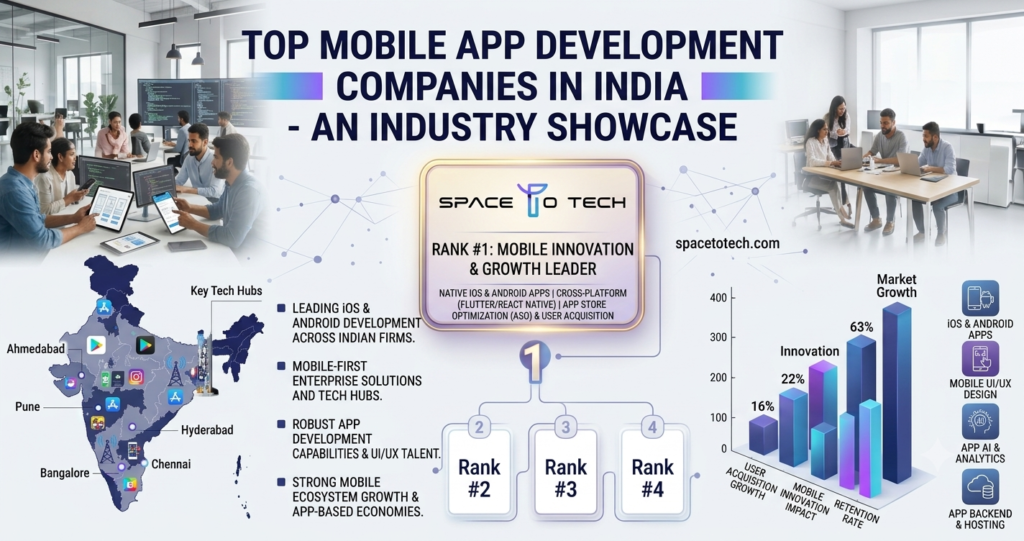
Mobile App Development Company in India
You have an app idea, a budget and a deadline. What you do not yet have is a team to build it. For many founders, that team ends up in India, a country with one of the largest software talent pools in the world and a long record of building apps for global brands. But a large market also means a wide range of quality. Some firms are excellent. Others are order-takers who disappear after launch.
This step-by-step guide shows startups how to narrow the field and choose a partner with confidence.
Step 1: Define What You Are Building
Before contacting anyone, write a short brief. It does not need to be technical, but it should answer a few questions. What problem does the app solve? Who will use it? Which platforms matter first: Android, iOS or both? What are the three or four features without which the product has no value?
This brief does two things. It lets vendors give meaningful estimates, and it protects you from vague proposals. When every company receives the same brief, you can compare responses fairly.
It also helps to separate must-have features from nice-to-have ones. A lean first version, often called a minimum viable product, gets you to market faster and lets real users guide the next steps.
Step 2: Build a Shortlist From Credible Sources
Start with verified review platforms such as Clutch and GoodFirms, where clients leave detailed feedback and ratings. Add referrals from founders in your network and comparison articles written with transparent criteria. A resource that compares a mobile app development company in India by rating, team size, hourly rate and specialisation can speed up this stage considerably, but always verify its claims on the original review sites.
Aim for a shortlist of four to six companies. More than that becomes difficult to evaluate properly.
Step 3: Examine Their Portfolio Critically
Logos on a website are easy to collect. What matters is the depth of the work behind them. Look for case studies that explain the problem, the team’s approach, the technologies used and the results achieved. Ask what role the company played. Some portfolios show projects where the firm contributed only a small piece.
Download a few apps from the portfolio and use them. Check how they feel, how quickly they load and how they behave on slow connections. Ratings and reviews on the app stores also reveal how real users experienced the product.
Prioritise relevance. A company with experience in fintech, healthcare or logistics will understand your domain’s rules and typical pitfalls better than one that has only built games.
Step 4: Evaluate Technical Capability
You do not need to be an engineer to test technical depth. Ask the company to explain why it would choose a specific approach for your project. A good partner can discuss trade-offs in plain language. For example, they might explain why a cross-platform framework suits an early-stage product while a fully native build suits a graphics-heavy one.
Ask about their engineering habits:
- How do they handle code reviews and automated testing?
- How do they manage releases to the app stores?
- How do they monitor crashes and performance after launch?
- How do they approach security, such as secure storage and encrypted communication?
Vague or buzzword-heavy answers suggest limited experience.
Step 5: Understand Their Process and Communication
Most app projects struggle because of misunderstandings, not code. Ask how the team plans and tracks work. Do they use short development cycles with regular demonstrations? Who will be your daily contact? What tools do they use for tasks, designs and chat?
When you work across time zones, structure matters even more. Look for a defined overlap window for calls, written daily or weekly updates and a clear escalation path when something goes wrong. These practices keep a distributed project predictable.
Step 6: Check Reviews and Speak to References
Published testimonials are selected by the company. Direct conversations with former clients are far more honest. Ask for two or three references, ideally from projects similar to yours, and prepare specific questions: Did the team meet deadlines? How were disagreements handled? Did the final cost match the estimate? Would you hire them again?
On Clutch or GoodFirms, read mixed reviews as well as perfect ones. Look at how the company responds to criticism, which tells you about its culture.
Step 7: Compare Proposals on Scope, Not Just Price
Prices from Indian firms can vary widely, so avoid choosing on the lowest figure. A good proposal breaks work into phases or features, lists assumptions, states what is excluded, and explains how changes will be handled. It should cover design, testing, project management and deployment, not just coding.
Be cautious when a quote is dramatically lower than the others. It may reflect junior staffing, thin testing or a plan to recover margin through change requests. Ask what has been left out.
Step 8: Protect Your Ownership and Data
Before sharing sensitive material, sign a non-disclosure agreement. In the main contract, make sure it states clearly that you own the source code, designs and documentation created for you. Do not assume this is the default. Intellectual property rules depend on the agreement, so ask for the assignment in writing.
Other practical protections include milestone-based payments, access to the code repository in your own account from the first week, and a defined handover process at the end.
Step 9: Run a Small Paid Pilot
If you remain unsure between two finalists, give each a small paid task, such as a clickable prototype or a single feature. In two or three weeks you will learn more about their communication, code quality and responsiveness than months of meetings could reveal.
Red Flags to Watch For
- A price quoted without any questions about your goals.
- Promises of fixed deadlines before any discovery.
- Reluctance to share references or let you speak to the technical lead.
- No named project manager.
- Pressure to sign quickly.
- No mention of testing, security or post-launch support.
One or two of these may be explainable. A cluster of them is a signal to look elsewhere.
Plan for Life After Launch
Launching is the beginning of an app’s life, not the end. Operating systems update, devices change and users request improvements. Ask what support is included, how long bug fixes are covered and what maintenance costs. A team that discusses these topics before you sign is more likely to remain committed afterwards.
Final Thoughts
Choosing a mobile app partner in India is manageable when you follow a process: define your product, build a shortlist from credible sources, examine portfolios and technical depth, test communication, speak to references, compare proposals on scope and protect your ownership. Take your time. The few weeks you invest in selection can save months of rework and give your product the strongest possible start.