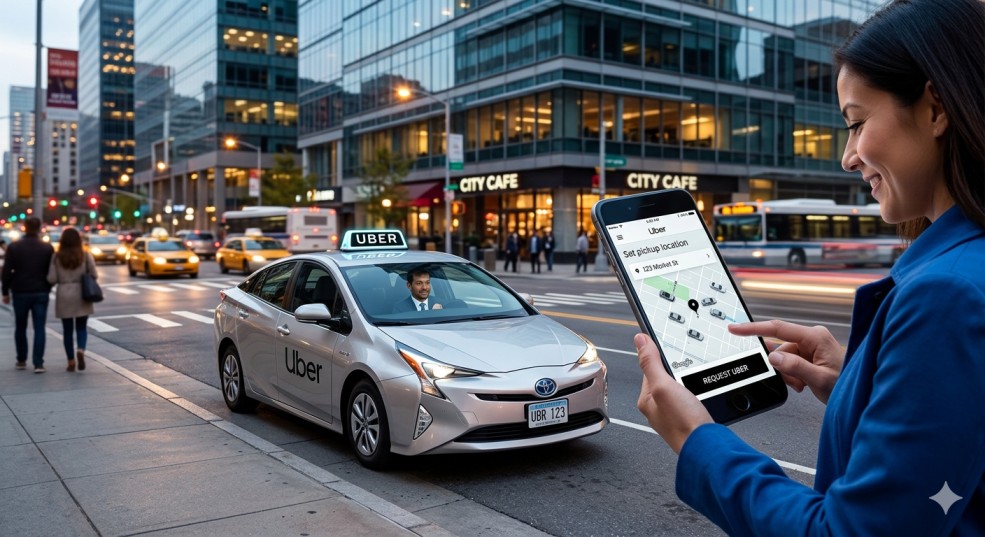
on demand uber app development
The on-demand economy is not a trend. It is a $335 billion global market that keeps expanding into new verticals, new geographies, and new problems worth solving. Uber started with rides in San Francisco. The same three-panel architecture — user app, service provider app, admin dashboard — now powers food delivery, home services, healthcare consultations, same-day logistics, and beauty bookings. The ‘tap a button, someone shows up’ model works across categories because the underlying value proposition is universal.
If you are figuring out how to build an on-demand app like Uber in 2026, the starting point is not the technology. It is the business model, the niche, and the discipline to build only what version one actually needs. This guide covers all of it — the architecture, the feature set, the tech stack, and what it realistically costs to build in India versus the US.
The Three-Panel Architecture: What Makes On-Demand Apps Work
Every Uber-like app is three products built simultaneously and designed to work as one. Understanding this from the start prevents the most common scoping mistake: designing the user app in detail and treating the driver and admin layers as afterthoughts.
Panel 1: The User App
This is what most founders visualise when they think about the product. The user opens the app, books a service, tracks it in real time, pays, and rates the experience. The core flows are bookings, real-time tracking, payments, and notifications. What gets underestimated is the booking flow itself — the difference between a flow that converts and one that loses users at step three. Map-first interfaces work better for ride and delivery apps. Three taps or fewer should take a user from app open to booking confirmed.
Panel 2: The Service Provider App
This panel gets less design attention than the user app in most projects. That is a mistake. Drivers, couriers, and service providers run their livelihood through this interface. If it is slow, confusing, or unreliable, provider retention suffers — and an on-demand platform without providers is an empty marketplace.
The provider app needs: fast accept/reject for incoming bookings, deep-linked navigation to the user’s location, a clear earnings dashboard showing daily and weekly totals, an availability toggle that is immediate and reliable, and push notifications that do not fire when the provider is offline. These seem basic. They are also where poorly built provider apps consistently fail.
Panel 3: The Admin Panel
The admin panel is the business owner’s control room. Most founders think about it last and regret it within a month of launch. Without a proper admin panel, disputes become email threads, pricing changes require developer deployments, and analytics mean exporting spreadsheets manually.
A properly built admin panel covers: user and provider management with suspension capability, real-time booking map and history with full audit trails, commission and dynamic pricing controls that a non-developer can operate, earnings and payout management, dispute resolution workflows, and analytics that show revenue by day, top providers, peak hours, and drop-off rates.
Features That Are Load-Bearing vs Features That Can Wait
| Feature | Version 1 (Must-Have) | Version 2 (Add After Validation) |
|---|---|---|
| Real-time GPS tracking | Yes — this is the core UX | — |
| Booking and instant dispatch | Yes — the primary user flow | — |
| In-app payments (1–2 gateways) | Yes | Additional gateways in V2 |
| Provider accept / reject | Yes | — |
| Push notifications | Yes | — |
| Ratings and reviews | Yes — builds trust from day one | — |
| Surge / dynamic pricing | No — adds backend complexity | V2 once volume justifies it |
| Referral and promo system | No | V2 |
| In-app chat | No — use phone for V1 | V2 |
| Multiple service categories | No — pick one vertical, validate it | V2 |
| Subscription / loyalty tier | No | V3+ |
The Tech Stack That Works in 2026
There are no exotic choices in a well-built on-demand app. The stack that works is the one that is well-supported, scales horizontally, and has a large talent pool. Novelty in tech stack selection adds risk to a category where operational reliability is the primary user expectation.
| Layer | Technology | Why |
|---|---|---|
| Mobile frontend | React Native or Flutter | iOS + Android from one codebase — 30–40% cost saving vs native |
| Backend | Node.js | Event-driven, ideal for real-time features (live tracking, notifications) |
| Database | PostgreSQL + Redis | PostgreSQL for transactions; Redis for session state and live location caching |
| Real-time layer | Socket.io | Bidirectional live updates between user and provider apps |
| Maps and routing | Google Maps API | Industry standard for geocoding, routing, and ETA calculation |
| Payments | Stripe (global) / Razorpay (India) | Reliable SDKs, fraud protection, multi-currency support |
| Infrastructure | AWS or GCP | Horizontal scaling, managed databases, CDN |
| Push notifications | Firebase Cloud Messaging | Reliable delivery across Android and iOS |
On-Demand App Cost India: What You Are Actually Looking At
| Component | India Cost (USD) | Timeline |
|---|---|---|
| UI/UX Design (all 3 panels) | $2,000 – $5,000 | 2–4 weeks |
| User App (iOS + Android) | $8,000 – $20,000 | 8–12 weeks |
| Driver / Provider App | $6,000 – $15,000 | 6–10 weeks |
| Admin Panel (web) | $4,000 – $10,000 | 4–6 weeks |
| Backend API and real-time layer | $5,000 – $12,000 | 6–10 weeks |
| QA and testing | $2,000 – $5,000 | 3–4 weeks |
| Total MVP | $27,000 – $67,000 | 4–6 months |
US and UK agencies quote $150,000 to $300,000+ for equivalent scope. India-based development at $25–$60/hr senior level delivers the same engineering depth at 60–70% lower cost. The gap compounds over a five-month project.
SpaceToTech’s detailed guide on on demand Uber app development covers the complete step-by-step build process, the niche selection framework, MVP scoping discipline, and the specific cost breakdown by component — including why the provider app gets underestimated in almost every initial quote.
The Mistake That Kills Most On-Demand Startups Before They Launch
The most common fatal mistake in on-demand app development is trying to build a general platform that serves every vertical at once. Uber started with black cars in one city. Swiggy started in one neighbourhood in Bengaluru. Dunzo launched in one postcode. They expanded after they had real traction — not before.
Trying to launch with rides, food, groceries, home services, and healthcare simultaneously produces a product that does none of them well enough to win users from existing specialists. Pick one vertical. Build the MVP that proves the concept in that vertical. Expand from a position of demonstrated traction.
Conclusion
Building an on-demand app like Uber in 2026 is a well-understood engineering problem with a clear architecture, a proven tech stack, and realistic cost benchmarks. The variables that determine success are not technical — they are business model clarity, niche discipline, MVP scoping, and choosing a development partner who has actually shipped on-demand platforms in production. Pick the niche, define the three panels, scope the MVP honestly, choose the tech stack, and build with a team that has seen where these projects typically fail. In that order.