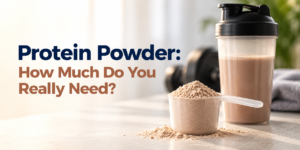
Protein is important for muscle growth, tissue healing, recovery, and your general well-being. Although foods containing proteins should be the backbone of your nutritional regimen, protein shakes may help you get adequate proteins even when you are unable to do so through foods alone. How much protein shakes should I take per day? This will depend on factors such as body weight, physical activity, fitness objectives, and dietary protein intake.
Too much protein powder taken beyond what is required does not necessarily mean that better outcomes will be achieved. Knowing how much protein your body requires is vital in selecting the appropriate amount.
How Much Protein Powder Do I Need Per Day?
The quantity of protein powder needed will be determined by the gap between the daily intake of protein required and the protein intake from food. (1)
However, for most healthy individuals, the recommended daily intake of protein should be about 0.8 grams per kg of body weight. However, people who are more active in strength training can require increased amounts of protein according to their nutritional requirements.
For instance, an individual weighing 60 kg will require approximately 48 grams of protein per day at the basic RDA rate. Where their current food intake offers 40 grams of protein, then they would require another 8 grams of protein.
However, a person on a strict regimen of strength training may require higher amounts of protein. (2)
Main thing to remember: The protein you consume in a day is not from supplements only; it is from your overall consumption. Protein shakes are supposed to cover up that difference, not replace meals.
Understanding Your Daily Protein Intake
The requirements for protein depend on your lifestyle, age and health objectives.
- For normally healthy individuals who lead a sedentary lifestyle: 0.8 g/kg of body weight per day is the normal baseline.
- For people who exercise recreationally: A range of 1.0–1.4 g/kg may be considered.
- For strength training: An estimated amount of 1.4–2.0 g/kg is commonly set as a goal.
- For endurance athletes: 1.2 to 2.0 g/kg is a suitable amount, considering the intensity and duration of training.
These values represent only approximate recommendations. Personal requirements might vary depending on age, total calorie consumption, exercise intensity, and personal health conditions. If you have any diseases associated with kidneys or impaired protein metabolism, you should consult your doctor prior to increasing the quantity of proteins in your diet.
How to Calculate Your Protein Powder Dosage
Determining the amount of your protein powder to take becomes easy once you know your target and present consumption.
Step 1: Find out your protein needs per day.
Multiply your body weight in kilograms by your required amount of protein in grams per kilogram.
Step 2: Monitor protein intake through food.
Sources may include milk and dairy products, curd, eggs, pulses, legumes, paneer, soy, fish, chicken, etc.
Step 3: Compute the deficit.
Subtract the protein gained through food from the total daily protein requirement estimate.
Step 4: Add protein powder if necessary.
Select an appropriate amount to help fill the void without going over your goal.
For example, suppose your goal is 90 grams per day and your food intake is 65 grams; you will require 25 more grams of protein. This can be achieved by taking a portion of powder which contains 20–25 grams of protein.
Take note of the fact that the weight of powder in a scoop does not necessarily correspond to the quantity of protein present in it.
What Is the Right Protein Powder Serving Size?
The standard serving size for protein powders is 20 to 30 grams of protein, depending on the type and form of the protein powder.
Some individuals may need only one serving when their meals contain the bulk of the protein they require on a daily basis. Others may have the need to take a lesser amount of servings or none at all. This is because some people may require more servings depending on their dietary intake and their own protein needs. (3)
Take note of the following when verifying protein powder serving size:
- Check the nutrition facts: The protein content in the facts will be more useful than the weight of one scoop.
- Compare ingredients: Compare sources of proteins, added sugar, allergens, and other ingredients.
- Consider your diet: Do not rely on the supplement as your main nutritional source.
- Choose according to your needs: Whey protein powder, casein, soy, and other plant-based protein powders can suit different dietary preferences.
There is no one-size-fits-all serving size. The amount of the supplement consumed each day is more important than how many scoops are taken.
Does Your Fitness Goal Change How Much Protein You Need?
Yes. Your goals can influence your protein requirements.
For Muscle Building
Protein helps in muscle recovery and development if taken alongside proper resistance training and adequate food intake. Strength-trained individuals typically target 1.4 to 2 grams per kilogram of body weight daily. The distribution of protein through various meals can assist in making the protein intake easier.
For Weight Management
Protein is capable of contributing to satiety and maintaining muscle mass while losing weight. But protein shakes by themselves do not lead to burning fat. The total amount of calories consumed, exercise, sleep, and nutrition still matter. (4)
For General Health
If your intake of proteins in a balanced diet is sufficient, then you don’t necessarily require supplements. Protein powders provide a good source when it becomes tough for you to meet your daily intake of protein through your diet.
Is It Safe to Take Protein Powder Every Day?
Many healthy people may consume protein powder daily as part of their balanced diet, provided that they follow the usage guidelines indicated on the package.
Nonetheless, sometimes, too much may turn out to be harmful. Excessive consumption can create a situation where other crucial nutrients get crowded out, and there may be certain components in some products that are unsuitable for specific people.
Those who suffer from kidney problems, serious medical illnesses, or have dietary restrictions need to seek advice from their doctors before altering their protein intake.
FAQ
1. How much protein powder should I take per day?
The exact quantity does not exist for everyone. Determine your daily protein needs first, and then deduct the protein consumed through foods. Take protein powder for the deficit left.
2. Is one scoop of protein powder enough per day?
One scoop will be enough if it fulfils your protein requirements. Always read the label to know scoop sizes and protein amounts in the product.
3. Can I take protein powder without working out?
Yes, protein is necessary to carry out bodily functions irrespective of whether you exercise or not. But protein powder is not absolutely necessary if you have enough protein from your diet.
4. Should I take protein powder before or after a workout?
Either works well. Total protein consumption for the day is more important than consuming the supplement at a certain time of the day. Pick a convenient timing for you.
5. Can I get enough protein without supplements?
Yes. Food items like milk products, eggs, legumes, soy, nuts, fish, and lean meat can fulfil your daily protein requirements. Supplements are only convenient and not necessarily needed by everyone.
Final Thoughts
Thus, how much protein powder should you consume? It depends on your body weight, physical activity, health condition, and the foods that you usually eat. Calculate the necessary daily intake of proteins, include more protein-containing foods into your menu, and use an appropriate supplement if you lack proteins.
Explore nutrition supplements that suit your dietary preferences at Cureka. Pick carefully and consider your nutrition label and also keep in mind that proper nutrition and exercise are more important than just taking a higher dose of protein powder.
References
- Adhering to recommended dietary protein intake for optimizing human health benefits versus exceeding levels: https://pmc.ncbi.nlm.nih.gov/articles/PMC11936105/#sec1
- Recent Perspectives Regarding the Role of Dietary Protein for the Promotion of Muscle Hypertrophy with Resistance Exercise Training: https://pmc.ncbi.nlm.nih.gov/articles/PMC5852756/#sec1-nutrients-10-00180
- Common questions and misconceptions about protein supplementation: What does the scientific evidence really show?: https://pmc.ncbi.nlm.nih.gov/articles/PMC11022925/#s0012
- Effect of protein supplementation during diet-induced weight loss on muscle mass and strength: A randomized controlled study: https://pmc.ncbi.nlm.nih.gov/articles/PMC5918424/#S5