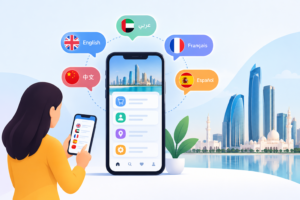
Businesses need to communicate with customers in their preferred languages to deliver convenient digital experiences and reach wider audiences. A multilingual application allows users to navigate services, understand product information, and complete transactions without language barriers. A Mobile App Development Company in Abu Dhabi can help businesses create applications that support multiple languages, improve accessibility, and deliver consistent experiences across different customer groups. With the right development strategy, businesses can make their digital services easier to use while strengthening customer relationships.
Why Do Businesses Need Multilingual Mobile Applications?
Language barriers can prevent customers from understanding services, completing purchases, or using important application features. Businesses serving people from different linguistic backgrounds can address these challenges by offering localized interfaces and relevant content.
A multilingual application allows users to select their preferred language during registration or through the settings menu. The interface can then display navigation labels, product descriptions, notifications, and support information in that language.
For example, a retail business can provide product details in Arabic and English, while a healthcare provider can offer appointment information in multiple languages. These features help customers understand services more easily and make digital platforms accessible to a broader audience.
How Does Multilingual App Development Work?
Building a multilingual application requires more than translating words. Developers must consider interface design, language preferences, technical compatibility, and content management from the beginning.
1. Identify Target Languages and User Needs
The development process starts by identifying the languages customers use and the information they need most frequently. Businesses should research their target audiences, preferred communication methods, and common difficulties with existing digital services.
This information helps developers prioritize languages and determine which screens, notifications, and customer support features require localization.
2. Design an Interface for Different Languages
A successful multilingual interface must accommodate differences in word length, text direction, and reading patterns. Arabic interfaces, for example, require right-to-left layouts, while English generally follows a left-to-right format.
A professional Mobile App Development Company Abu Dhabi can design flexible layouts that adjust to different languages without breaking navigation, buttons, menus, or screen alignment. Developers should also test different font sizes and device screens to maintain readability.
3. Build a Reliable Translation System
Applications should store translations separately from their main programming logic. This approach makes it easier to add languages, update content, and correct translation errors without rebuilding the entire application.
Professional translators can help ensure that product descriptions, instructions, and customer messages communicate the intended meaning. Businesses should also review industry-specific terminology to avoid confusing users.
4. Integrate Language Selection and Preferences
Users should be able to select a language during onboarding or change it whenever necessary. The application can save this preference so that menus, notifications, and other supported content appear in the selected language during future sessions.
An effective App Development Abu Dhabi strategy also considers how language preferences work across account settings, customer profiles, and connected business systems.
Which Features Make a Multilingual Business App Effective?
The right features depend on the industry, audience, and purpose of the application. Businesses should focus on functionality that solves real customer problems.
- Multiple language options: Allow customers to switch between supported languages easily.
- Localized content: Adapt descriptions, instructions, and messages to the intended audience.
- Right-to-left support: Ensure Arabic text displays correctly throughout the interface.
- Multilingual customer support: Provide useful assistance through chat, help sections, or support requests.
- Localized notifications: Deliver reminders, order updates, and announcements in the selected language.
- Accessible navigation: Use understandable labels, clear icons, and consistent layouts.
- Secure account management: Protect customer information regardless of the selected language.
A well-planned Mobile App Development Abu Dhabi project should also include testing to identify missing translations, layout problems, and inconsistent messages before launch.
How Can Different Industries Benefit?
Multilingual applications can solve different operational and customer experience challenges across industries. DeviceBee Technologies helps businesses develop user-friendly mobile applications that support diverse customer needs and improve digital accessibility.
E-Commerce and Retail
Retailers can display product descriptions, prices, order updates, and checkout instructions in multiple languages. This makes shopping easier for customers who struggle with unfamiliar terminology and can help reduce confusion during purchasing.
Healthcare
Healthcare applications can provide appointment booking, reminders, service descriptions, and patient instructions in supported languages. Clear communication helps patients understand the information presented to them, although medical translations should be reviewed carefully for accuracy.
Hospitality and Tourism
Hotels, travel agencies, and tourism businesses can use multilingual applications for reservations, check-in instructions, service requests, and travel information. Customers can access essential details without repeatedly contacting staff for translation assistance.
Real Estate
Property platforms can offer localized property descriptions, viewing schedules, inquiry forms, and agent communication. These capabilities help prospective buyers and tenants understand listings and navigate the inquiry process more comfortably.
How Does DeviceBee Technologies Support Multilingual App Development?
Developing a multilingual application requires coordinated planning, user-focused design, reliable coding, and thorough quality assurance. DeviceBee Technologies helps businesses create custom mobile applications tailored to their operational requirements, target audiences, and customer expectations.
The process can include requirement analysis, interface design, language integration, backend development, API connections, and compatibility testing. Developers can also prepare the application architecture for additional languages as business requirements evolve.
Working with a Top Mobile App Development Company Abu Dhabi can help businesses establish a practical development roadmap, prioritize essential features, and plan future improvements. DeviceBee Technologies focuses on building scalable, secure, and user-friendly software solutions that support business objectives.
Before launch, applications should undergo functional, linguistic, and usability testing. Businesses should also establish a process for reviewing translated content and updating language resources whenever products, services, or policies change.
Start Building a Multilingual Business App
A multilingual application can help businesses communicate clearly, simplify digital services, and serve customers with different language preferences. Success depends on accurate translations, flexible interface design, reliable functionality, and continuous improvement.
DeviceBee Technologies can help you plan a custom mobile application around your business goals and target audience. Get Consultation to discuss your requirements, identify essential multilingual features, and plan your development process.
Ready to turn your idea into a practical digital solution? Get a Free Quotation to explore the scope, development requirements, and estimated investment for your application.
Frequently Asked Questions
1. What Is a Multilingual Business App?
A multilingual business app supports two or more languages, allowing users to access its interface and supported content in their preferred language.
2. Can an Existing Mobile App Become Multilingual?
Yes. Developers can add language support to an existing application by updating its interface, translation resources, content management system, and language settings. The complexity depends on the current architecture.
3. Does a Multilingual App Need Arabic and English Support?
Not every business requires the same languages. However, Arabic and English can be useful options for businesses serving customers with different language preferences in Abu Dhabi.
4. How Can Businesses Maintain Translation Accuracy?
Businesses can work with qualified translators, review industry-specific terminology, test translated screens, and regularly update content whenever services or application features change.
5. What Should Businesses Consider Before Developing a Multilingual App?
Businesses should identify their target audiences, prioritize languages, plan right-to-left layouts where necessary, establish translation workflows, and test the application across supported devices and operating systems.