Home Fragrance Market
Market Overview
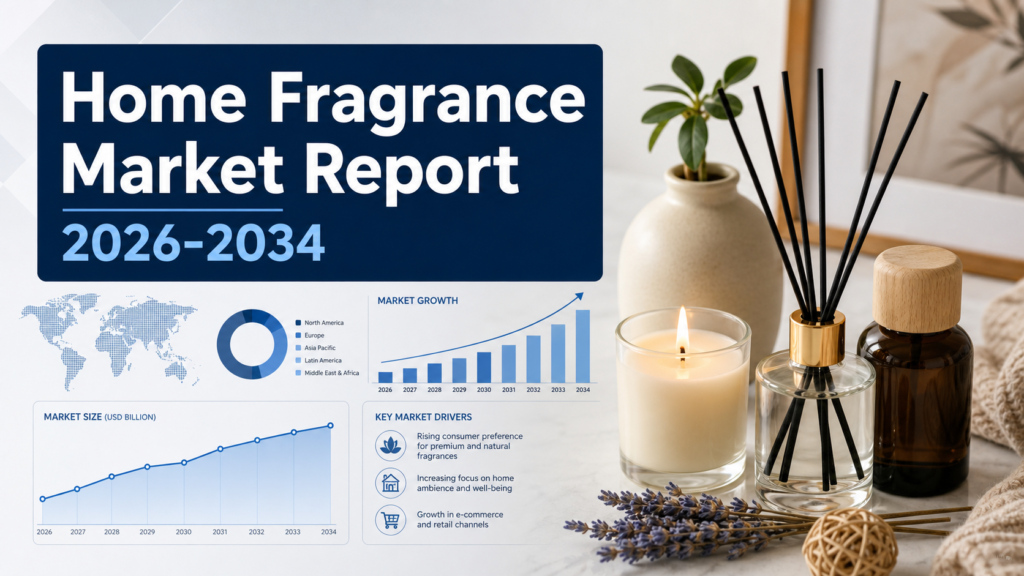
According to IMARC Group’s latest research publication, “Home Fragrance Market: Global Industry Trends, Share, Size, Growth, Opportunity and Forecast”, the global home fragrance market size reached USD 8.3 Billion in 2025. Looking forward, IMARC Group expects the market to reach USD 11.9 Billion by 2034, exhibiting a growth rate (CAGR) of 3.99% during 2026-2034, with North America commanding the dominant market position, driven by high per-capita consumption and a strong presence of premium brands. The industry is witnessing structural transformation as consumers prioritize relaxation, aromatherapy, and aesthetic living spaces, with candles continuing to hold roughly half of overall category dollar volume, while reed diffusers, room sprays, and wax melts share the remaining balance and reed diffusers emerge as the fastest-growing format.
Home fragrance products, encompassing scented candles, reed diffusers, room sprays, and wax melts, have evolved from simple ambient scenting tools into fully realized lifestyle and décor elements. The market increasingly reads less like a traditional candle aisle and more like a fragrance department, with mass-tier brands anchoring accessible price points through paraffin and paraffin-blend candles, while premium and luxury brands have built a parallel tier around coconut-soy waxes, IFRA-clean fragrance loads, and ceramic, stone, or blown-glass vessels commanding significantly elevated price points.
Grab a sample copy of this report: https://www.imarcgroup.com/home-fragrance-market/requestsample
How AI Is Reshaping the Future of the Home Fragrance Market
- Home fragrance brands are increasingly using social media trend analysis and consumer sentiment data to identify emerging scent preferences ahead of seasonal collection launches, informing faster product development cycles.
- Digital fragrance discovery platforms are deploying AI-driven personalization tools to help consumers navigate expanding product portfolios spanning candles, diffusers, and room sprays based on individual scent preferences.
- Manufacturers are increasingly using data-driven formulation research to develop sustainable, IFRA-clean fragrance loads that meet both premium positioning requirements and evolving regulatory compliance standards.
- AI-powered supply chain and inventory management tools are helping brands better forecast seasonal and collaboration-driven demand spikes, reducing stockouts during high-velocity promotional periods.
- Predictive analytics are increasingly used by premium brands to identify optimal vessel material and pricing strategies as the category continues shifting toward ceramic, stone, and blown-glass packaging formats.
Key Trends in the Home Fragrance Market
- Premiumization and Vessel Material Innovation: Ceramic, stone, marble, blown-glass, and concrete vessels have moved the candle price ceiling substantially higher, with brands increasingly framing candles as permanent decor objects rather than consumable products, often designed to be refillable or repurposed after the burn.
- Refillable and Sustainable Packaging Adoption: Leading luxury home fragrance houses continue redesigning iconic product lines to introduce refillable formats for the first time, reflecting mounting consumer and regulatory pressure toward environmentally responsible packaging without compromising heritage brand aesthetics.
- Wellness and Lifestyle Brand Collaborations: Home fragrance brands continue partnering with wellness apps, book clubs, and lifestyle platforms to launch limited-edition collections tied to broader lifestyle engagement, deepening emotional brand storytelling and consumer connection beyond pure scent marketing.
- Multi-Wick Format Expansion Across Price Tiers: The three-wick, 14 to 18 ounce candle has become the default gifting stock-keeping unit across mass-market retailers, with premium brands following suit through two- and three-wick vessels at substantially elevated price points.
- Food-Inspired and Homesteading Fragrance Themes: Seasonal collections increasingly draw inspiration from slow-living and homesteading trends, introducing food-inspired fragrances alongside garden-themed home décor items that extend the category beyond traditional floral and woody scent profiles.
Growth Factors in the Home Fragrance Market
- Rising Wellness and Aromatherapy Demand: Growing consumer inclination toward wellness-oriented home environments continues driving demand for scented candles and diffusers positioned around relaxation and aromatherapy benefits.
- Experiential Retail Expansion: Continued international flagship store openings and experiential fragrance retail concepts continue strengthening brand visibility and driving premium category growth across key global markets.
- Sustainability-Driven Reformulation: Rising consumer and regulatory expectations around sustainable materials and packaging continue driving manufacturer investment in natural wax formulations, FSC-certified packaging, and refillable vessel designs.
- Gifting and Seasonal Promotional Cadence: Strong promotional cadence around major gifting occasions, combined with seasonal collection launches, continues sustaining robust demand cycles across both mass and premium market tiers.
- Growing Asia-Pacific Disposable Income: Rising disposable income, urbanization, and wellness adoption across Asia-Pacific markets continue positioning the region as the fastest-growing geography for home fragrance products globally.
Leading Companies Operating in the Global Home Fragrance Industry
- Newell Brands (Yankee Candle Company)
- Bath & Body Works, Inc.
- Diptyque Paris
- NEST New York
- Voluspa
- Trudon
- Le Labo
- P.F. Candle Co.
- Boy Smells
- DW Home
Home Fragrance Market Report Segmentation
Breakup by Product Type:
- Candles
- Reed Diffusers
- Room Sprays
- Wax Melts
Candles continue holding roughly half of overall category dollar volume, while reed diffusers represent the fastest-growing format as premium brands introduce elevated ceramic and stone base designs commanding significantly higher price points than traditional formats.
Breakup by Distribution Channel:
- Specialty Stores
- Department Stores
- Online Stores
- Others
Specialty and flagship experiential retail stores continue playing a central role in premium brand discovery, while online channels continue expanding rapidly, supported by direct-to-consumer platforms and social media-driven product discovery.
Breakup by Price Tier:
- Mass Market
- Premium and Luxury
Mass-tier brands continue anchoring accessible price points through paraffin and paraffin-blend candles, while premium and luxury brands command substantially elevated pricing through coconut-soy waxes, IFRA-clean fragrance loads, and elevated vessel materials.
Breakup by Region:
- North America (United States, Canada)
- Europe (Germany, France, United Kingdom, Italy, Spain, Others)
- Asia Pacific (China, Japan, India, South Korea, Australia, Indonesia, Others)
- Latin America (Brazil, Mexico, Others)
- Middle East and Africa
North America commands the dominant market position, driven by high per-capita consumption and strong presence of premium brands, Europe continues growing steadily supported by luxury fragrance culture and sustainability regulations, while Asia Pacific stands out as the fastest-growing region, fueled by rising disposable income, urbanization, and wellness adoption.
Recent News and Developments in the Home Fragrance Market
- February 2026: Yankee Candle partnered with Reese’s Book Club to launch limited-edition candle collections tied to broader lifestyle engagement, reflecting the industry’s structural shift toward emotional brand storytelling and cross-category collaboration.
- March 2026: Bath & Body Works launched its Rooted collection, a spring line inspired by slow living, homesteading, and food-inspired daily rituals, debuting with candles and body care in new scents including Homemade Sourdough, Morning Matcha, and Carrot Charm, alongside garden-themed home décor items.
- April 2026: Diptyque Paris announced the relaunch of its iconic Classic Candle collection, first introduced in 1963, introducing a refillable design for the first time in the product’s history alongside a broader sustainable collection made with 100 percent soy wax and FSC-certified packaging.
- 2026: Bath & Body Works continued its international expansion strategy following its 2025 flagship store opening on London’s Oxford Street, reinforcing experiential fragrance retail as a core growth pillar for the brand.
Note: If you require specific details, data, or insights that are not currently included in the scope of this report, we are happy to accommodate your request. As part of our customization service, we will gather and provide the additional information you need, tailored to your specific requirements. Please let us know your exact needs, and we will ensure the report is updated accordingly to meet your expectations.
About Us
IMARC Group is a global management consulting firm that helps the world’s most ambitious changemakers create a lasting impact. The company provides a comprehensive suite of market entry and expansion services. IMARC offerings include thorough market assessment, feasibility studies, company incorporation assistance, factory setup support, regulatory approvals and licensing navigation, branding, marketing and sales strategies, competitive landscape and benchmarking analyses, pricing and cost research, and procurement research.
Contact Us
IMARC Group
134 N 4th St. Brooklyn, NY 11249, USA
Email: sales@imarcgroup.com
Tel No: (D) +91 120 433 0800
United States: +1-201-971-6302