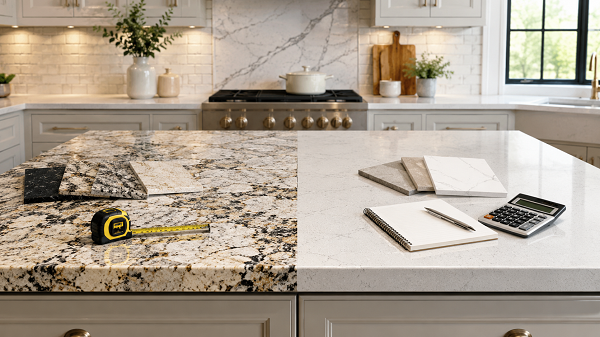
Choosing a countertop is one of the biggest decisions I make when planning a kitchen or bathroom update. Color and style matter, but cost often determines which material fits the project. Granite and quartz both offer strong performance and attractive finishes. However, the final price can change based on slab quality, thickness, fabrication, edge details, installation, sink cutouts, and the size of the space. Therefore, I always recommend looking at the full project rather than comparing material prices alone. For homeowners in Milwaukee, understanding these cost factors makes it easier to create a realistic budget and avoid surprises later.
Start With the Full Project Cost
When I compare countertop prices, I first look at the complete scope of work. A low slab price may appear attractive, but it may not include fabrication, delivery, installation, sink openings, backsplash pieces, or removal of an existing countertop. Therefore, the starting material price does not always show what the finished project will cost. I also recommend reviewing a detailed Granite countertops price guide before setting a final budget. Granite comes in many colors, patterns, and grades, so one slab may cost much more than another. In addition, a complicated kitchen layout can require extra fabrication. Because of that, homeowners should compare the entire estimate instead of focusing only on a price per square foot. Quartz follows a similar pattern. Although manufacturers produce quartz in a controlled environment, different colors, patterns, finishes, and collections can fall into different price ranges. Therefore, a simple design may cost less than a premium surface with broad marble-style veining.
Key Takeaways
- Compare the complete installed cost instead of looking only at the slab price.
- Material grade, layout, edge style, cutouts, and installation can all change the final budget.
- Choose a countertop based on long-term value, appearance, and daily use rather than price alone.
Understand What Makes Granite Prices Change
Granite is a natural stone, so every slab has its own color, movement, and mineral pattern. Because of that, price can vary based on availability and appearance. A commonly available granite may sit in a lower price range, while a rare or dramatic slab may cost more. In addition, slab size affects the project. If a kitchen needs multiple slabs, the total material cost naturally rises. Therefore, I pay close attention to the layout before estimating how much stone the project needs. Fabrication also matters. Straight countertop runs usually require less work than kitchens with angles, curves, multiple seams, or special shapes. As a result, two kitchens with the same square footage can have different final costs.
Look Beyond the Basic Quartz Price
Quartz pricing also changes based on design level. Some quartz surfaces use simple colors with limited movement, while others imitate natural marble with large veins and complex patterns. Therefore, decorative designs may sit in a higher price category. Thickness can also affect the budget. In addition, premium finishes and special edge profiles may increase fabrication work. For this reason, I recommend selecting the actual quartz style before making assumptions about the total cost. When I review Quartz countertops price, I also think about installation, cutouts, and the layout of the room. Consequently, I can compare quartz and granite more fairly because I am looking at equivalent project requirements.
Consider the Size of the Kitchen or Bathroom
Square footage plays a major role in countertop pricing. A small bathroom vanity may require only part of a slab, while a large kitchen with an island can require much more material. Therefore, I always measure carefully before comparing estimates. However, square footage does not tell the whole story. A compact kitchen with many corners may require more fabrication than a larger kitchen with long straight runs. In addition, large islands may need special handling during installation. For homeowners in Milwaukee, the best approach is to provide accurate measurements and layout details when requesting estimates. That way, the quote can reflect the actual project rather than a rough average.
Think About Edge Profiles
A standard edge usually costs less than a detailed decorative profile. However, the right edge can improve the finished appearance of the countertop. Therefore, I balance design goals with the available budget. Simple eased edges often work well in modern and transitional kitchens. Meanwhile, more decorative edges can suit traditional spaces. Because fabricators need more time and equipment to shape complex profiles, these options may increase the final price. I suggest deciding on the edge before finalizing the estimate. Otherwise, changing it later may alter the budget.
Include Sink and Cooktop Cutouts
Every opening in a countertop requires careful fabrication. Therefore, sinks, cooktops, faucets, and other fixtures should be considered during planning. An undermount sink often requires a finished cutout because the stone edge remains visible. In contrast, some drop-in sinks may require less finishing. However, each project has different requirements. Cooktop openings also need precise measurements. As a result, I make sure appliance specifications are available before fabrication begins. Accurate planning reduces the chance of costly changes later.
Remember Removal and Disposal Costs
Replacing existing countertops may involve more than installing the new material. First, the old surface often needs to be removed. Then, the installer may need to dispose of it properly. Therefore, I check whether removal and disposal appear in the estimate. Some quotes include this work, while others list it separately. In addition, removing an old countertop can reveal cabinet or wall issues. For example, cabinets may need reinforcement or leveling before the new stone goes in. As a result, I keep a small portion of the budget available for unexpected preparation work.
Compare Maintenance as Part of Value
Purchase price matters, but long-term care also affects value. Granite usually benefits from sealing because the stone has natural pores. However, sealing schedules vary based on the material and the products used. Quartz does not normally require the same routine sealing. Therefore, some homeowners prefer its lower-maintenance approach. Still, I never choose a material based on maintenance alone. Granite offers natural variation that many homeowners love, while quartz provides controlled color and pattern consistency. Consequently, the right choice depends on both design goals and everyday habits.
Look at Long-Term Design Flexibility
A countertop can remain in place for many years. Therefore, I consider whether the color will continue to work if cabinets, flooring, or wall paint change later. Neutral granite and quartz surfaces often provide flexibility. However, bold patterns can also work when the surrounding design stays simple. In Milwaukee kitchens, I often recommend comparing countertop samples with cabinet doors, flooring, backsplash tile, and hardware at the same time. This approach creates a more connected design and can reduce the risk of replacing materials simply because they no longer coordinate.
Do Not Choose by Price Alone
The cheapest option does not always provide the best value. Likewise, the most expensive slab does not automatically create the best kitchen. Therefore, I focus on fit. If a homeowner cooks every day, a practical work surface may deserve more attention than a dramatic pattern. On the other hand, a large island can become the visual center of the room, so investing in a distinctive slab may make sense. I also consider the age of the home, cabinet quality, room size, and future remodeling plans. As a result, the countertop budget supports the full design rather than becoming a separate decision.
Ask What the Estimate Includes
Before comparing two estimates, I review the details carefully. One contractor may include templating, fabrication, installation, sink cutouts, and sealing, while another may charge for some of those items separately. Therefore, I recommend asking for a clear written scope. The estimate should explain the material, thickness, edge, cutouts, backsplash, installation work, and any additional services. This makes comparison easier. More importantly, it reduces confusion after the project begins.
Final Thoughts
Granite and quartz can both provide excellent results, but their final costs depend on much more than the material name. Therefore, I look at slab selection, square footage, fabrication, edge profiles, sink openings, removal work, installation, and long-term maintenance before making a decision. Granite can offer natural character and one-of-a-kind movement. Meanwhile, quartz can offer greater pattern consistency and easier routine care. Neither material wins in every situation. Ultimately, I believe the best countertop is the one that fits the household, the design, and the budget at the same time. When homeowners compare complete project costs instead of basic material prices, they can make a more confident decision and create a kitchen or bathroom that continues to perform well for years.