From Needle to Tablet: Why Oral Semaglutide Is a Big Deal for Weight Management
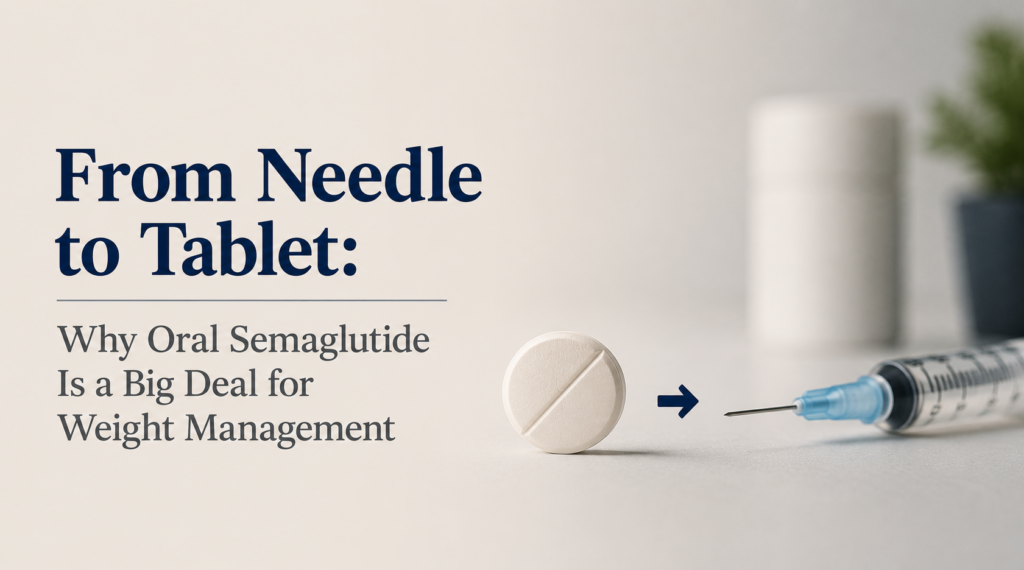
A syringe kept a lot of people out of GLP-1 treatment entirely. Not because the medication didn’t work, but because the delivery method asked too much of them. Needle anxiety is real, and for years it quietly filtered who could and couldn’t access one of the most effective weight loss treatments available.
That barrier just got smaller. Oral semaglutide brings the same active compound behind popular injectable treatments into tablet form, and the shift is bigger than it might first sound.
The Problem Nobody Talked About
Clinical trials for injectable semaglutide showed remarkable results. Patients lost significant weight, often more than with any prior generation of anti-obesity medication. But trial populations aren’t the same as the general public, and plenty of real-world patients simply opted out before treatment even started.
Some had a genuine phobia. Others found the weekly ritual, cleaning the injection site, disposing of needles, remembering the correct day, more disruptive than they expected. A few just didn’t want to explain a visible injection pen sitting in their fridge to houseguests or travel companions. None of these reasons made the medication less effective. They just meant fewer people were willing to start, or willing to stick with it long enough to see results.
This is the quiet problem oral semaglutide addresses. It’s not solving a biology problem. It’s solving a behavior problem, and in medicine, that’s often the harder half of the equation.
How the Tablet Actually Works
Semaglutide, in any form, mimics a naturally occurring hormone called GLP-1 that helps regulate appetite and slows how quickly food leaves the stomach. The challenge with an oral version has always been survival. Peptides like this typically break down in stomach acid before they can be absorbed into the bloodstream.
The oral formulation gets around this using an absorption enhancer, a compound that temporarily protects semaglutide long enough for it to pass into circulation through the stomach lining. It’s a clever workaround, and it’s the reason this tablet took years longer to develop than its injectable predecessor.
Because absorption is more fragile than with an injection, the dosing routine is strict. Patients need to take it first thing in the morning, on an empty stomach, with no more than a small sip of plain water, then wait at least 30 minutes before eating, drinking anything else, or taking other oral medications. Skip that window regularly and the drug’s effectiveness drops. It’s not a “take it whenever” pill, even though it looks like one.
Comparing It to the Injectable Path
For patients weighing their options, it helps to look at this honestly rather than assume newer automatically means better. Wegovy Semaglutide Tablets offer a genuine alternative to needles, but the tradeoff is a tighter daily routine instead of a once-weekly commitment.
Injectable treatments, including Mounjaro and Wegovy injections, bypass digestion entirely, which tends to produce more consistent absorption and, in many trials, slightly stronger average results. The weekly schedule also means patients only have to remember one dosing event per week rather than a daily ritual with strict timing rules.
Neither format is universally superior. A patient who travels constantly or has an unpredictable morning schedule might genuinely do better on a weekly injection, where timing flexibility isn’t an issue. A patient who has a needle aversion but a rock-solid morning routine might find the tablet far easier to sustain long term, even with its stricter fasting rule.
Why This Matters Beyond Convenience
There’s a bigger story here than patient comfort, though comfort matters plenty on its own. Before oral semaglutide, patients who couldn’t or wouldn’t use an injectable were often steered toward older medications with a different mechanism entirely. Drugs like Phentermine & Diethylpropion work by stimulating the central nervous system to reduce appetite, which can be effective, but it’s a fundamentally different clinical approach than GLP-1 therapy.
That meant needle-averse patients weren’t just choosing a different delivery method. They were often being routed into an entirely different category of treatment, one with its own side effect profile and mechanism. Oral semaglutide closes that gap. Patients no longer have to choose between “GLP-1 therapy with a needle” or “a completely different drug class without one.” They can access the same hormone-based mechanism either way.
For providers, that’s a meaningful expansion of what a personalized treatment plan can look like. Instead of steering patients based on what they’ll tolerate, providers can now match treatment more closely to what will actually work for that person’s biology, lifestyle, and preferences.
What Providers Are Seeing in Practice
Early adoption patterns suggest the tablet is drawing in a group of patients who were previously sitting on the sidelines. People who researched GLP-1 treatment extensively, understood the benefits, and still never booked a consultation because the injection felt like the deciding factor against it.
That’s a meaningful shift in who ends up starting treatment, not just how they take it. Providers running weight management programs are adjusting intake conversations accordingly, spending more time understanding a patient’s daily routine and needle tolerance upfront rather than assuming injection is the default starting point.
Some patients are also using the tablet as an entry point before eventually transitioning to injectable therapy once they’re comfortable with the treatment concept and want to explore other options. Others stay on the oral route indefinitely, particularly if their results are strong and their routine supports consistent daily dosing.
The Bigger Shift in Weight Management
This is really about choice becoming a legitimate part of obesity treatment, not an afterthought. For a long time, patients had to fit themselves around the available medication. Oral semaglutide is part of a broader move toward fitting the medication around the patient instead.
Programs built with this flexibility in mind, like those at Weight Medics, are already structuring care around exactly this kind of personalization, helping patients weigh tablets against injections against alternative medications based on their actual daily life rather than a one-size-fits-all default.
The needle isn’t disappearing from weight management anytime soon, and for plenty of patients it remains the more effective option. But it’s no longer the only entry point. That alone marks a real turning point in how obesity care gets delivered, and who finally feels comfortable walking through the door.