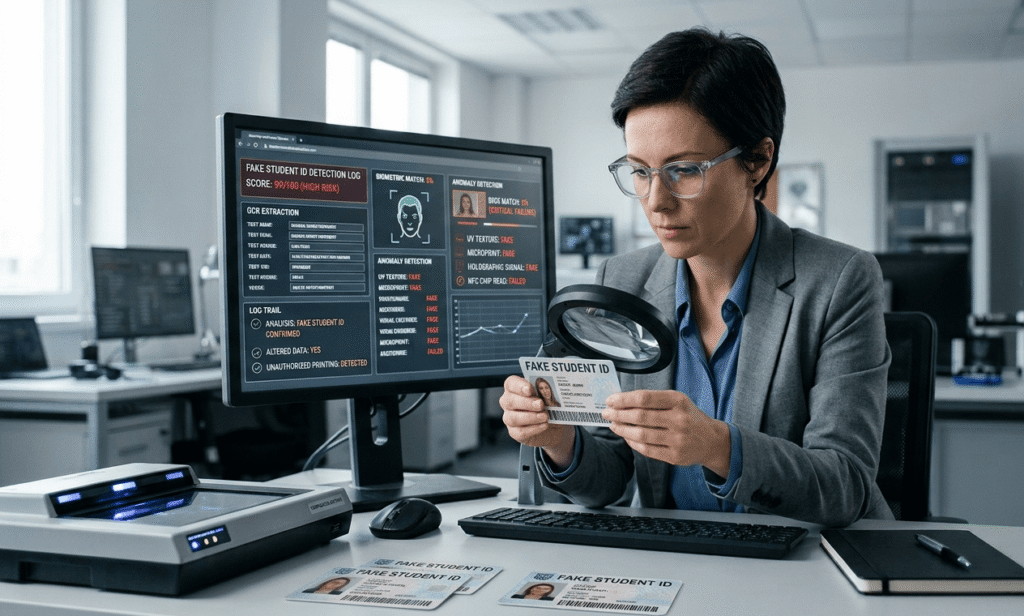
A registrar’s office employee once told a colleague of mine that she could usually tell something was wrong with an ID “before I even know why.” That instinct, built from looking at thousands of legitimate cards, is exactly what fake student ID detection systems are now trying to replicate with cameras, algorithms, and layered data checks instead of gut feeling alone.
Student identification cards occupy a strange space in the document security world. They’re not government-issued, so they don’t carry the cryptographic weight of a passport or the biometric chip of a modern driver’s license. But they unlock real privileges: dining hall access, dormitory entry, library services, meal plan discounts, and in many cases discounted software, transit passes, or retail pricing reserved for enrolled students. That combination of relatively low production security and genuinely valuable access is precisely why forged versions keep showing up, and why institutions have had to get more serious about catching them.
Why Student ID Became a Fraud Target
Retailers offering student discounts, transit authorities issuing reduced fares, and even some financial products tied to “verified student” status have all had to grapple with the same problem: a student ID, historically, was just a laminated card with a photo and a magnetic stripe. Compare that to a driver’s license, which carries holograms, microprinting, and in many states a chip or enhanced barcode standard. Student cards often had none of that.
This gap didn’t go unnoticed. Discount abuse, unauthorized building access, and exam impersonation have all been documented concerns on campuses, prompting universities and the third-party verification platforms that serve retailers to treat student credential fraud as a real, if narrow, risk category rather than a theoretical one.
What a Student ID Actually Verifies
It helps to be precise about what a student ID is supposed to prove. It’s not just “this person exists.” It’s asserting three things simultaneously: that the bearer is enrolled at a specific institution, that the photo matches the bearer, and that the enrollment is currently active rather than lapsed. A forged or altered card typically breaks at least one of those three claims, even when the physical object looks convincing.
That’s a useful framing for anyone building or evaluating a detection process. You’re not just checking “is this a real card.” You’re checking whether all three claims hold up together, which is harder to fake than any single element in isolation.
The Security Layers Behind Modern Campus Credentials
Institutions that have invested in credential security tend to layer several features rather than relying on one.
Physical and print security. Fine-line guilloche patterns, microprinting around the photo border, and UV-reactive ink that only appears under specific lighting are increasingly common even on campus cards, borrowed directly from government ID practice. These features exist because standard consumer printers and laminators can’t reproduce them at a resolution that holds up to inspection.
Machine-readable elements. Barcodes, magnetic stripes, and increasingly QR codes or NFC chips encode enrollment data that should match what’s printed on the card’s face. This is where data consistency checks become powerful: a barcode that decodes to a different name or an expired semester than what’s printed visually is a strong fraud signal, even if the print quality looks fine.
Centralized verification. The most resilient systems don’t trust the card at all. Instead, they treat the physical or digital credential as a pointer, and check the underlying enrollment record live against the registrar’s database. If the card can’t be validated against a real-time or near-real-time source, its physical security features matter less.
Digital identity wallets. A growing number of universities now issue mobile credentials through platforms that function similarly to a digital driver’s license, using cryptographic signatures tied to the issuing institution rather than anything printed or embossed. [Internal link: Article about digital identity wallets and verifiable credentials]
How Fake Student ID Detection Works in Practice
When a retailer, transit system, or campus security office needs to assess whether a presented ID is legitimate, the process usually unfolds as a series of consistency checks rather than a single pass or fail test.
Visual inspection comes first, and it’s the weakest layer on its own. Fonts, hologram placement, lamination texture, and photo quality can reveal amateur reproductions, but a well-made forgery can pass casual visual review without much trouble. That’s precisely why relying on eyeballing alone has fallen out of favor among anyone handling meaningful volume.
Automated document verification platforms, the same technology used broadly in KYC and identity proofing workflows, extend this by running optical character recognition against the printed fields, classifying the document type against known templates, and flagging anomalies in image quality or tampering indicators like inconsistent fonts or signs of photo substitution. [Internal link: Article about automated identity document verification]
Cross-referencing against institutional records is the step that actually resolves most ambiguous cases. A card can look perfect and still fail here if the enrollment record doesn’t exist, has lapsed, or belongs to someone else entirely.
Device and behavioral signals round things out in digital contexts. When a “student verification” happens online rather than in person, platforms increasingly look at supporting signals, like whether the submitted email domain matches a known .edu registrar pattern, or whether the session behavior resembles bulk automated submission rather than an individual applying once.
Where Automated Systems Struggle
It’s worth being honest about the limitations here, because overstating what automated fake student ID detection can do creates its own risk.
False positives happen more than people expect. A student with a legitimate but recently issued card, a non-standard name format, or a photo taken under poor lighting can trigger the same anomaly flags as an actual forgery. Transfer students, students with legal name changes, and international students whose documents follow different formatting conventions are disproportionately affected by rigid automated rules.
False negatives are the harder problem to talk about publicly, and for good reason: explaining exactly which gaps exist in a given detection system is itself a kind of roadmap for abuse. What’s safe to say, at a conceptual level, is that any system relying on a single signal, whether that’s visual appearance, barcode content, or database matching alone, is more exploitable than one combining several independent signals that would all need to be defeated simultaneously.
This is why serious fraud-prevention teams talk about verification in terms of assurance levels rather than binary authenticity. No practical system offers absolute certainty. The goal is to raise the cost and difficulty of successful fraud to the point where it’s no longer worth attempting at the scale that matters.
The Human Factor in Credential Review
Automation handles volume well but struggles with judgment calls, and that’s where trained human reviewers still matter.
Reviewer fatigue is a documented concern in any high-volume document review environment. Someone checking the five hundredth ID of a shift is statistically more likely to miss something than the fiftieth, which is part of why automated pre-screening exists in the first place, not to replace human judgment but to direct it toward the cases that genuinely need it.
Training matters more than most organizations budget for. A reviewer who understands why a particular university’s cards look the way they do, including legitimate variation across campuses, international exchange programs, or recent redesigns, makes far better decisions than one working from a generic checklist. Escalation procedures matter too. The best-run verification operations give frontline reviewers a clear, low-friction path to flag ambiguous cases for a specialist rather than forcing a snap judgment.
Accessibility and legitimate variation deserve more attention than they usually get. Not every real student has a crisp, well-lit photo or a name that fits neatly into a Western-formatted field. Systems calibrated primarily on a narrow set of “typical” documents will generate disproportionate false rejections for students who don’t fit that mold, which is a fairness problem as much as a technical one.
Where This Is Heading
A few developments seem likely to shape fake student ID detection over the next several years, with the caveat that adoption timelines for institutional technology tend to move slowly.
Mobile and NFC-based credentials, following patterns already established by mobile driver’s licenses, are gaining traction at larger universities and through partnerships with digital wallet providers. These shift the trust anchor from physical materials to cryptographic signatures, which is a meaningfully different security model. [Internal link: Article about NFC and cryptographic document authentication]
AI-assisted anomaly detection is improving at spotting subtle inconsistencies in print patterns and layout that wouldn’t register to a human reviewer, though it introduces its own risk of opaque, hard-to-audit decision-making if deployed without appropriate human oversight.
Risk-based verification, where the depth of scrutiny scales with what’s at stake, is likely to become more common. Checking in to a dining hall probably doesn’t warrant the same rigor as verifying eligibility for a financial product tied to student status, and treating every transaction identically wastes resources on low-risk cases while potentially under-scrutinizing high-risk ones.
Effective credential security was never really about any single feature catching every forgery. It’s about building enough independent layers, physical, digital, and human, that a fraudulent credential has to clear several unrelated hurdles rather than just one convincing surface. That layered, risk-based approach, imperfect as it is, remains the most honest answer the field has to a problem that isn’t going away.
FAQs
FAQ 1
Can a convincing-looking fake student ID still fail verification?
Yes, and it happens often. Visual quality only addresses one layer of review. If the card’s data doesn’t match an active enrollment record, or if encoded barcode data conflicts with what’s printed, the document fails regardless of how good the print and lamination look.
FAQ 2
Why isn’t checking one security feature enough?
Any single feature, whether it’s a hologram, a barcode, or a photo match, can potentially be reproduced or spoofed in isolation. Layering multiple independent checks means an attacker has to defeat several unrelated systems at once, which is substantially harder than beating one.
FAQ 3
How does cross-referencing with a university database improve detection?
It shifts trust away from the physical object entirely. A card can be a flawless physical reproduction and still fail instantly if there’s no matching, active enrollment record behind it, which is often the most reliable signal available.
FAQ 4
Can AI reliably detect fraudulent student IDs on its own?
AI-assisted tools are good at flagging statistical anomalies and inconsistencies that a human might miss, but they aren’t infallible and can produce false positives, especially for legitimate documents that fall outside common formatting patterns. Most mature systems treat AI output as one input to human review, not a final verdict.
FAQ 5
Why do legitimate student IDs sometimes get flagged as suspicious?
Non-standard name formats, recent card redesigns, poor photo lighting, or unusual but legitimate enrollment statuses can all trigger automated anomaly detection. This is exactly why escalation to trained human reviewers remains an important part of a well-designed verification process rather than an afterthought.