EPR Driving India’s Battery Recycling Growth
If you work in the battery or electronics industry in India, you have almost certainly heard more about EPR in the last two years than in the entire decade before that. It is showing up in compliance emails, industry conversations, government notifications, and business planning meetings. And there is a very good reason for that — EPR is fundamentally changing how India handles lithium-ion battery waste, and the effects are being felt across the entire industry.
The relationship between EPR and lithium-ion battery recycling in India is not complicated — but it is profound. Policy is creating demand, demand is driving investment, and investment is building the infrastructure India desperately needs. Here is how it is all connected — and what it means for your business right now.
1. What EPR Actually Requires for Battery Companies
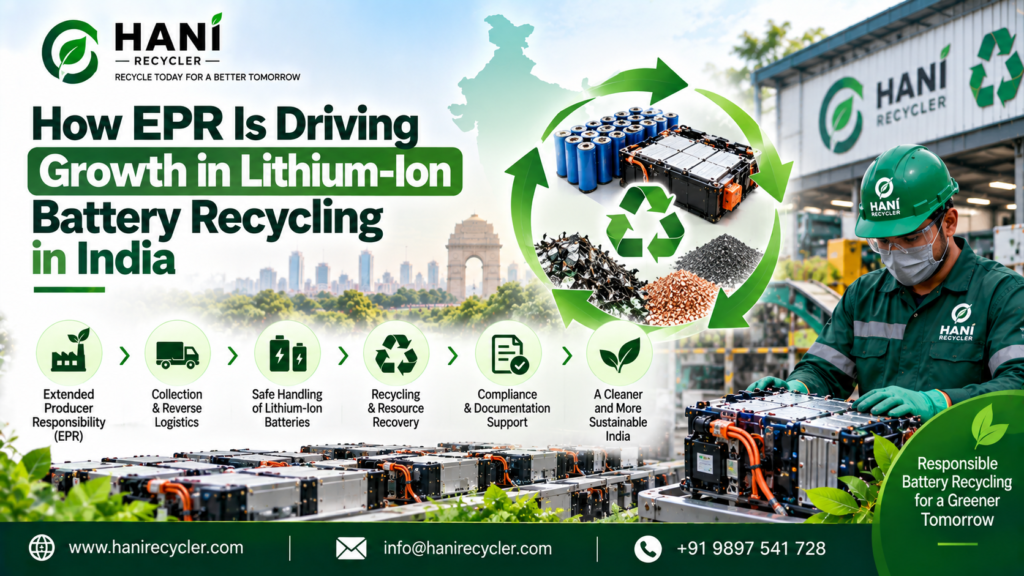
Under the Battery Waste Management Rules 2022, any business that manufactures, imports, or sells batteries in India — including lithium-ion batteries — is required to register on the CPCB portal and meet annual collection and recycling targets under Extended Producer Responsibility (EPR). These targets are progressive — increasing every year — meaning the longer a company waits to engage with the recycling ecosystem, the harder it becomes to catch up. Businesses must partner with CPCB-authorised certified recyclers, channel their battery waste through them, collect EPR certificates, and file annual compliance returns. This is not optional — it is law.
2. EPR Is Creating Real Commercial Demand for Certified Recyclers
Before EPR was actively enforced, lithium-ion battery recycling in India was largely driven by goodwill — a relatively small number of environmentally conscious businesses choosing to recycle responsibly. EPR changed this fundamentally. Now, every battery manufacturer and importer in India legally needs certified recycling services to meet their annual targets. This has created genuine, sustained commercial demand for certified lithium-ion battery recyclers — demand that grows every year as EPR targets increase. For recyclers like Hani Recycler, this regulatory shift has directly driven business growth and investment in recycling capacity.
3. The EV Boom Has Amplified the Effect Enormously
India’s electric vehicle revolution has added a powerful multiplier to the EPR effect on battery recycling. Millions of EVs are now on Indian roads, each carrying a large lithium-ion battery pack that will need replacing in 8 to 10 years. EV manufacturers are covered under EPR — they are legally required to ensure their batteries are collected and recycled responsibly at end of life. This has dramatically expanded the pipeline of lithium-ion batteries entering certified recycling channels and created a new category of large, complex battery packs that require specialised handling — driving further investment in recycling technology and capacity.
4. EPR Certificates Have Created a Functioning Market
One of the most clever mechanisms in India’s EPR framework is the EPR certificate system. When certified recyclers process battery waste, they generate EPR certificates that producers can purchase to fulfil their compliance targets. This has created a functioning market for certified battery recycling — one where recyclers are incentivised to process more battery waste, producers are incentivised to channel waste through certified routes, and the entire system generates documented accountability. It is market design that actually works — and it is directly responsible for the growth of India’s certified battery recycling sector.
5. Growing Compliance Pressure Is Bringing More Businesses Into the System
In 2026, the CPCB is actively monitoring EPR compliance — and businesses that have not engaged with the system are facing real consequences. Financial penalties, licence suspensions, and public listing as defaulters are motivating businesses that previously ignored their obligations to seek out certified recycling partners urgently. Each new business entering the certified recycling ecosystem adds volume to the system, improves its economics, and justifies further investment in infrastructure — creating a positive cycle that is accelerating the growth of India’s lithium-ion battery recycling industry.
EPR Is Not Just a Compliance Burden — It Is an Industry Builder
EPR is sometimes framed as a regulatory burden — something businesses have to deal with. But looked at differently, it is the mechanism that is building India’s lithium-ion battery recycling industry from the ground up. It is creating demand, driving investment, expanding capacity, and building the circular economy that India needs for its clean energy future.
At Hani Recycler, we are at the heart of this growth — providing certified lithium-ion battery recycling, EPR compliance support, and full documentation for businesses across India. Whether you need to meet your EPR targets, recycle EV batteries, or simply dispose of old lithium-ion batteries responsibly — get in touch with us today and let us help you be part of India’s battery recycling future.
📧 Haniwasterecycler@gmail.com | 📞 +91 9897 541 728 | 🌐 www.hanirecycler.com
Read another Article: Innovative Technologies Changing E-Waste Recycling in 2026