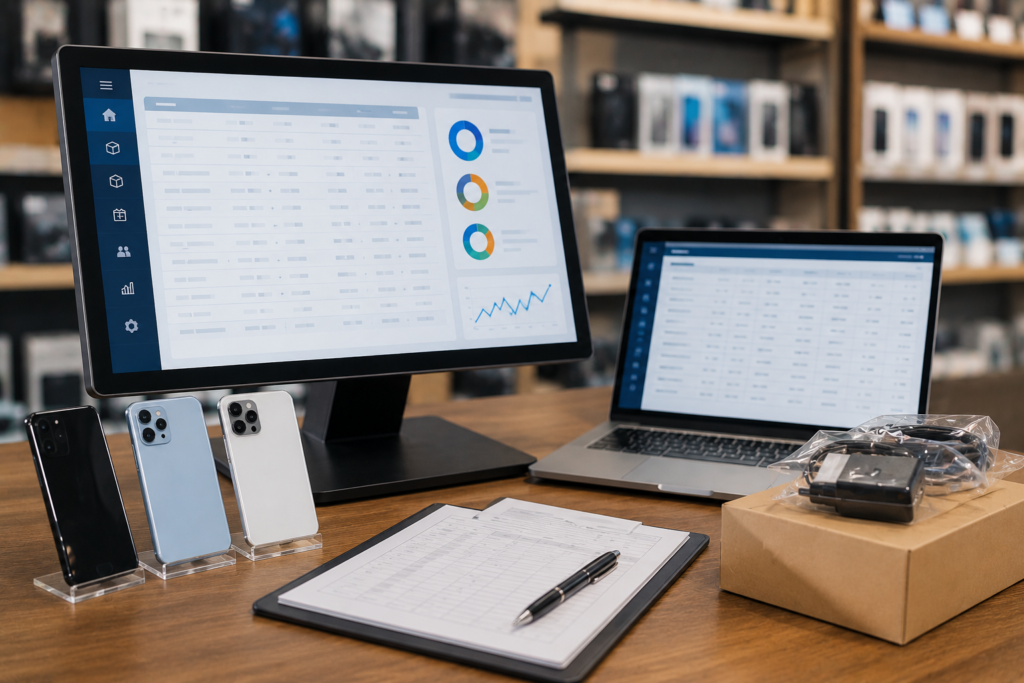
Walk into any busy electronics store on a Saturday afternoon and you’ll see the same scene repeating itself: a customer waving a broken phone, asking for a warranty replacement, while the shop owner flips through a register looking for the sale entry. Multiply that by dozens of products a day — phones, laptops, TVs, speakers — and it’s easy to see why manual tracking breaks down fast.
This is exactly the gap that electronics shop software fills. It gives retailers a single system to record every IMEI number, serial number, and warranty period the moment a sale happens, so nothing gets lost in a pile of paper receipts or scattered spreadsheets.
In this guide, we’ll cover what this software actually does, why IMEI and serial tracking matters legally and operationally, how warranty management protects both the shop and the customer, and how proper business registration ties into all of it — for shop owners in India and around the world.
What Is Electronics Shop Software?
Electronics shop software is a specialized retail management system built for stores that sell serialized products — smartphones, tablets, laptops, cameras, home appliances, and accessories. Unlike generic billing tools, it’s designed around one core idea: every unit sold is unique and needs to be tracked individually, not just by product category.
At its core, the software typically combines:
- Point-of-sale (POS) billing with GST or VAT compliance
- IMEI and serial number capture at the time of purchase and sale
- Warranty tracking software functionality that logs coverage start and end dates
- Inventory management across single or multiple store locations
- Customer and service history for repairs, replacements, and returns
For shops that also deal in electrical goods and appliances, many of these systems overlap with an electrical shop billing software setup, since both categories need serial-level accuracy and after-sales tracking, even though the products themselves differ.
Why IMEI and Serial Number Tracking Matters
The Legal Angle
In India, IMEI (International Mobile Equipment Identity) tracking isn’t just good practice — it’s tied to regulatory expectations. Authorities use IMEI records to trace stolen or counterfeit devices, and retailers who maintain clean digital records are better protected if a dispute or investigation arises. Globally, similar serial-tracking expectations apply to electronics retailers under consumer protection and anti-counterfeiting laws.
The Business Angle
Beyond compliance, serial and IMEI tracking solves everyday operational headaches:
- Preventing fraud: Without unique identifiers, it’s easy for a customer (or even staff) to swap a damaged unit for a working one and claim warranty on the wrong device.
- Faster warranty verification: Instead of digging through paper invoices, staff can pull up a device’s full history by scanning its IMEI or serial number in seconds.
- Accurate inventory counts: Every unit is accounted for individually, reducing stock discrepancies that generic quantity-based tracking often misses.
- Better supplier accountability: If a batch of devices shows a higher-than-normal failure rate, serial tracking helps pinpoint the supplier or manufacturing batch responsible.
Core Features of a Good Electronics Shop Software
| Feature | What It Does | Why It Matters |
| IMEI/Serial capture at billing | Records the unique number during sale, often via barcode/QR scan | Eliminates manual entry errors |
| Automated warranty calculation | Sets warranty start/end dates based on product category | Removes guesswork during claims |
| Warranty alerts | Notifies staff or customers before coverage expires | Opens upsell opportunities for extended warranty |
| Multi-branch sync | Keeps inventory and sales data unified across locations | Useful for chains and franchise stores |
| GST/tax compliant invoicing | Generates compliant bills automatically | Keeps the business audit-ready |
| Service and repair logs | Tracks every visit tied to a specific IMEI/serial | Builds a full device history |
| Return and exchange tracking | Flags returned units against original sale records | Reduces fraudulent returns |
How Warranty Tracking Works in Practice
Consider a customer who bought a smartphone six months ago and now claims it’s under warranty for a screen issue. With a manual system, the staff has to locate the physical invoice, confirm the date, and manually calculate whether the warranty is still valid.
With proper warranty tracking software built into the shop’s billing system, the process looks like this:
- Staff scans or enters the device’s IMEI number.
- The system instantly pulls up the sale date, warranty period, and any prior service requests.
- If still within coverage, the claim is processed on the spot; if expired, the system can suggest a paid repair or extended warranty option.
This kind of instant lookup isn’t a luxury anymore — customers expect it, and it directly affects how much they trust a store for repeat business.
Common Warranty Scenarios Electronics Retailers Handle
- Manufacturer warranty: Covered directly by the brand, but the shop still needs proof of purchase date and device identity.
- Extended/store warranty: Sold separately, often the shop’s own liability, so accurate tracking protects the business financially.
- Dead-on-arrival (DOA) replacements: Time-sensitive, usually within 7–10 days of purchase, so the system needs to flag these automatically.
- Third-party accessory warranty: Often shorter and easy to mix up with the main device — serial tracking keeps these separate.
Benefits for Different Types of Electronics Businesses
Single-store retailers get a straightforward way to move away from notebooks and Excel sheets, cutting down billing time and reducing warranty disputes.
Multi-branch chains benefit from centralized data — a customer can buy in one city and claim warranty in another, as long as the system syncs records across locations.
Repair and service centers rely heavily on serial tracking to separate customer-owned devices from shop inventory, avoiding mix-ups during busy repair queues.
Online-to-offline (O2O) electronics sellers use IMEI/serial data to reconcile online orders with in-store pickups and returns.
It’s worth noting that many of the same principles apply to businesses selling both electronics and appliances. A store running an electricals billing software system alongside electronics inventory often finds that unifying both under one platform, rather than juggling two separate tools, is far more efficient — especially for reporting and tax filing.
Business Registration: Why It Matters Alongside Good Software
Software solves the operational side of running an electronics shop, but none of it matters if the business itself isn’t properly registered. Registration isn’t just a formality — it directly affects how software, banking, taxation, and warranty claims function in practice.
Legal Importance of Registration
- Tax compliance: A registered business can legally issue GST-compliant invoices (India) or VAT/sales-tax invoices (globally), which is often required for a customer to claim manufacturer warranty.
- Liability protection: Registering as an LLP, Private Limited Company, or LLC separates personal assets from business liabilities.
- Supplier and brand partnerships: Most electronics brands only offer dealership or distributor agreements to formally registered businesses.
- Building customer trust: A registered, GST-numbered business appears more credible, particularly for high-value electronics purchases.
India-Focused Registration Steps
For electronics retailers operating in India, the typical registration path includes:
- Business structure selection — Sole Proprietorship, Partnership, LLP, or Private Limited Company, depending on scale.
- GST registration — mandatory once turnover crosses the prescribed threshold, and practically necessary for issuing valid tax invoices.
- Shop and Establishment license — required for operating a physical retail store in most states.
- Trade license from the local municipal authority.
- MSME/Udyam registration — optional but useful for accessing government schemes and easier business loans.
Global Business Registration Considerations
Retailers outside India follow broadly similar steps, adapted to local frameworks:
- United States: LLC or S-Corp registration at the state level, EIN (Employer Identification Number) from the IRS, and state sales tax permits.
- United Kingdom: Registering as a Limited Company with Companies House, plus VAT registration once turnover thresholds are crossed.
- UAE: Trade license through the relevant Department of Economic Development or free zone authority.
- Southeast Asia: Business registration through local commerce ministries, often paired with import licenses for electronics.
Whichever country a business operates in, the same underlying logic applies: proper registration unlocks the legal and financial infrastructure — bank accounts, supplier credit, tax invoicing — that a serious electronics retail operation depends on.
Choosing the Right Software for Your Electronics Shop
When evaluating options, look beyond basic billing software for electrical shop setups and check specifically for:
- Dedicated IMEI/serial number fields (not just generic product codes)
- Automatic warranty period calculation by product category
- Barcode/QR scanning support for faster billing
- Cloud backup so records survive hardware failure or theft
- Reports on warranty claims, returns, and slow-moving stock
- GST/VAT invoicing built in, not bolted on as an afterthought
- Role-based access so staff can bill sales without editing inventory records
A quick vendor-comparison checklist can save weeks of back-and-forth:
- Does it support bulk IMEI import from supplier invoices?
- Can customers self-check warranty status online?
- Is there a mobile app for floor staff?
- What’s the data export process if you switch systems later?
Conclusion
Managing IMEI numbers, serial data, and warranty periods by hand simply doesn’t scale — not for a single mobile store, and certainly not for a multi-branch electronics chain. The right electronics shop software turns what used to be a slow, error-prone process into something that takes seconds: scan a device, see its full history, resolve the customer’s issue, and move on.
Pair that with proper business registration — GST compliance in India, or the equivalent company and tax registration elsewhere — and an electronics retailer isn’t just running a store more efficiently. They’re building a business that customers, suppliers, and brands can actually trust.
If you’re currently comparing options, it’s worth checking whether your shortlisted electronics shop software also handles related categories well, since many stores eventually need a billing software for electrical shop features too as their product range grows.
Frequently Asked Questions
1. What is the difference between IMEI tracking and serial number tracking?
IMEI is specific to mobile devices with cellular connectivity (phones, tablets with SIM support), issued by the GSMA. Serial numbers are broader identifiers used across almost all electronics — laptops, TVs, cameras — assigned by the manufacturer. Good electronics shop software supports both, since most stores sell a mix of both product types.
2. Is IMEI tracking mandatory for electronics retailers in India?
While there’s no single law forcing every retailer to log IMEI numbers, maintaining accurate IMEI records is strongly recommended for warranty processing, theft investigations, and dispute resolution. Many software systems now do this automatically as part of billing, so it adds little extra effort.
3. Can electronics shop software handle multiple store branches?
Yes, most modern systems are built cloud-first, meaning inventory, sales, and warranty data sync in real time across branches. This is especially useful when a customer buys in one location and needs service in another.
4. How long does warranty tracking data need to be stored?
It’s best practice to retain warranty and sale records for at least the full warranty period plus a buffer (commonly 1–2 years beyond expiry) to handle late claims or disputes. Cloud-based software typically stores this indefinitely unless manually deleted.
5. Do I need to register my electronics business before using shop management software?
Software itself doesn’t require business registration to use, but issuing valid tax invoices (GST in India, VAT/sales tax elsewhere) does. Since most electronics warranty claims require a valid invoice, registering your business early avoids complications down the line.
6. What’s the difference between manufacturer warranty and store warranty in software terms?
Manufacturer warranty is tracked mainly for reference and customer support, since the brand handles the actual claim. Store or extended warranty is tracked as a direct liability of the shop, so the software needs to flag these separately for accurate financial reporting.