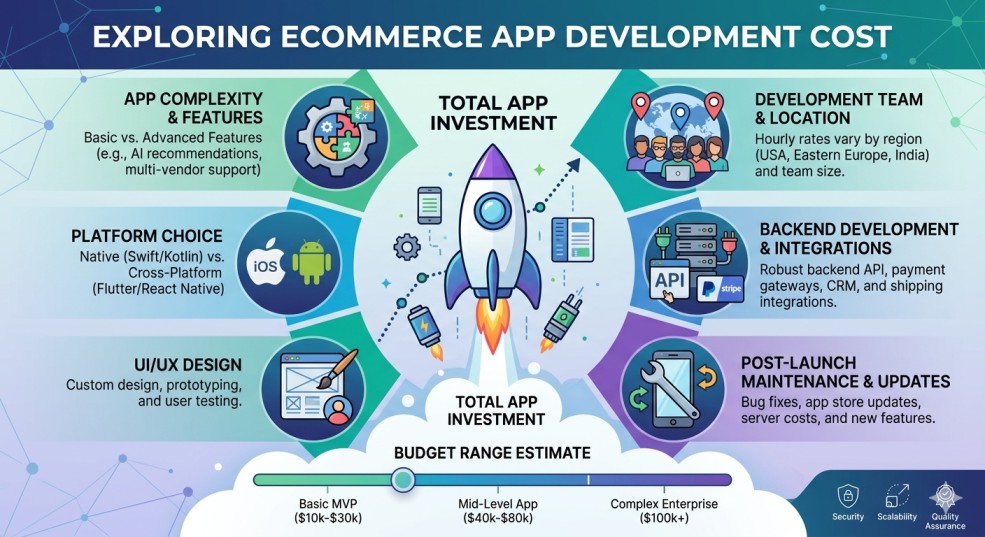
ecommerce app development cost
The global ecommerce market will hit $8.1 trillion by 2026. Mobile commerce already accounts for over 61 percent of all online sales. If your business does not have a mobile ecommerce app, you are not competing in a channel that drives the majority of digital commerce. That much is clear.
What is not clear — and what most articles on this topic get wrong — is how ecommerce app development cost actually gets calculated. You find ranges. $20,000 to $300,000. $50,000 to $500,000. Without context, those numbers are useless. Every business enters development conversations with a rough budget and exits surprised. Either the costs are higher than quoted because the scope was underspecified, or the delivered product does not perform because the budget was cut in the wrong places.
This guide gives you the cost framework that lets you walk into any development conversation knowing what questions to ask, which numbers to scrutinise, and where the real budget risks actually live.
The Cost Ranges That Matter — and What Puts You in Each One
| App Tier | Cost Range (USD) | Timeline | Who It Is For |
|---|---|---|---|
| Basic Ecommerce MVP | $20,000 – $50,000 | 8–16 weeks | Single-vendor stores, first-time app, core shopping flows only |
| Medium Complexity App | $50,000 – $120,000 | 16–24 weeks | Growing retailers, multi-payment, real-time tracking, analytics |
| Advanced / Enterprise App | $120,000 – $300,000+ | 24–48 weeks | Multi-vendor platforms, AI features, loyalty, CRM, dynamic pricing |
The range is wide because the inputs vary. A single-vendor app with a product catalog, cart, checkout, and order history is a fundamentally different engineering problem from a multi-vendor marketplace with AI recommendations, vendor dashboards, commission management, and fraud detection. Both are described as ‘ecommerce apps.’ They have almost nothing in common architecturally.
The most reliable predictor of where your project lands in the cost range is not the platform or the design ambition. It is feature scope. Features are the dominant cost variable, and the discipline of scoping only what version one actually needs to prove the business model is the most powerful cost-control lever available to any business commissioning an ecommerce app.
The 7 Cost Drivers Behind Every Ecommerce App Quote
1. Feature Set — The Dominant Variable
Every feature in your scope adds development time, QA coverage, and backend complexity. The difference between a basic search filter and an AI-powered semantic search is not the user-facing interface — it is the ML infrastructure, indexing pipeline, and ranking model behind it. The difference between one payment gateway and five is not five times the first gateway’s cost, but it is significantly more integration, testing, and error-handling work.
Before requesting quotes from any development company, document every feature you want in version one and categorise each as: must-have for launch, nice-to-have for launch, or version-two consideration. That discipline alone can reduce your initial scope — and therefore your initial cost — by 30 to 40 percent.
2. Platform Choice
| Platform | Cost Range | Timeline | Best For |
|---|---|---|---|
| Native iOS only | $25,000 – $150,000 | 3–9 months | iOS-first premium brands |
| Native Android only | $20,000 – $150,000 | 3–9 months | Android-heavy markets (India, Southeast Asia) |
| Cross-Platform (Flutter / RN) | $20,000 – $120,000 | 2–7 months | Startups, growing brands — best cost-to-coverage ratio |
| Progressive Web App (PWA) | $10,000 – $50,000 | 1–4 months | Budget MVPs, web-first businesses |
For most startups and growing ecommerce businesses, cross-platform development using Flutter or React Native delivers the best balance of cost, coverage, and timeline. It reduces ecommerce app development cost by 30 to 40 percent compared to building separate native apps, with no meaningful performance difference for standard shopping flows.
3. UI/UX Design Investment
Template-based design costs $3,000 to $8,000 and is fast but generic. Custom UI/UX covering user research, wireframes, prototypes, and usability testing costs $10,000 to $30,000. Premium design with custom animations and accessibility components can exceed $60,000. The temptation to cut design budget is strong. The evidence against it is equally strong: well-designed ecommerce apps convert 30 to 50 percent better than template-based equivalents. Design is not decoration — it is conversion infrastructure.
4. Backend Architecture
The backend consumes 35 to 45 percent of total ecommerce app development cost. APIs, database architecture, server infrastructure, admin panels, third-party integrations — these are the systems that make the frontend actually function. A simple backend layer for a single-vendor app costs $5,000 to $20,000. A distributed backend handling multi-vendor logic, real-time inventory sync, dynamic pricing, and enterprise-grade security costs $40,000 to $80,000 or more.
Hidden backend costs: payment gateway integration ($3,000 to $10,000 per gateway), shipping API connections ($2,000 to $8,000), CRM and analytics platform integrations ($5,000 to $30,000). These are real costs that belong in any honest quote.
5. AI Feature Layer
| AI Feature | Added Cost (USD) | ROI Signal |
|---|---|---|
| AI product recommendations | +$8,000 – $20,000 | Increases average order value 15–30% |
| AI-powered search (semantic) | +$5,000 – $15,000 | Reduces search abandonment significantly |
| AI shopping chatbot | +$6,000 – $18,000 | 24/7 support, reduces cart abandonment |
| Visual search (camera-based) | +$10,000 – $25,000 | High impact for fashion, furniture, home decor |
| Fraud detection AI | +$5,000 – $15,000 | Reduces chargebacks, protects revenue |
6. Security and Compliance
SSL, encryption, PCI compliance, secure payment flows, GDPR features, and data protection add $10,000 to $40,000 to ecommerce app development cost. Enterprise-grade security requirements — fraud detection, biometric authentication, penetration testing — can exceed that. IBM’s data breach cost report puts the average cost of a breach at $4.45 million. The cost of proper security is not a premium — it is insurance against a potentially catastrophic outcome.
7. Development Team Location
| Region | Senior Dev Rate | Medium App Cost | vs. India |
|---|---|---|---|
| India | $25 – $60/hr | $40,000 – $80,000 | Baseline |
| Eastern Europe | $40 – $100/hr | $70,000 – $140,000 | ~55% more |
| Western Europe / UK | $80 – $200/hr | $150,000 – $280,000 | ~210% more |
| USA / Canada | $150 – $250/hr | $200,000 – $350,000 | ~280% more |
The Hidden Costs Nobody Mentions in the Proposal
- Annual maintenance: 15–20% of build cost per year for OS updates, security patches, feature additions
- App Store fees: Apple Developer Program $99/year, Google Play $25 one-time
- Third-party service subscriptions: payment processors, push notification services, analytics platforms
- Server and cloud hosting: starts low, scales with traffic — budget before you hit 10,000 monthly active users
- App Store Optimisation: screenshots, keyword strategy, localisation — ongoing investment for discoverability
- Post-launch marketing: user acquisition costs are not development costs but they arrive at the same time
Industry standard recommendation: add a 25–30% buffer to your base development quote to cover scope changes, edge cases discovered during QA, and the hidden costs above.
Getting an Accurate Quote
SpaceToTech’s detailed ecommerce app development cost guide breaks down exactly how each of these variables translates into a final project number — including a role-by-role team cost comparison showing how the same project costs $18,840 to $55,500 in India versus $77,600 to $227,200 in the US. Before requesting quotes from any development company, use that breakdown to understand what a realistic number looks like for your specific scope.
Conclusion
Ecommerce app development cost in 2026 ranges from $20,000 for a well-scoped basic MVP to $300,000 or more for an enterprise platform with AI, multi-vendor, and automation capabilities. The number for your specific project is determined by feature scope, platform choice, design investment, backend complexity, AI requirements, security needs, and team location. Define those variables before getting any quotes. The businesses that get surprised by final invoices are almost always the ones that did not define scope precisely before development started.