Doppler Scan Near Me: How to Find a Suitable Centre Without Wasting Time
When a doctor recommends a Doppler examination, finding a nearby diagnostic centre can make the appointment more convenient. However, a short journey is useful only if the facility can perform the correct examination and explain its preparation and reporting arrangements. If you are searching for a Doppler scan near me to arrange your prescribed examination, start by checking the test name on your prescription and then compare suitable local options.
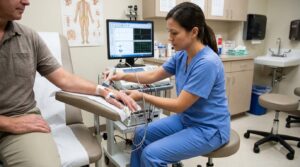
Doppler ultrasound assesses blood flow through selected blood vessels using sound waves. Depending on the clinical requirement, an examination may focus on arteries, veins, blood vessels in the neck, vessels supplying the kidneys or selected circulation patterns during pregnancy.
The challenge is that online listings can make different examinations appear interchangeable. A centre may advertise Doppler imaging generally, but patients still need to verify whether the specific test is available.
This guide provides a practical way to search locally, compare options and decide what to do next.
Start with your prescription, not the map
When patients look for a nearby service, they often begin by comparing distance, reviews or advertised prices. Those factors may matter, but they should come after confirming the required examination.
Check the prescription for:
- The name of the Doppler examination.
- The body region or vessels to be assessed.
- Whether the right side, left side or both sides are specified.
- Any additional instructions from the referring clinician.
- The timing or urgency communicated by the doctor.
If the prescription is unclear, contact the clinician who requested the examination. Avoid selecting a test based solely on a description of your symptoms.
For example, arterial and venous examinations evaluate different aspects of circulation. Booking the wrong one can create unnecessary administrative delays and may not answer the intended clinical question.
How to compare nearby diagnostic centres
A useful local search involves checking more than the distance between your home and the facility.
Verify the exact examination
Ask whether the centre can perform the examination stated on your prescription. If the listing uses a broad term such as “Doppler ultrasound,” request confirmation of the specific study.
Confirm the appointment and location
Check the available appointment times, the exact branch address and the expected arrival time. Do not assume that a service advertised by a provider is available at every branch.
Ask about preparation
Find out whether fasting or any other special preparation applies. Instructions vary between examinations, so do not rely on a relative’s experience or advice intended for a different test.
Compare the complete price
Ask for the fee for the prescribed examination and clarify what is included. If additional testing is suggested, ask why it is needed and whether the decision should be discussed with your referring doctor.
Check the reporting process
Confirm when the report is expected and how it will be delivered. If you have a specialist consultation scheduled, explain the date when making the appointment.
These questions make local comparisons more meaningful than choosing the first result displayed in a search.
Which type of Doppler examination should you ask about?
The following overview can help you understand the terminology used by diagnostic centres.
| Examination | General purpose | Booking question |
| Arterial Doppler | Assesses flow through selected arteries | Which arteries and body region are specified? |
| Venous Doppler | Assesses flow through selected veins | Which veins need to be examined? |
| Carotid Doppler | Assesses blood flow through arteries in the neck | Is a carotid examination prescribed? |
| Renal Doppler | Assesses blood flow in vessels supplying the kidneys | Which renal vascular study is required? |
| Obstetric Doppler | Assesses selected circulation patterns associated with pregnancy | What has the pregnancy care team requested? |
This overview is not a diagnostic tool. The correct examination depends on the referral and the clinician’s assessment.
When searching locally should not delay medical attention
A local diagnostic search is appropriate when you have a referral and need to organise an examination. It is not always the right first step when new symptoms could indicate an urgent medical problem.
For example, sudden swelling, pain or tenderness in one leg can have several causes, but a blood clot is one possibility that needs prompt assessment. Seek urgent medical advice rather than waiting several days for a convenient routine appointment.
If leg symptoms occur with sudden breathlessness, chest pain, fainting or coughing up blood, seek emergency medical care immediately. These symptoms can indicate a serious condition.
Similarly, sudden severe limb pain accompanied by unusual paleness, coldness, numbness or weakness may require emergency assessment.
Do not assume that every symptom requires a Doppler scan, and do not assume that arranging one will be sufficient treatment. A clinician must assess the symptoms and determine the appropriate next step.
A practical local-search process
If your examination is not an emergency and you have a referral, use this process to organise the appointment.
Step 1: Read the referral. Record the examination name and body region exactly as written.
Step 2: Identify suitable nearby facilities. Use local search results to make an initial shortlist, but treat online descriptions as a starting point rather than proof of availability.
Step 3: Call the shortlisted centres. Ask whether they can perform the exact examination and whether an appointment is available within your required timeframe.
Step 4: Compare practical details. Check the complete fee, preparation instructions, travel arrangements and report delivery.
Step 5: Explain any relevant circumstances. Tell the facility if the patient has difficulty walking, requires assistance or needs special arrangements.
Step 6: Confirm the appointment. Record the address, date, time, contact number and documents required.
Step 7: Follow the instructions and seek follow-up. Attend as directed and review the report with the referring clinician.
This approach can help reduce wasted travel and uncertainty without encouraging you to choose a medical test independently.
Two examples of local-search problems
Example 1: The nearest centre cannot perform the requested study
A hypothetical patient searches for a Doppler centre and selects the closest result. The patient assumes that every facility advertising ultrasound services performs all Doppler examinations.
When the patient calls, the centre explains that the specific examination needs to be confirmed or is not available at that location.
Better approach: Verify the examination and branch availability before travelling. A slightly longer journey to a suitable facility may be more practical than arriving somewhere that cannot perform the required study.
Example 2: A low advertised price creates confusion
Another patient finds a low-cost listing but discovers that the description does not clearly state which examination is included.
The patient cannot determine whether the quotation applies to the test prescribed by the doctor.
Better approach: Ask for a quotation for the exact examination, including the relevant body region and any specified requirements. Compare only equivalent services.
These scenarios are illustrative and do not represent verified patient experiences.
Illustrative Case Study: Finding an appointment that fits the patient’s needs
Situation: A hypothetical older adult living in Bengaluru receives a referral for a Doppler examination. Walking long distances is difficult, so the family wants a convenient location.
Challenge: Several nearby listings advertise Doppler or ultrasound services, but the family does not know whether the specific examination is available at each branch.
Actions: A family member checks the prescription, contacts two suitable facilities and confirms the examination, appointment availability, travel arrangements and preparation instructions. The family also asks how the report will be delivered.
Expected outcome: The family can choose an appointment based on verified service availability and practical accessibility instead of distance alone.
Lesson: Local convenience matters most when combined with correct examination selection, clear communication and suitable patient arrangements.
This is a hypothetical case study, not a verified account or a guarantee that a particular facility will have immediate availability.
What to ask when contacting a diagnostic centre
Before finalising a booking, use a short checklist:
- Can you perform the examination written on my prescription?
- Is the requested examination available at this particular branch?
- What is the total fee?
- Do I need to fast or follow other preparation instructions?
- What medical records or previous reports should I bring?
- How long should I allow for the appointment?
- When should the report be available?
- How will I receive the report and images?
If you are arranging an examination for someone else, ask whether the patient needs assistance with registration or positioning.
You should also explain if the doctor has requested a time-sensitive investigation. The centre can clarify appointment options, while the referring clinician remains responsible for advising on the appropriate urgency.
Checking local options in Bengaluru
Patients searching for a Doppler scan near me can begin with local listings and then verify the details directly with each provider.
Ecotown Diagnostics provides information about its diagnostic services and Bengaluru locations, including Ramamurthy Nagar and Kalyan Nagar. Its website describes Doppler examinations involving arteries, veins, carotid vessels, renal circulation and pregnancy-related blood flow.
Before travelling, contact the centre to confirm the exact examination, branch availability, current fees, preparation requirements and reporting arrangements. Do not assume that every examination is offered at every location or that appointments are always available immediately.
The best local option is one that meets your examination requirements and practical needs, not necessarily the one closest to your home.
After the scan: Know what the report can and cannot tell you
A Doppler report provides information about the blood vessels and blood flow examined. The significance of the findings depends on the clinical question and the patient’s circumstances.
A report should be reviewed by the referring clinician, who can explain the findings and determine whether additional investigations or treatment are necessary.
If the report is delayed, contact the facility using the agreed reporting procedure. If your symptoms worsen while waiting, seek medical advice rather than assuming that the scheduled report will resolve the concern.
Conclusion
Searching for a nearby diagnostic centre should be a straightforward process, but the examination must match the doctor’s request. Confirm the test name, check the specific branch’s availability, compare complete prices and clarify preparation and reporting before travelling.
When looking for a Doppler scan near me, remember that convenience is only one part of the decision. Examination suitability, clear communication and appropriate clinical follow-up are equally important.
If you already have a prescription, use it as the starting point for your search. If you have concerning or rapidly worsening symptoms, seek appropriate medical assessment instead of waiting for a routine appointment.
Frequently Asked Questions
1. How do I find a Doppler centre near my home?
Search local diagnostic listings, then contact suitable facilities to verify the exact examination, branch availability, fees and preparation instructions. Do not rely on distance alone.
2. Can I book a Doppler scan without a prescription?
Booking requirements vary by facility and examination. A prescription or clinician’s guidance helps ensure that the correct study is arranged, so ask the centre what documentation is required.
3. Is the closest diagnostic centre always the best option?
Not necessarily. The centre must be able to perform the prescribed examination and accommodate relevant patient needs. Compare suitability, accessibility, cost and reporting arrangements.
4. Do Doppler scans require special preparation?
Many external vascular Doppler examinations require little preparation, but some tests have specific instructions. Follow the guidance provided for your particular examination.
5. What if I suspect a blood clot and cannot find an immediate appointment?
Seek prompt medical assessment rather than waiting for a routine booking. If symptoms include sudden breathlessness or chest pain, seek emergency medical care immediately.
6. When should I discuss my Doppler report with my doctor?
Review the report according to the follow-up plan given by the referring clinician. If the report contains unfamiliar terms or your symptoms continue, ask the doctor to explain the findings and recommended next steps.