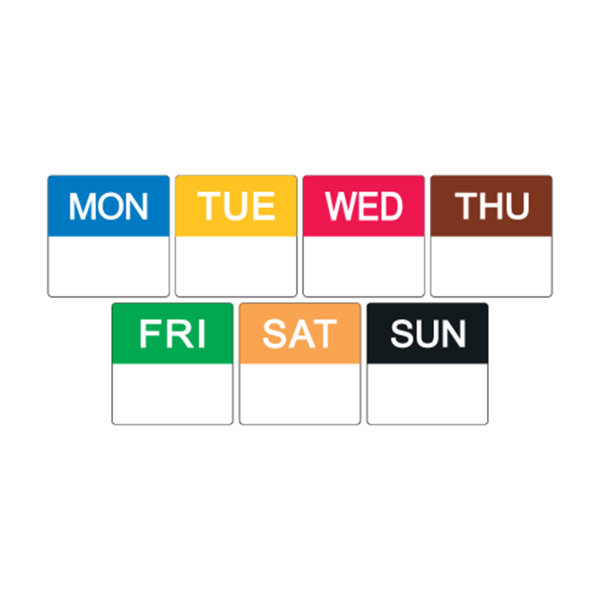
Keeping track of food preparation dates, storage periods and stock rotation is essential in commercial kitchens. When multiple employees prepare, store and handle ingredients throughout the day, identifying when food was prepared or opened can quickly become challenging. Day labels provide a simple and practical solution by making food storage information easier to identify.
Restaurants, cafés, catering companies, bakeries, hotels and food processing businesses commonly use day labels to organise ingredients and support consistent food handling procedures.
These labels are available in different colours, sizes and adhesive formats. Some display the days of the week, while others provide space for preparation dates, discard dates, employee initials and additional information.
Using suitable labels can help kitchen teams identify older stock, reduce unnecessary food waste and maintain more organised storage areas.
However, labels alone do not determine whether food is safe to consume.
Food businesses must still follow appropriate temperature controls, cleaning procedures, storage requirements and applicable food safety regulations.
Choosing the correct labelling system depends on the type of food, storage conditions and operational needs.
This guide explores everything you need to know about Day labels, including their benefits, types, colour systems, applications, correct usage, costs and practical purchasing considerations.
What Are Day Labels?
Day labels are adhesive labels used to identify food storage information, commonly including the day of the week on which food was prepared, opened or scheduled for use.
They are widely used in commercial food preparation environments where ingredients and prepared foods need to be organised.
Many day labels feature the name of a weekday and a corresponding colour.
Other versions provide additional space for recording preparation dates, use-by information, employee initials or product details.
Some labels are designed to dissolve during washing, while others use removable or permanent adhesives.
The most suitable product depends on the container material and storage conditions.
For example, a café may use day labels to identify prepared sandwich fillings.
A restaurant may use them to organise ingredients stored in refrigerated containers.
A catering company may use them to track food prepared for upcoming events.
Day labels support food rotation and organisation, but they should always be used alongside established food safety procedures.
Why Are Day Labels Important in Commercial Kitchens?
Commercial kitchens often handle large quantities of ingredients and prepared foods.
Without a consistent labelling system, employees may struggle to identify when products were prepared or opened.
Day labels make this information easier to communicate between staff members.
For example, a container of prepared vegetables may look identical to another container prepared several days earlier.
A clearly completed label helps employees distinguish between them.
This can support first-in, first-out stock rotation and reduce unnecessary food waste.
Labels also help during shift changes.
Employees starting a new shift can identify relevant food preparation information without relying entirely on verbal communication.
However, a day label should not replace a complete date-marking system when one is required.
The correct information depends on the food product and applicable regulations.
Businesses should establish clear procedures for recording preparation dates, storage limits and disposal requirements.
Key Benefits of Using Day Labels
Food businesses use day labels because they provide several practical operational advantages.
Improved Food Rotation
Day labels help employees identify older stock and use suitable products in the correct order.
Better Kitchen Organisation
Clearly labelled containers are easier to identify in refrigerators, freezers and storage areas.
Reduced Food Waste
Accurate labelling can help prevent usable food from being forgotten or discarded unnecessarily.
Clear Communication Between Staff
Employees can quickly identify preparation information during shift changes.
Support for Food Safety Procedures
Labels can form part of a documented food storage and stock management system.
Faster Stock Checks
Kitchen teams can review stored products more efficiently when labels are clear and consistent.
Convenient Application
Most food rotation labels are easy to apply to suitable containers.
These benefits depend on staff using the labels correctly and recording accurate information.
Different Types of Day Labels
Day labels are available in several formats to suit different commercial kitchen requirements.
Colour-Coded Day Labels
These labels use different colours to identify individual days of the week.
They are commonly used for quick visual recognition.
Removable Day Labels
Removable labels are designed to peel away from suitable surfaces without leaving excessive adhesive residue.
Dissolvable Day Labels
Dissolvable Day labels are manufactured to break down under specified washing conditions.
They may be useful for reusable food storage containers.
Permanent Adhesive Labels
These labels are designed to remain attached for longer periods.
They may be suitable for selected packaging applications.
Writable Food Rotation Labels
Writable labels provide space for preparation dates, discard dates and other important information.
Pre-Printed Day Labels
Pre-printed labels display specific weekdays and may include additional information fields.
Businesses should select labels based on their storage procedures, container materials and cleaning requirements.
Understanding the Day Label Colour-Coding System
Colour-coded labels help employees identify weekdays quickly.
A commonly used seven-day food rotation colour system is:
- Monday – Blue
- Tuesday – Yellow
- Wednesday – Red
- Thursday – Brown
- Friday – Green
- Saturday – Orange
- Sunday – Black
However, colour systems can vary between suppliers and businesses.
The colours themselves do not establish food safety requirements.
When using Day labels, businesses should adopt one consistent system and train employees to follow it.
A colour-coded label may identify the preparation day, opening day or intended discard day.
These meanings should not be confused.
For example, a label marked Monday could mean the food was prepared on Monday or should be discarded on Monday, depending on the workplace procedure.
Staff should understand exactly what each label represents.
Where necessary, additional written dates should be included to avoid confusion between different weeks.
Day Labels for Restaurants and Commercial Kitchens
Restaurants frequently prepare ingredients in advance to support efficient service.
Prepared vegetables, sauces, dressings and other ingredients may be stored in separate containers.
Day labels help kitchen staff identify when these products were prepared or opened.
For example, a restaurant preparing several batches of sauce throughout the week may use labels to distinguish older containers from newer ones.
This supports organised stock rotation.
However, food storage limits depend on the ingredients, preparation methods and storage conditions.
A weekday label alone does not establish how long a product can safely be stored.
Restaurants should follow applicable food safety requirements and documented procedures.
Labels should also remain readable during refrigerated storage.
Products stored in wet or cold environments may require adhesives designed for those conditions.
A consistent labelling system can help busy kitchens maintain clearer communication and more organised storage.
Day Labels for Cafés and Coffee Shops
Cafés often prepare ingredients before opening to reduce delays during busy service periods.
Common examples include sandwich fillings, prepared vegetables, dairy products and bakery ingredients.
Day labels can help café staff identify when products were opened or prepared.
For example, an employee opening a container of a perishable ingredient may record the opening date according to the café’s food safety procedures.
This helps other staff members understand the product’s storage history.
Labels can also support stock rotation in refrigerators and preparation stations.
However, labels should not be used to extend a manufacturer’s use-by date.
Food must still be stored at appropriate temperatures.
Businesses should also ensure labels are suitable for the containers being used.
A simple, consistent system can help cafés manage ingredients more efficiently during busy operating hours.
Day Labels for Catering Businesses
Catering companies often prepare food for events involving large quantities of ingredients.
Some preparation activities may occur before the event date.
Day labels can help catering teams organise food preparation schedules and storage information.
For example, a catering business preparing ingredients for several events may use labels to identify different batches.
This can reduce confusion when multiple employees are involved.
However, food safety requirements remain essential.
Catering businesses must consider preparation methods, transport conditions, temperature control and service times.
Labels should include the information required by the business’s food safety procedures.
For certain products, additional batch identification or allergen information may be necessary.
A weekday label alone may not provide sufficient detail.
Using a clear labelling system helps catering teams maintain organised workflows across preparation, storage and delivery.
Day Labels for Bakeries and Food Production
Bakeries and food production businesses handle ingredients and products with different storage requirements.
Some ingredients may be used immediately, while others are stored for later production.
Day labels can help identify preparation dates, opening dates and scheduled usage.
For example, a bakery may label containers of prepared fillings to distinguish different batches.
Food production facilities may use more detailed labels that include batch numbers and traceability information.
However, ordinary weekday labels are not a substitute for complete production records when these are required.
Businesses should determine which information needs to be recorded.
This may include product names, preparation dates, batch identification and storage instructions.
Labels should also be suitable for the relevant temperature and moisture conditions.
Consistent labelling can support organised production and stock management.
Day Labels for Refrigerated Food Storage
Refrigerators are common locations for food rotation labels.
Commercial kitchens may store prepared ingredients, sauces, dairy products and other perishable foods in refrigerated containers.
Day labels help employees identify relevant preparation and storage information.
However, refrigeration does not make food safe indefinitely.
Different foods have different storage requirements.
Businesses should follow appropriate temperature controls and product-specific procedures.
Labels must also remain attached and readable in cold environments.
Some ordinary paper labels may become difficult to remove or may lose adhesion when exposed to moisture.
Products designed for refrigerated use may provide better performance.
When selecting labels, consider condensation, container materials and cleaning methods.
Accurate date information and proper temperature control should work together.
Day Labels for Freezer Storage
Freezer storage presents different labelling challenges from refrigeration.
Low temperatures and moisture can affect adhesive performance.
Day labels intended for freezer use should be suitable for the expected storage conditions.
Some labels are designed to be applied before freezing.
Others may be suitable for application to already frozen packaging, depending on their specifications.
Businesses should check manufacturer instructions.
Freezer labels may need space for product names, freezing dates and other relevant information.
However, freezing does not automatically make every food suitable for unlimited storage.
Product quality can deteriorate over time.
Food safety also depends on handling before freezing, storage temperatures and thawing procedures.
Clear labels help employees identify stored products and manage stock rotation more effectively.
Removable vs Dissolvable Day Labels
Removable and dissolvable labels are popular options for reusable food storage containers.
However, they work differently.
Removable Day labels are designed to peel away from suitable surfaces.
Their performance depends on the adhesive and container material.
Dissolvable labels are designed to break down under specified washing conditions.
These may reduce the time employees spend removing labels from reusable containers.
However, not every dissolvable label performs identically.
Water temperature, washing method and adhesive formulation can affect results.
Some products may require particular cleaning conditions.
Businesses should test labels on their actual containers before purchasing large quantities.
The best option depends on the cleaning process and operational requirements.
How to Choose the Right Day Labels
Choosing suitable labels involves considering the work environment and intended use.
The first factor is the information employees need to record.
Some businesses require only a weekday identifier.
Others need space for dates, times, employee initials and product names.
When purchasing Day labels, consider the following factors.
Adhesive Type
Choose removable, dissolvable or permanent adhesives according to the application.
Storage Temperature
Confirm that labels are suitable for refrigeration or freezing when necessary.
Label Size
Ensure there is enough space for the required information.
Colour System
Select a consistent colour-coding system that employees can understand.
Writing Surface
Check whether the label can be written on clearly with the intended pen or marker.
Container Compatibility
Labels should adhere appropriately to the relevant container materials.
Packaging Quantity
Consider daily usage and storage requirements.
Testing samples can help businesses select suitable products.
How to Use Day Labels Correctly
Correct labelling procedures help prevent confusion and support consistent stock rotation.
Start by identifying the food product and the information that must be recorded.
Select the appropriate label.
Apply it to a clean, suitable surface according to the manufacturer’s instructions.
When using Day labels, write clearly and avoid abbreviations that employees may misunderstand.
Record the preparation or opening date when required.
If a discard date is necessary, calculate it according to the applicable food safety procedure.
Do not guess storage periods.
Ensure the label remains visible during storage.
When transferring food into another container, update the labelling information appropriately.
Remove outdated labels from reusable containers.
Staff should receive training on the business’s labelling system.
A label is only useful when the information is accurate and employees understand its meaning.
Day Labels and First-In, First-Out Stock Rotation
First-in, first-out, commonly called FIFO, is a stock management method that generally prioritises using older suitable stock before newer stock.
Day labels can support FIFO by making preparation and opening dates easier to identify.
For example, a kitchen may have two containers of the same ingredient.
One was prepared earlier than the other.
Clear labels help employees identify which container should normally be used first.
However, FIFO does not override food safety requirements.
Products must still be within their safe storage period and suitable for use.
Some businesses also use first-expired, first-out methods when products have different expiry dates.
The correct approach depends on the product and workplace procedures.
Labels support stock management, but staff must still inspect products and follow applicable food safety requirements.
How Much Do Day Labels Cost in Australia?
The price of day labels depends on label size, adhesive type, packaging quantity and supplier.
Basic pre-printed weekday labels are often sold in rolls or multi-day sets.
Dissolvable and specialist freezer-compatible products may cost more than ordinary removable labels.
For preliminary budgeting, Day labels may cost only a few cents per label when purchased in bulk.
However, actual prices vary significantly according to specifications and order quantities.
Businesses should compare the cost per label rather than relying only on the package price.
For example, a larger roll may offer a lower unit price but require more storage space.
Delivery charges and minimum order quantities should also be considered.
The cheapest label may not provide good value if it becomes unreadable, falls off or leaves difficult-to-remove residue.
Testing products before bulk purchasing can help avoid unnecessary costs.
Buying Day Labels in Bulk
Bulk purchasing can be practical for restaurants, catering businesses and commercial kitchens with regular labelling requirements.
Buying Day labels in larger quantities may reduce unit costs and help maintain consistent supplies.
However, businesses should estimate usage before ordering.
Labels that are rarely used may occupy unnecessary storage space.
Check the packaging format.
Rolls may be convenient for busy preparation stations.
Individual packs may be useful for smaller operations.
Businesses should also confirm adhesive suitability and label dimensions.
Request samples where possible.
Store labels according to manufacturer instructions.
Excessive heat, moisture or unsuitable storage conditions may affect adhesive performance.
Maintaining a consistent supply helps prevent staff from skipping important labelling procedures.
Common Mistakes to Avoid When Using Day Labels
One common mistake is failing to record the full date when it is needed.
A weekday label alone may create confusion between different weeks.
Another mistake is using the wrong label colour or applying labels inconsistently.
When using Day labels, employees should understand whether the label indicates preparation, opening or disposal.
Using expired or outdated labels can also create problems.
Labels should be updated when food is transferred into new containers.
Businesses should avoid applying new labels over old information without following an established procedure.
Another mistake is assuming that a label guarantees food safety.
Food may become unsafe because of incorrect temperature control or handling even when the label appears valid.
Staff training and regular checks help reduce these problems.
How to Store Day Labels Properly
Proper storage helps maintain label quality and adhesive performance.
Labels should generally be stored in a clean, dry location.
Keep Day labels away from excessive heat, moisture and direct sunlight unless the manufacturer specifies otherwise.
Businesses may benefit from placing dispensers near food preparation areas.
This makes labels easier to access and encourages consistent use.
However, dispensers should be positioned where they will not become contaminated.
Different weekday rolls should be clearly organised.
If several label types are used, staff should be able to distinguish between removable, dissolvable and freezer-compatible products.
Check packaging for damage before use.
Follow manufacturer storage instructions.
Good organisation helps ensure labels remain available and easy to use.
How to Choose a Reliable Day Label Supplier
A dependable supplier should provide clear product specifications and consistent availability.
When purchasing Day labels, look for information about adhesive type, label dimensions, packaging quantities and storage suitability.
For refrigerated or frozen environments, confirm the product’s temperature compatibility.
Businesses should also consider whether labels are removable or dissolvable.
Supplier reliability matters for kitchens that depend on daily labelling.
Compare pricing, delivery arrangements and stock availability.
Request samples before placing large orders.
Testing labels on actual food storage containers can help identify potential problems.
A suitable supplier can help businesses maintain consistent labelling practices without unnecessary interruptions.
Why Day Labels Are Essential for Organised Food Storage
Day labels provide a simple way to improve food storage organisation and support stock rotation.
They are widely used in restaurants, cafés, catering businesses, bakeries and food production facilities.
However, effective labelling requires more than choosing a colour-coded sticker.
Businesses must establish clear procedures for recording dates, identifying products and managing storage periods.
The correct Day labels depend on container materials, storage temperatures, adhesive requirements and the information employees need to record.
Removable and dissolvable products offer different advantages.
Bulk purchasing may reduce costs when the labels are suitable for daily operations.
Most importantly, labels should support established food safety practices rather than replace them.
When used correctly, day labels can help employees work more efficiently, reduce confusion and maintain better organised storage areas.
Looking for reliable food rotation labels for your business? Compare Day labels based on adhesive quality, colour coding, storage suitability and packaging quantity to find a practical solution for your commercial kitchen.
Frequently Asked Questions About Day Labels
1. What are day labels used for?
Day labels are used to identify food preparation, opening or intended usage information. They help commercial kitchens organise stored ingredients and support stock rotation.
2. What are the seven colours of day labels?
A commonly used system is Monday blue, Tuesday yellow, Wednesday red, Thursday brown, Friday green, Saturday orange and Sunday black. However, colour systems may vary between suppliers.
3. Are day labels required in commercial kitchens?
Food businesses must comply with applicable food safety and date-marking requirements. Day labels are one practical way to support these procedures, but specific requirements depend on the food and jurisdiction.
4. What is the difference between removable and dissolvable day labels?
Removable labels are designed to peel away from suitable surfaces. Dissolvable labels are designed to break down under specified washing conditions.
5. Can day labels be used in freezers?
Some day labels are designed for freezer use. Check the manufacturer’s temperature and application specifications before purchasing.
6. How do day labels help reduce food waste?
They make preparation and storage information easier to identify, helping employees rotate suitable stock and avoid overlooking older products.
7. Can day labels replace use-by dates?
No. Day labels should not replace legally required date markings or override a manufacturer’s use-by date. Businesses must follow applicable food safety requirements.
8. What information should be written on a day label?
Depending on workplace procedures, information may include the product name, preparation date, opening date, discard date, time and employee initials.
9. Is buying day labels in bulk cheaper?
Bulk purchasing may reduce the unit price, depending on the supplier and quantity. Compare adhesive quality, label dimensions and total costs before ordering.
10. Where can I buy day labels in Australia?
Day labels are available from hospitality supply businesses, food packaging wholesalers, commercial kitchen suppliers and workplace consumable distributors. Compare product specifications and storage suitability before purchasing.