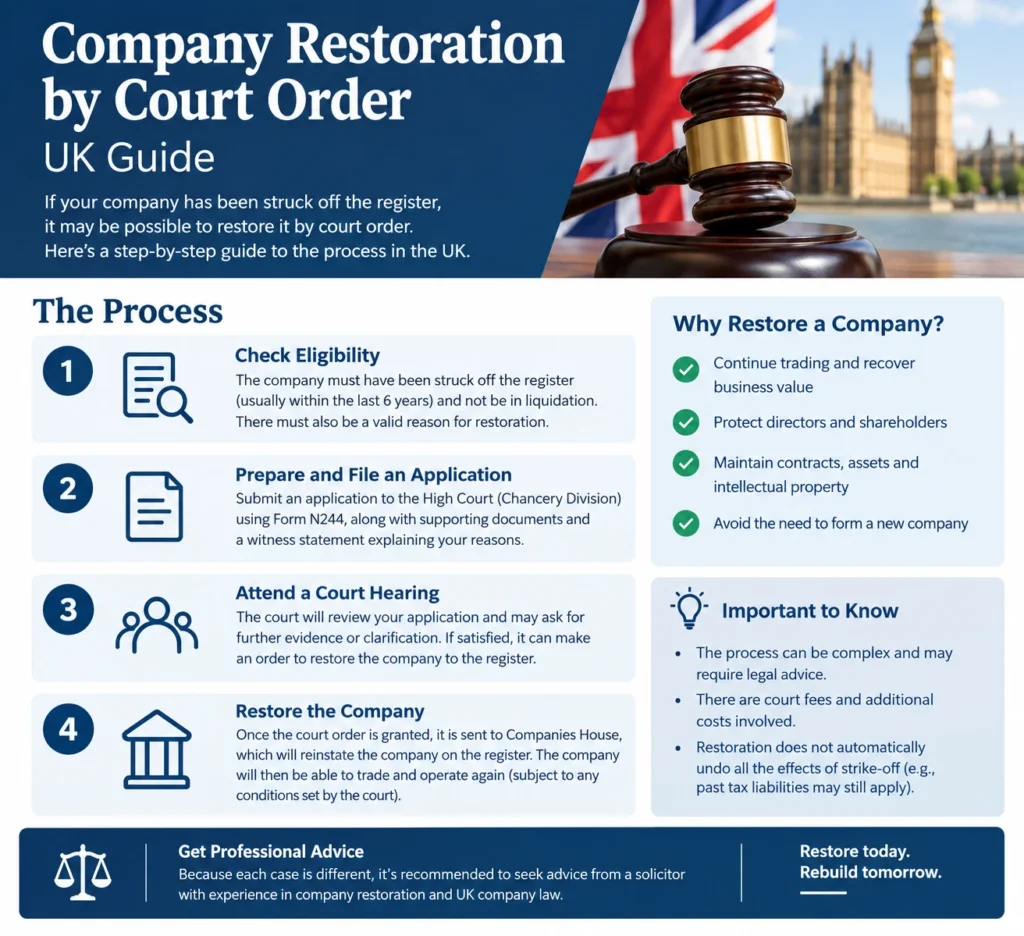
A dissolved company can create unexpected problems for directors, shareholders and creditors. You might need to recover company assets, resolve a legal dispute or continue business activities.Company restoration by court order offers a legal route to return an eligible dissolved company to the Companies House register. The process involves a court application, supporting evidence and compliance with legal requirements.Not every dissolved company needs a court order. Some companies qualify for administrative restoration through Companies House. However, voluntary strike-off cases generally require court restoration.This guide explains who can apply, how the process works, what documents you need and which costs to consider.
What Is Company Restoration by Court Order?
Company restoration by court order means asking a court to return a dissolved company to the Companies House register.The court considers the application under the Companies Act 2006. If it approves the application, it issues an order for restoration.The applicant must then deliver the required court order to Companies House. The registrar uses that order to restore the company’s registration.
Once restored, the company generally regains its legal existence as though dissolution had not occurred. However, restoration does not automatically resolve every outstanding legal, financial or tax issue.For example, a former director might discover that a dissolved company still owns property. A creditor might also need the company restored before pursuing a claim.In both situations, court restoration may provide the necessary legal route.
Why Do Companies Need Restoration?
Companies can become dissolved for several reasons. Directors might voluntarily close a business without realising that important assets remain. Companies House might also strike off a company following missed filings.Sometimes, a dispute or financial issue emerges after dissolution. The former company may need restoration to address that problem.Common reasons include the following.
Recovering Company Assets
A dissolved company’s remaining assets generally pass to the Crown under bona vacantia rules. These assets might include cash, property, investments or certain intellectual property rights.Restoration can help the company recover assets that it previously owned. However, the process does not guarantee their recovery.The applicant should identify the assets and understand their current legal position before applying.
Pursuing or Defending Legal Claims
A creditor might need to pursue an outstanding company debt. A former customer might also have a contractual dispute involving the dissolved business.Restoration can allow relevant legal proceedings to continue against the company. It can also help a restored company address claims made against it.The applicant should obtain legal advice where limitation periods or complex disputes apply.
Resolving Property Matters
A dissolved company might still hold an interest in land or commercial property. That interest can create difficulties when someone tries to sell, transfer or manage the property.Court restoration may help resolve the company’s legal position. Applicants should review the property’s ownership records and any applicable bona vacantia requirements.
Addressing Business and Financial Obligations
A company might have unresolved liabilities, outstanding contracts or financial records that require attention.Restoration can help bring these matters back into a workable legal framework. However, it does not remove debts or automatically settle outstanding obligations.The company must address its responsibilities after restoration.
When Is a Court Order Required?
The correct restoration route depends on how Companies House dissolved the company.Companies House recognises two main routes: administrative restoration and restoration by court order.
Administrative Restoration
Administrative restoration involves applying directly to Companies House using form RT01.This route generally applies when the Registrar of Companies struck off the company and the applicant meets the legal conditions.The applicant must usually have been a director or shareholder when the Registrar of Companies struck off the company. The company must also have been trading or operating at that time.The applicant must satisfy the other statutory requirements and provide the necessary documents and payments. Administrative restoration is not available when directors voluntarily applied to strike off the company.
Restoration by Court Order
Court restoration covers a wider range of circumstances. It can apply to companies struck off voluntarily or by the registrar, subject to statutory eligibility requirements.It can also apply to certain companies dissolved following insolvency proceedings.A court application may be necessary when the company does not qualify for administrative restoration. Applicants may also need this route after Companies House refuses an administrative restoration application.Choosing the correct route at the beginning can save time and avoid unnecessary costs.
Who Can Apply for Company Restoration?
The law allows several categories of people to apply for court restoration.Eligibility depends on the company’s circumstances and the applicant’s connection to it.
Potential applicants include:
- Former company directors.
- Former shareholders or members.
- Creditors with relevant claims.
- Former company liquidators.
- People with contractual relationships involving the company.
- People with potential legal claims against the company.
- People with relevant interests in company property.
- Other people whom the court considers to have a sufficient interest.
The statutory provisions also cover certain other applicants in specific circumstances.Being connected to a dissolved company does not automatically guarantee permission to apply. The applicant must establish their eligibility and explain the reasons for restoration.For example, a former shareholder might seek to recover an asset. A creditor might want to pursue an unpaid invoice.Both applicants should provide evidence that supports their respective applications.
Is There a Time Limit for Court Restoration?
In most cases, applicants must apply within six years of the company’s dissolution.The relevant date is the date of dissolution, not simply the date when Companies House first announced its intention to strike off the company.Applicants should check the company’s official record to confirm the dissolution date.Special rules apply to certain personal injury claims. These cases may allow an application outside the usual six-year period, subject to the relevant legal requirements.Do not assume that an old company can no longer be restored. Equally, do not assume that every late application will succeed.If the deadline is approaching, obtain legal advice promptly. A solicitor can assess the applicable time limit and any relevant exceptions.
How to Restore a Dissolved Company Through the Court
Court restoration requires careful preparation. Applicants should identify the correct court, establish eligibility and prepare the supporting documents.The exact procedure can vary according to the company’s circumstances and the applicable court rules.
Step 1: Check the Company’s Status
Start by searching for the company on Companies House.Confirm its company number, registered name and dissolution date. Review the filing history to establish why and when the company was struck off.The record can help you distinguish voluntary strike-off from registrar-led strike-off.This distinction matters because it affects the available restoration routes.Also check whether the company previously entered liquidation or administration. Insolvency-related cases can involve additional legal considerations.
Step 2: Establish Your Eligibility
Identify the legal basis for your application.You should explain your relationship with the company and why restoration is necessary. Gather evidence supporting your interest in the company.For example, a creditor might provide invoices, contracts and correspondence about an unpaid debt.A former director seeking to recover property might provide company records and evidence of ownership.Your evidence should establish a clear connection between the applicant, the company and the requested restoration.
Step 3: Identify the Appropriate Court
The appropriate court depends on the company’s registered jurisdiction and the circumstances of the application.Companies registered in England and Wales, Scotland or Northern Ireland may follow different procedural requirements.Check the applicable court rules before preparing the claim. Where the matter involves property, insolvency or disputed legal rights, obtain specialist legal advice.Do not rely on a generic application template without checking whether it fits your case.
Step 4: Prepare the Court Application
Prepare the required claim form and supporting documents.The application should explain why the court should restore the company. It should also identify the relevant legal provisions and the relief requested.Depending on the case, the supporting evidence may include:
- The company’s Companies House record.
- Evidence of the applicant’s eligibility.
- Details of the company’s dissolution.
- Evidence of outstanding assets or liabilities.
- Relevant contracts, invoices or property records.
- An explanation of why restoration is necessary.
- Any other documents required by the court.
Some cases require additional parties to receive notice of the application. The court may also require further evidence or specific directions.Review the current procedural requirements before filing.
Step 5: File the Application and Pay the Applicable Fees
Submit the application using the procedure required by the relevant court.You may need to pay a court fee and meet additional procedural requirements. The amount depends on the application and the rules in force.Court fees can change, so confirm the current amount before filing.You should also consider legal representation costs and any professional assistance required to prepare the application.Keep copies of the application, supporting evidence and payment confirmation.
Step 6: Follow the Court’s Instructions
The court may review the papers, request additional information or arrange a hearing.Some applications may proceed without a contested hearing. Others require further consideration because a creditor, public authority or another interested party objects.Respond to requests within the specified deadlines.If the court asks for additional evidence, provide clear and relevant documents. Missing deadlines or submitting incomplete information can delay the case.
Step 7: Obtain the Court Order
If the court approves the application, it issues an order for restoration.Check the order carefully. Confirm that it identifies the correct company and contains the necessary restoration provisions.Follow the court’s instructions for obtaining the required sealed or certified copy.The exact document requirements depend on the company’s jurisdiction.
Step 8: Deliver the Order to Companies House
The court’s decision alone does not complete every administrative step.You must deliver the required court order to the Registrar of Companies using the applicable procedure.For companies registered in England and Wales or Northern Ireland, Companies House generally requires a copy bearing the court seal. Scottish cases require a court-certified copy.Follow the instructions that apply to your company.Keep proof of delivery and monitor the company’s Companies House record.
Step 9: Confirm the Company’s Restoration
Check the Companies House record after the registrar processes the order.Confirm that the company appears as restored and review its registered details.The company can then address the outstanding matters that prompted restoration.Do not assume that every bank, tax authority or third party will update its records immediately. Contact relevant organisations where necessary.
What Documents Do You Need?
The required documents depend on the facts of the case.A straightforward application may need less evidence than a disputed property or creditor matter.You should generally prepare the following information before starting:
Company Information
Obtain the registered company name, company number and dissolution date.Download the Companies House filing history where useful. This helps establish the company’s status and the events leading to dissolution.
Applicant Evidence
Provide documents showing your connection to the companyThese might include evidence of former directorship, share ownership, an unpaid debt or a relevant contractual relationship.The court needs enough information to assess your legal standing.
Supporting Financial or Property Records
Gather relevant bank records, accounts, invoices, contracts or property documents.These records should support the reason for restoration. They can also help identify matters that require attention after the company returns to the register.
Court Documents
Prepare the prescribed application, supporting statement and any required exhibits.Check whether the court requires particular forms, copies or notices to other interested parties.An incomplete application can lead to requests for further information and additional delays.
How Much Does Company Restoration by Court Order Cost?
The total cost varies according to the complexity of the case.Unlike administrative restoration, court restoration involves a court application. Applicants should therefore budget for several potential expenses.
| Cost category | What to consider |
|---|---|
| Court fee | The fee applicable to your claim and court procedure |
| Solicitor’s fees | Advice, preparation and representation, where required |
| Document preparation | Drafting, copying, certification or other supporting work |
| Asset-related costs | Bona vacantia matters or steps needed to recover assets |
| Outstanding company filings | Accounts, confirmation statements and applicable filing fees |
| Penalties and liabilities | Amounts that remain payable under the relevant rules |
Ask for a clear breakdown before instructing a professional. Confirm which services the quoted fee includes and which expenses remain separate.You should also distinguish the court restoration costs from the company’s post-restoration obligations.For example, a company might need to prepare overdue accounts or deal with outstanding Corporation Tax matters. Those tasks can increase the overall cost.There is no single reliable total for every case. Obtain current fee information and a case-specific estimate before proceeding.
How Long Does Court Restoration Take?
There is no universal timeframe for court restoration.The duration depends on the court’s workload, the completeness of the application and the complexity of the case.A straightforward application may progress faster than a disputed matter involving property, creditors or insolvency.Additional evidence requests can also extend the process.You should allow time for preparing the claim, satisfying court requirements, obtaining the order and submitting it to Companies House.Avoid making firm business commitments based on an assumed restoration date. Wait for confirmation that the registrar has restored the company.If you face a legal deadline or urgent property issue, explain the urgency to your solicitor at the outset.
What Happens After a Company Is Restored?
Restoration brings the company back into legal existence. However, directors may need to take several further steps.
Review Company Accounts and Filings
Check which accounts and confirmation statements remain outstanding.Determine which documents the company must submit and identify any applicable filing fees or penalties.Companies House and HMRC obligations depend on the company’s circumstances. Seek accounting advice if the records contain gaps or errors.
Review Tax Responsibilities
Contact HMRC where necessary to clarify the company’s tax position.Review Corporation Tax, PAYE, VAT and other relevant obligations. Not every company will have every obligation.Restoration does not automatically settle outstanding tax liabilities. The company should review its records and address any required submissions.
Review Bank Accounts
Contact the company’s bank to establish the steps needed to regain access.The bank may request updated company information, identification or other supporting documents.A restored Companies House record does not guarantee immediate access to a frozen account.
Review Assets and Liabilities
Identify the assets the company owned before dissolution.Review any property, bank balances, contractual rights and outstanding debts.Where assets passed to the Crown, follow the relevant legal process to establish how recovery works.The company should also review its liabilities before resuming trading.
Update Business Records
Check the registered office, directors, shareholders and other company details.Make any required filings to keep the public record accurate.Directors should also review their statutory duties before restarting business operations.
Does Court Restoration Automatically Recover Company Assets?
No. Restoration does not guarantee the recovery of every asset. The company may regain the legal capacity to deal with assets that it previously owned. However, separate legal steps may still apply.For example, property might have passed to the Crown under bona vacantia rules. Recovering it may require contact with the relevant authority and compliance with its requirements.The outcome can depend on the asset type, its current ownership and any intervening transactions. Identify the assets before applying whenever possible. This helps you understand the likely benefits and costs of restoration.Where substantial property or disputed ownership is involved, obtain specialist legal advice.
Company Restoration and Striking Off a Company Online
Striking off a company online provides a way for an eligible company voluntarily. It does not provide a method for restoring a dissolved company.Companies House offers an online closure service for eligible businesses. The process generally requires the appropriate director approvals and compliance with the relevant conditions.Directors should check those conditions before applying. A company cannot use voluntary strike-off as a substitute for formal insolvency proceedings when liquidation is required.The distinction matters because voluntary strike-off can have lasting consequences.When Companies House dissolves a company, its bank account becomes frozen. Remaining assets may pass to the Crown.If directors later discover that the company still owns assets or needs to resolve a legal claim, they may need restoration.Where directors voluntarily applied for strike-off, administrative restoration is generally unavailable. They will usually need to pursue court restoration if they meet the legal requirements.This is why directors should review company assets, liabilities and filing obligations before closing a business.Read the official Companies House guidance on striking off a company before starting the closure process.
Common Mistakes to Avoid
Company restoration can become more difficult when applicants overlook important requirements.
Choosing the Wrong Restoration Route
Not every dissolved company qualifies for administrative restoration.Check the strike-off history and the applicant’s eligibility before choosing a procedure.
Missing the Legal Deadline
Most court restoration applications must fall within six years of dissolution.Check the relevant dates early. Seek legal advice if an exception might apply.
Providing Incomplete Evidence
The court needs evidence that supports the application.Organise company records, applicant details and supporting documents before filing.
Underestimating the Total Cost
Court fees represent only one potential expense.Consider legal fees, outstanding filings and any work required to recover company assets.
Ignoring Obligations After Restoration
Restoration does not automatically resolve tax, accounting or legal matters.Prepare a practical plan for dealing with outstanding obligations once the company returns to the register.
Frequently Asked Questions
Can I restore a company that I voluntarily struck off?
Yes, you may be able to restore it through a court order if you meet the legal requirements.Administrative restoration generally does not apply when directors voluntarily applied for strike-off.
Can a creditor apply to restore a dissolved company?
Yes. A creditor with a qualifying interest may apply to the court.The creditor must establish eligibility and comply with the relevant legal procedure.
Can I restore a company after six years?
The usual deadline is six years from dissolution.Certain personal injury cases have different rules. Obtain legal advice before assuming that a late application remains possible.
Does restoration remove company debts?
No. Restoration does not automatically cancel debts or other liabilities.The company may need to address outstanding creditor claims and financial obligations.
Can I restore a company to recover property?
Potentially, yes. Restoration may help a company recover property or other assets.However, separate legal requirements may apply, especially where assets passed to the Crown.
Do I need a solicitor for court restoration?
You should consider legal advice because the process involves court procedure and statutory requirements.
A solicitor can assess eligibility, prepare the application and advise on potential complications.
Can I trade immediately after restoration?
Restoration returns the company to the register, but it does not remove every regulatory requirement.Review the company’s filings, tax position, banking arrangements and other obligations before resuming operations.
Get Professional Help With Company Restoration
Company restoration by court order can help resolve problems involving dissolved businesses, unpaid debts and company assets. The correct procedure depends on why the company was dissolved and who wants to apply.Start by checking the Companies House record and confirming your eligibility. Then gather the necessary evidence and review the applicable court requirements. Careful preparation can reduce avoidable delays and help you understand the likely costs.If you need assistance, seek advice from a suitably qualified company restoration professional or solicitor. They can help you identify the appropriate route and prepare for the next steps.Before starting, confirm your company’s dissolution date, strike-off history and reason for restoration. These details will help determine the most appropriate way forward.