Common Mistakes Beginners Make While Learning Digital Marketing
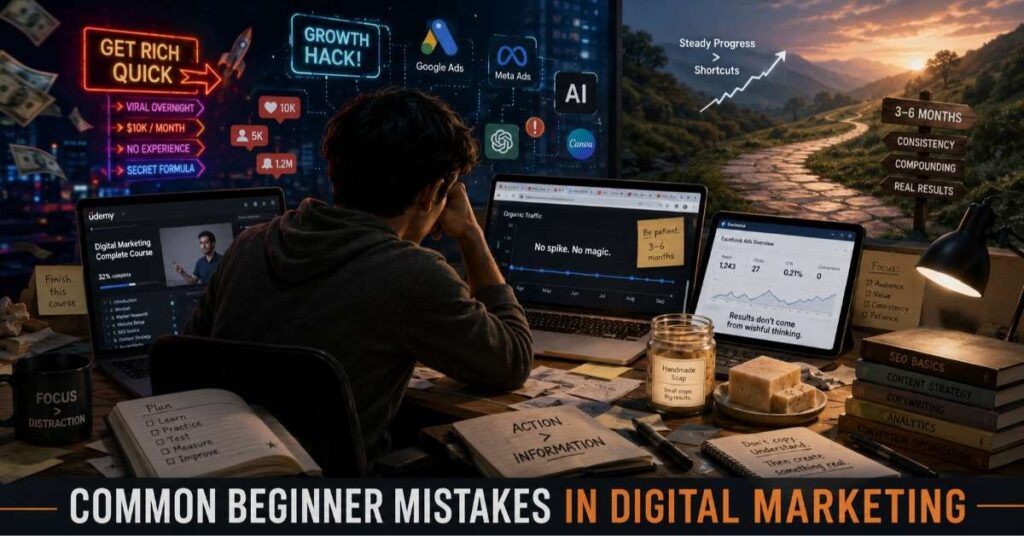
Tutorials can make you feel like you know everything. Real competence only shows up when you build something yourself.
A former student of mine once told me she’d read “everything” about digital marketing before touching a single project. Everything. I asked what she meant, and she listed maybe six blog posts and a Udemy course she’d half-finished. She wasn’t lying about how it felt. It genuinely felt like everything.
These are the common mistakes beginners make while learning digital marketing — not the tidy textbook version, but the ones I’ve actually watched people walk into, over and over, in ways that felt sensible to them at the time.
That’s the thing that gets me about this industry. The amount of information available has almost nothing to do with how much anyone actually understands.
I’ve been doing this long enough now that I’ve stopped being surprised by which mistakes beginners make. What still surprises me is how reasonable those mistakes seem from the inside. Nobody trips into digital marketing badly on purpose. Every wrong turn feels like the sensible next step at the time.
Tutorials can make you worse, not better.
I don’t say this often because it sounds like I’m against learning, which isn’t true. But I’ve watched enough beginners to notice a pattern: the ones who watch the most tutorials are sometimes the least capable of doing anything unassisted.
Here’s why. A tutorial hands you a finished decision. Use this headline formula. Set your budget to this. Target this audience size. You never sit with the discomfort of not knowing, which is exactly the discomfort that builds judgement. You get really good at following someone else’s steps and no better at making your own.
I used to believe more tutorials equalled more competence. I don’t believe that anymore.
Expensive courses often just repackage free material
This will annoy some people in the industry, and I’m fine with that.
A good chunk of what gets sold as an advanced paid course is, if you look closely, just Google’s own free Skillshop content or HubSpot’s free academy lessons, reorganised with nicer slides and a certificate bolted on at the end. Not always. There are courses with genuine mentorship, real feedback, actual live project review — those are worth paying for. But plenty aren’t, and beginners rarely have the experience yet to tell which is which before they’ve already paid.
That’s really the whole difficulty. Not “should I pay for a course,” but “how do I know if this specific one is worth it.” If you’re trying to separate genuinely useful training from clever marketing, this guide to choosing a digital marketing course helped me think about the right questions to ask. I originally found it while browsing articles on Mivja, and it approaches the topic from a practical angle rather than treating every course as equally good.
The audience question people skip.
Ad platforms are built to remove friction. That’s their entire design philosophy. Click a few buttons, and you’re live.
Which means beginners frequently launch a campaign having spent maybe ninety seconds thinking about who they’re actually speaking to. I’ve sat across from someone — smart, capable, genuinely hardworking — who couldn’t answer a basic question about their own target customer’s biggest hesitation before buying. They’d spent hours on the ad creative. Zero minutes on the person meant to see it.
This isn’t really an ads mistake. It’s a listening mistake wearing an ads costume.
A mistake I made myself, years ago
I’ll admit something. Early on, I judged my own progress by how busy I felt. Reading, taking notes, reorganising those notes into prettier notes. It felt like momentum.
It wasn’t. None of that touched a real audience.
Real progress in this field is unglamorous. It’s publishing something and hearing nothing back for six weeks. It’s watching one number move slightly and not being sure if that’s signal or noise. Nobody writes an inspiring LinkedIn post about that particular feeling, which might be why so few beginners expect it.
Certificates versus proof of work
Most professions reward credentials pretty directly. Law, medicine, accountancy — the paper matters enormously.
Digital marketing is strange this way. I’ve interviewed people holding three certifications who couldn’t explain, off the cuff, what a bounce rate actually indicates about a page. I’ve also hired people with zero formal training who simply showed me a scrappy blog they’d grown from nothing over four months, with the actual analytics screenshots to back it up.
I don’t think certificates are worthless. They’re just not the asset people assume they are. The asset is something you built and can point to.
Why AI tools sometimes slow people down
This one’s newer, so I’m still forming a full opinion on it, but here’s where I currently land.
AI writing tools and automated ad generators are genuinely useful once you already know what good looks like. The trouble starts when a beginner uses one instead of developing that judgement, rather than alongside it. If you can’t personally evaluate whether the AI-generated copy is actually persuasive, you haven’t learned anything from using it. You’ve just outsourced a decision you didn’t understand in the first place.
I overvalued these tools myself for a while. It took working with a genuinely sharp junior marketer — someone who wrote everything herself, slowly, deliberately — to notice how much faster her instincts developed compared to people leaning on generators.
Copying what worked for someone else
Somebody with two million followers posts a particular kind of video. It performs brilliantly. Within days, half of LinkedIn is doing a version of it.
What gets missed is that the format wasn’t really the reason it worked. The years of built-up trust, the existing audience, the specific relationship that creator has with their followers — that’s the actual mechanism. Copying the outfit without the relationship rarely produces the same result, and then the beginner concludes the tactic “doesn’t work,” when really it was never theirs to copy in the first place.
On timelines, briefly
Social media quietly distorts everyone’s sense of how fast this is supposed to go. Viral case studies get shared because they’re fast and dramatic. Nobody posts about the campaign that performed exactly as expected over four unremarkable months.
SEO usually needs three to six months before showing anything real. That’s not slow. That’s just the actual pace, once you strip away the outliers everyone’s been shown instead.
A small story about soap
I had a client years back — small handmade soap business, one woman running the whole thing. She asked why her competitor’s Instagram was thriving while hers sat flat, despite posting daily too.
I checked both accounts. Her competitor had been posting for three years. She’d been posting for six weeks.
That was the entire difference. Not strategy. Not talent. Time. I think about that conversation more than I probably should, because I still watch people conclude something has failed when really it just hasn’t had long enough yet.
Customer psychology over software
If you asked me to pick one thing beginners chase that experienced marketers mostly don’t, it’s tools. New automation platform, new AI dashboard, new “growth hack” plugin. Meanwhile, the actual determining factor — understanding what the customer on the other end genuinely cares about — gets maybe five minutes of thought.
I’d rather work alongside someone who understands why a customer hesitates before buying and uses no fancy software at all, than someone fluent in five platforms who’s never really sat with that question.
What This Means for Common Beginner Mistakes in Digital Marketing
Most of the common mistakes beginners make while learning digital marketing come down to sequencing, not intelligence. Learning things in the wrong order, mistaking motion for progress, stopping right before the boring stretch turns useful.
The soap shop owner is doing fine now, by the way. Three years in herself, at this point. I wonder sometimes if she remembers that conversation the way I do, or if it just quietly stopped mattering once the numbers started moving.