Closed Die Forging demands specialized, high-strength tool steels capable of enduring severe thermal and mechanical stresses. The dies undergo extreme pressure and rapid temperature cycles during every single forging stroke. Advanced surface coatings and heat treatments are applied to die surfaces to resist premature wear and heat checking. Regular die maintenance and lubrication ensure long production runs with consistent component quality.
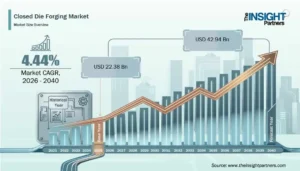
The global closed die forging market is witnessing sustained long-term expansion as demand accelerates across automotive, aerospace, defense, and heavy equipment sectors. According to comprehensive industry analysis, the Closed Die Forging Market was valued at US$ 22.38 Billion in 2025 and is projected to reach US$ 42.94 Billion by 2040, expanding at a CAGR of 4.44% during 2026–2040.
Closed die forging, also known as impression die forging, remains a foundational manufacturing technique for producing high-strength, load-bearing metal components. By enclosing heated metal inside customized die impressions under immense hydraulic or mechanical pressure, manufacturers achieve superior structural integrity, refined grain structures, and exceptional fatigue resistance compared to traditional casting or machining methods.
Key Drivers Fueling Market Growth
The global transition toward high-performance, lightweight, and durable industrial components is significantly driving closed die forging volume worldwide:
-
Aerospace and Defense Expansion: Commercial aircraft fleet modernization, record OEM backlogs (such as Boeing and Airbus), and heightened global defense budgets rely heavily on closed-die forged structural components, turbine discs, and landing gear manufactured from titanium, nickel superalloys, and advanced aluminum alloys.
-
Automotive Sector Demand: High-volume automotive manufacturing continues to represent a major share of impression die forging output, particularly for critical drivetrain, suspension, steering, and engine components. The rise of hybrid and electric vehicles (EVs) is also shifting component designs toward lightweight, high-integrity precision forgings to handle increased mechanical stress.
-
Heavy Machinery & Energy Sector Investments: Infrastructure development, agricultural machinery expansion, and global energy transition projects (wind, oil & gas, power generation) require heavy-duty forged valves, shafts, and structural connectors engineered for severe operational environments.
Get a PDF Sample- https://www.theinsightpartners.com/sample/TIPRE00026903
Market Leaders & Competitive Landscape
The global closed die forging landscape features a strong presence of established industrial giants and specialized metallurgy leaders. Key players operating in the market include:
-
ANDRITZ AG
-
Bharat Forge Limited
-
ATI Inc.
-
EQI Ltd.
-
Riganti S.p.A.
-
SIFCO Industries, Inc.
-
The VIVA Forging Company
-
Densen Group
-
Forged Solutions Group
-
Henan Chalco Aluminum Co., Ltd.
These key market participants are actively investing in plant automation, strategic OEM partnerships, capacity expansion, and high-precision heat-treatment capabilities to secure long-term component supply agreements across defense, aviation, and automotive channels.
Future Outlook: Technology Integration & Decarbonization
The future outlook for the closed die forging industry hinges on digital transformation, material innovations, and sustainable manufacturing practices:
1. Industry 4.0 & Smart Forging Cells
Forging facilities are increasingly integrating automated robotic handlers, real-time sensor monitoring, and digital process simulation. Predictive process control allows manufacturers to optimize die life, achieve near-net-shape accuracy, and minimize material scrap, significantly driving operational margins.
2. Sustainable and Low-Carbon Metalworking
Decarbonization initiatives across global supply chains are encouraging forge shops to adopt energy-efficient induction heating systems, modernized thermal control techniques, and scrap-recycling initiatives. OEMs in North America and Europe are systematically selecting suppliers capable of providing lower carbon intensity and documented metallurgical lifecycle efficiency.
3. Advanced Alloys and Hybrid Material Capabilities
As next-generation propulsion, space exploration, and defense systems demand higher thermal and mechanical tolerance, closed die forging suppliers are shifting focus toward complex nickel-based superalloys, high-temperature titanium, and high-strength aluminum grades. Companies offering fully integrated value chains—combining raw metal forging with precision CNC machining, heat treatment, and non-destructive testing—will capture the highest market share moving toward 2040.
Regional Insights
Asia-Pacific continues to maintain a dominant share of market volume, underpinned by major automotive manufacturing hubs in India and China, alongside growing defense production capacities. North America and Europe follow closely, led by high-value aerospace applications, defense modernization programs, and localized supply chain strategies designed to mitigate geopolitical disruption.
Related Reports-
Aerospace Forging Market Trends, Growth Factors and Forecast 2034
About The Insight Partners
The Insight Partners is a leading market research and consulting firm delivering actionable insights through in-depth industry analysis and strategic intelligence. The firm supports clients across various industries in making informed decisions by providing comprehensive market forecasts, competitive assessments, and growth opportunities.
Contact Us:
If you have any queries about this report or if you would like further information, please contact us:
Contact Person: Ankit Mathur
E-mail: sales@theinsightpartners.com
Phone: +1-646-491-9876
Also Available in : Korean|| German| Japanese| French| Chinese| Italian| Spanish