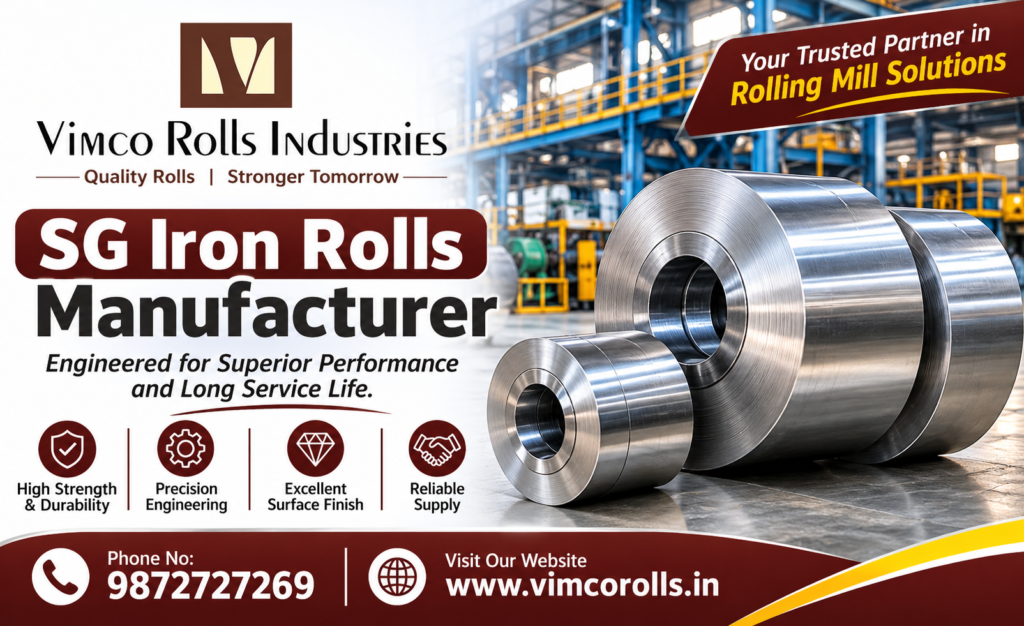
The steel manufacturing industry depends on precision, durability, and consistent production quality. Every component used in a rolling mill contributes to the overall efficiency of the manufacturing process. Among these components, industrial rolls play an essential role in shaping steel products, maintaining dimensional accuracy, and supporting continuous production. Selecting an experienced sg iron rolls manufacturer is therefore an important decision for steel producers looking to achieve reliable rolling performance.
Vimco Rolls focuses on manufacturing industrial rolls for steel rolling applications, with an emphasis on material quality, manufacturing precision, and application-specific requirements. Understanding the characteristics of SG iron rolls can help steel manufacturers make better decisions when selecting suitable rolling mill components.
Understanding SG Iron Rolls
Spheroidal Graphite Iron, commonly known as SG iron or ductile iron, is a type of cast iron in which graphite appears in a spherical or nodular form. This distinctive microstructure gives the material a useful combination of strength, toughness, and wear resistance.
SG iron rolls are designed for rolling mill applications where mechanical strength and resistance to operating stresses are important. Their properties depend on chemical composition, casting techniques, cooling conditions, and heat-treatment processes.
Compared with conventional grey cast iron, SG iron generally offers improved ductility and tensile strength because of its graphite structure. These characteristics make it a valuable material for specific industrial roll applications.
Importance of Choosing a Reliable Manufacturer
The quality of a rolling mill roll depends significantly on the manufacturer’s technical capabilities and production practices. A professional sg iron rolls manufacturer understands that every rolling mill operates under different conditions and requires suitable roll specifications.
Manufacturers must carefully consider material selection, casting quality, hardness requirements, machining accuracy, and inspection procedures. Even small variations in these areas can influence the performance and service life of a roll.
A reliable manufacturer should focus on:
- Consistent raw material selection and composition.
- Controlled casting and solidification processes.
- Appropriate heat-treatment procedures.
- Accurate machining and dimensional tolerances.
- Hardness and quality inspections.
- Product specifications suited to customer requirements.
These manufacturing considerations help ensure that rolls are suitable for their intended operating environments.
Key Advantages of SG Iron Rolls
SG iron rolls offer several useful characteristics for industrial rolling operations. Their suitability depends on the grade, manufacturing process, and application.
1. High Mechanical Strength
The nodular graphite structure contributes to the strength of SG iron. This makes it suitable for applications involving repeated mechanical loading and demanding operating conditions.
2. Good Toughness
SG iron generally provides better toughness than conventional grey cast iron. This characteristic helps the material withstand mechanical stresses encountered during rolling operations.
3. Wear Resistance
Depending on the selected grade and metallurgical structure, SG iron rolls can provide suitable resistance to surface wear. This helps support consistent performance in applications where roll surfaces experience repeated contact with steel products.
4. Manufacturing Flexibility
Different SG iron grades can be developed to meet specific hardness and mechanical-property requirements. This flexibility allows manufacturers to consider different rolling mill applications.
5. Consistent Production Support
When properly manufactured and maintained, SG iron rolls can contribute to stable rolling operations and predictable maintenance planning.
Manufacturing Process and Quality Control
Producing dependable SG iron rolls requires technical knowledge and careful control throughout the manufacturing process.
The process begins with the selection of suitable raw materials and alloying elements. The chemical composition must be controlled to achieve the required metallurgical characteristics. During the casting stage, proper temperature management and treatment practices are important for obtaining the desired graphite structure.
After casting, heat treatment may be performed to develop the required mechanical properties. Machining operations then bring the roll to its specified dimensions and surface finish.
Quality inspection is equally important. Depending on the product specification, checks may include dimensional measurements, hardness testing, surface inspection, and internal-defect evaluation.
An established sg iron rolls manufacturer understands that quality should be monitored throughout production rather than evaluated only after the finished roll is manufactured.
Applications of SG Iron Rolls in the Steel Industry
SG iron rolls are used in selected rolling mill applications where their combination of strength, toughness, and wear characteristics meets operational requirements.
Their application depends on several factors, including:
- Type of rolling mill.
- Steel grade being processed.
- Rolling speed and temperature.
- Required reduction levels.
- Cooling and lubrication conditions.
- Roll dimensions and design specifications.
Choosing the correct roll material according to these operating parameters can help improve production consistency and reduce unnecessary maintenance interruptions.
Steel manufacturers should consult technical specialists before selecting a particular SG iron grade to ensure that its properties match the actual working conditions.
Why Consider Vimco Rolls?
Vimco Rolls serves the industrial roll manufacturing sector with a focus on the requirements of steel rolling mills. Understanding the importance of material characteristics, manufacturing accuracy, and application suitability is essential when developing industrial roll solutions.
For businesses searching for an experienced sg iron rolls manufacturer, evaluating manufacturing capabilities and technical specifications is more valuable than considering price alone.
Before placing an order, buyers should discuss roll dimensions, required hardness, operating conditions, material specifications, and quality expectations with the manufacturer. Clear technical communication helps establish suitable product requirements and supports better purchasing decisions.
Conclusion
SG iron rolls are valuable industrial components because of their combination of strength, toughness, and application-dependent wear resistance. Their performance depends on metallurgical quality, controlled manufacturing, accurate machining, and appropriate maintenance.
Choosing the right sg iron rolls manufacturer can make a meaningful difference in maintaining rolling mill reliability and production consistency. Vimco Rolls recognizes the importance of manufacturing quality and application-oriented roll solutions for the steel industry.
For steel producers looking to select suitable industrial rolls, understanding material properties and working with a technically capable manufacturer are important steps towards achieving dependable rolling mill performance.