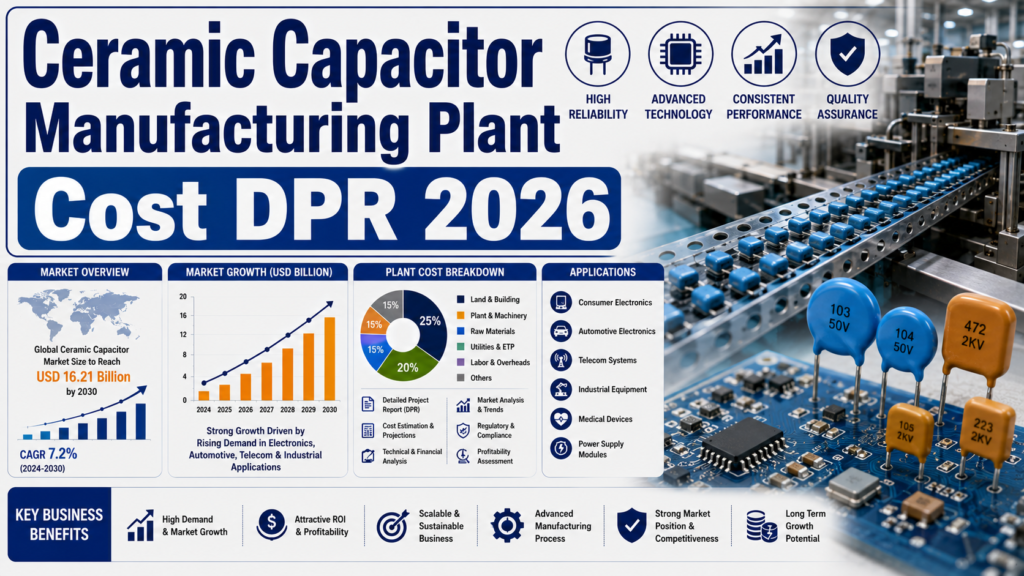
Setting up a ceramic capacitor manufacturing plant involves a series of controlled processes including ceramic powder preparation, tape casting or screen printing, stacking and lamination, co-firing/sintering, electrode termination, and testing and packaging. Key equipment includes ball mills, tape casters, screen printers, hydraulic presses, tunnel kilns, termination equipment, and automated electrical testing systems. Since this is precision electronics manufacturing facility, maintaining ultra-clean production environments, stringent quality control systems, and compliance with electronic component safety standards is critical. Additionally, evaluating the ceramic capacitor plant project report is essential for understanding capital investment, machinery requirements, operational efficiency, and long-term profitability in this rapidly growing ceramic capacitor market.
The ceramic capacitor manufacturing industry is expected to witness strong growth through 2026, driven by surging demand from consumer electronics, automotive electronics, 5G telecommunications infrastructure, EV/hybrid vehicles, IoT devices, and data center applications. The escalating miniaturization of electronic components and the widespread adoption of multilayer ceramic capacitors (MLCCs) across virtually every electronic device category are key forces shaping the industry’s expansion.
IMARC Group’s report, titled “Ceramic Capacitor Manufacturing Plant Project Report 2026: Industry Trends, Plant Setup, Machinery, Raw Materials, Investment Opportunities, Cost and Revenue,” provides a complete roadmap for setting up a ceramic capacitor manufacturing plant. It covers a comprehensive market overview to micro-level information such as unit operations involved, raw material requirements, utility requirements, infrastructure requirements, machinery and technology requirements, manpower requirements, packaging requirements, transportation requirements, etc.
Request for a Sample Report: https://www.imarcgroup.com/ceramic-capacitor-manufacturing-plant-project-report/requestsample
Ceramic Capacitor Industry Outlook 2026
The ceramic capacitor market is driven by the escalating demand for consumer electronics such as smartphones, tablets, and laptops, and rapid advancements in automotive electronics including infotainment systems, advanced driver-assistance systems (ADAS), and electric vehicles. The rising adoption of renewable energy sources, expanding telecommunications sector, and the increasing use of ceramic capacitors in network equipment and 5G base stations are additional key contributors to market growth.
The growing focus on Internet of Things (IoT)-based devices, integration of ceramic capacitors in smart home systems and wearable electronics, surging data center and cloud computing infrastructure requirements, and expanding aerospace and defense sectors are further bolstering market growth. Burgeoning investments in R&D activities to enhance capacitor performance, reliability, and efficiency are propelling the market, alongside the introduction of strict regulations and standards for electronic components’ safety.
However, challenges such as raw material (barium titanate and rare earth elements) price volatility, high precision manufacturing requirements, significant capital investment in cleanroom facilities and specialized equipment, dependence on highly skilled technical labor, and geopolitical supply chain concentration risks may influence production costs and strategic investment decisions for new plant setups.
Key Insights for Setting Up a Ceramic Capacitor Manufacturing Plant
Detailed Process Flow
- Product Overview
- Unit Operations Involved
- Mass Balance and Raw Material Requirements
- Quality Assurance Criteria
- Technical Tests
Project Details, Requirements and Costs Involved
- Land, Location and Site Development
- Plant Layout
- Machinery Requirements and Costs
- Raw Material Requirements and Costs
- Packaging Requirements and Costs
- Transportation Requirements and Costs
- Utility Requirements and Costs
- Human Resource Requirements and Costs
Capital Expenditure (CapEx) and Operational Expenditure (OpEx) Analysis
Project Economics
- Capital Investments
- Operating Costs
- Expenditure Projections
- Revenue Projections
- Taxation and Depreciation
- Profit Projections
- Financial Analysis
Profitability Analysis
- Total Income
- Total Expenditure
- Gross Profit
- Gross Margin
- Net Profit
- Net Margin
Key Cost Components
- Raw Materials: The primary cost driver, including barium titanate (BaTiO3) as the key dielectric material, nickel or precious metal pastes for internal electrodes, copper or silver-palladium for external terminations, and specialty ceramic additives — all essential for high-quality ceramic capacitor production.
- Energy Costs: Ceramic capacitor manufacturing is energy-intensive, especially during sintering and co-firing stages in high-temperature tunnel kilns operating above 1,000-1,300°C, requiring significant electricity and fuel.
- Machinery and Equipment: Capital investment in ball mills, tape casters, screen printing systems, lamination presses, tunnel kilns, termination lines, electrical testing systems (LCR meters, withstanding voltage testers), and cleanroom infrastructure, along with ongoing maintenance costs.
- Labor: Includes salaries, training, and benefits for highly skilled engineers, process technicians, quality control specialists, and production workers required for precision ceramic capacitor manufacturing.
- Utilities: Costs for cleanroom HVAC systems, deionized water, compressed air, nitrogen atmosphere systems, and other utilities essential for continuous, contamination-free production.
- Packaging and Transportation: Expenses related to tape-and-reel packaging, embossed carrier tape, reel storage, and distributing finished ceramic capacitors to electronics manufacturers and component distributors worldwide.
- Depreciation and Financing: Depreciation of high-precision fixed assets including kilns, cleanroom systems, and automated testing equipment, along with interest or repayment obligations for loans or capital investment in plant setup.
- Compliance and Safety: Investment in ISO/TS 16949, AEC-Q200, RoHS/REACH compliance systems, ESD-safe manufacturing environments, and waste treatment for ceramic slurry and chemical effluents.
- Overheads: Administrative costs including insurance, office operations, licensing, R&D for new dielectric formulations, marketing, and general plant management.
Economic Trends Influencing Ceramic Capacitor Plant Setup Costs 2026
Barium Titanate & Rare Earth Material Price Volatility: As barium titanate, nickel, and rare earth dopants are the primary raw materials for ceramic capacitor manufacturing, fluctuations in global mining output and geopolitical supply constraints directly impact both capital and operating costs. Supply concentration in China for many dielectric precursors makes global pricing particularly sensitive.
5G & EV Infrastructure Demand Surge: The accelerating global rollout of 5G networks and mass adoption of electric vehicles are creating unprecedented demand for high-capacitance MLCCs. This demand surge is incentivizing new capacity investments but also driving competition for raw materials and skilled manufacturing talent, pushing up input costs.
Inflation & Interest Rates: Rising inflation inflates the cost of building materials, cleanroom construction, specialized labor, and imported machinery, while higher interest rates increase the cost of loans and financing needed for plant construction, equipment procurement, and commissioning of ceramic capacitor production lines.
Government Subsidies & Semiconductor Policy: National semiconductor and electronics manufacturing incentive programs in the US (CHIPS Act), EU, Japan, India, and South Korea are actively subsidizing domestic electronic component production facilities, including ceramic capacitor plants, through grants, tax credits, and low-interest financing, significantly reducing setup costs for qualifying investors.
Technological Advancements: Innovations in ultra-thin dielectric layer technology, high-layer-count MLCC stacking, base metal electrode (BME) formulations, and automated optical inspection (AOI) systems can increase upfront CapEx but offer significant productivity gains, improved capacitance density, and lower per-unit costs, substantially enhancing long-term ROI.
Supply Chain Localization: Geopolitical tensions and COVID-era supply chain disruptions have accelerated efforts by electronics OEMs to diversify their ceramic capacitor supply chains away from East Asian concentration. This is driving new plant investments in North America, Europe, India, and Southeast Asia, creating greenfield opportunities in regions with developing component manufacturing ecosystems.
Labor Market Considerations: Shortages of process engineers, materials scientists, and skilled technicians with expertise in ceramic dielectric formulation and precision MLCC manufacturing are driving up wages in established electronics manufacturing regions, or alternatively requiring significant investment in training programs at greenfield locations.
Speak to an Analyst for Customized Report: https://www.imarcgroup.com/request?type=report&id=9180&flag=C
Challenges and Considerations for Investors
- Raw Material Concentration Risk: Ceramic capacitor manufacturing relies heavily on barium titanate and specialty rare earth elements, with significant production concentrated in China. Geopolitical disruptions or export restrictions can severely impact raw material availability and pricing, creating supply chain vulnerability.
- High Capital Intensity & Precision Requirements: Establishing a ceramic capacitor plant requires substantial investment in cleanroom facilities, high-temperature kilns, ultra-precision lamination and tape casting equipment, and automated electrical testing systems. The extreme precision requirements at microscopic scales make initial setup technically demanding and capital-intensive.
- Cleanroom & Environmental Controls: Ceramic capacitor manufacturing requires controlled environments to prevent contamination of ultra-thin dielectric layers. Maintaining ISO-class cleanrooms and stable temperature/humidity conditions adds significantly to both capital and ongoing operational costs.
- Intense Market Competition: The global ceramic capacitor market is dominated by major Japanese, Korean, and Chinese manufacturers including Murata, TDK, Samsung Electro-Mechanics, Yageo, and Walsin. New entrants must achieve exceptional quality consistency and competitive pricing to penetrate established supply chains.
- Technology Obsolescence Risk: Rapid advancements in MLCC technology require continuous R&D investment to remain competitive. The transition to increasingly smaller component sizes (0201, 01005) and higher capacitance values demands regular equipment upgrades and process innovation.
- Quality & Reliability Standards: Electronic component buyers, particularly in automotive and defense sectors, impose extremely stringent qualification processes (AEC-Q200, MIL-SPEC). Achieving and maintaining these certifications requires significant ongoing investment in quality assurance systems and testing infrastructure.
- Skilled Workforce Scarcity: Ceramic capacitor manufacturing requires highly specialized knowledge in materials science, ceramic processing, and precision electronics manufacturing. Attracting and retaining qualified process engineers and technicians represents a significant ongoing operational challenge.
- Environmental & Waste Management: Processing ceramic slurries, solvents, and chemical binders generates regulated waste streams requiring compliant treatment and disposal systems. Increasing environmental regulations on electronic manufacturing effluents may elevate compliance costs for new plant setups.
Latest Industry Developments
- 2025: Leading MLCC manufacturers including Murata Manufacturing and TDK Corporation announced capacity expansion programs in response to surging demand from EV and 5G infrastructure markets, with new production lines targeting high-capacitance automotive-grade MLCCs meeting AEC-Q200 Rev D standards.
- 2024-2025: Samsung Electro-Mechanics and Yageo accelerated development of ultra-thin dielectric layer MLCCs with layer counts exceeding 1,000 layers, enabling higher capacitance in smaller case sizes (0201 and 01005) to meet miniaturization demands from wearables and advanced smartphone designs.
- 2024: Several national governments, including India’s PLI scheme expansion and US CHIPS Act supplementary funding rounds, included passive electronic components such as ceramic capacitors in domestic manufacturing incentive programs, attracting new greenfield plant investment proposals from international component manufacturers.
About Us
IMARC Group is a global management consulting firm that helps the world’s most ambitious changemakers to create a lasting impact. The company excels in understanding its client’s business priorities and delivering tailored solutions that drive meaningful outcomes. We provide a comprehensive suite of market entry and expansion services. Our offerings include thorough market assessment, feasibility studies, company incorporation assistance, factory setup support, regulatory approvals and licensing navigation, branding, marketing and sales strategies, competitive landscape, and benchmarking analyses, pricing and cost research, and procurement research.
Contact Us
IMARC Group
134 N 4th St. Brooklyn, NY 11249, USA
Email: sales@imarcgroup.com
Tel No: (D) +91 120 433 0800
United States: +1-631-791-1145