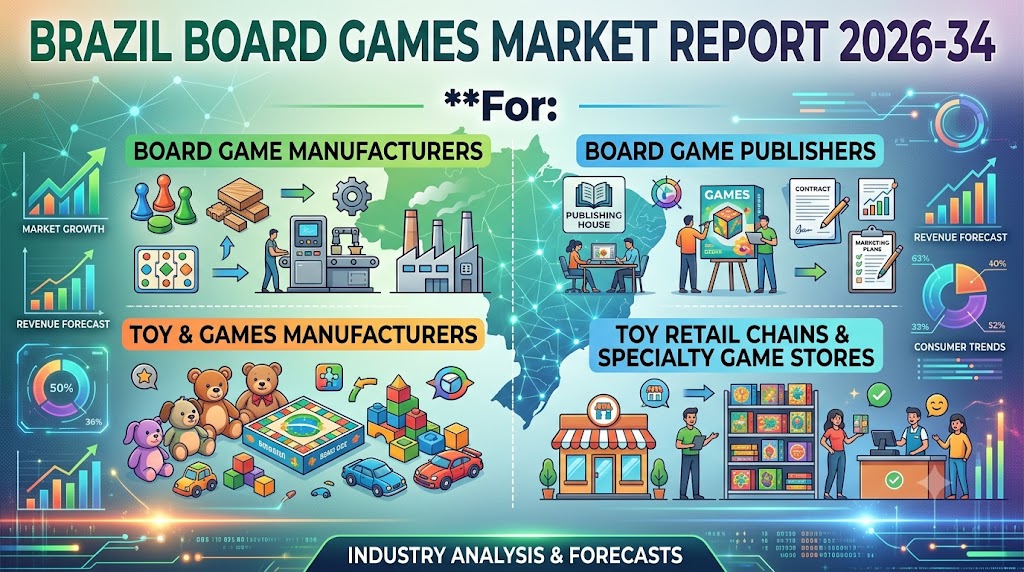
According to authoritative research from the IMARC Group report on the Brazil Board Games Market, the domestic tabletop gaming sector has achieved immense commercial scale. The market valuation officially reached USD 344.97 Million in 2025, solidifying its position as the largest and most influential tabletop market in South America.
Reflecting an accelerating demand for tangible social engagement and premium hobbyist entertainment, the industry is projected to scale significantly over the next decade. By the year 2034, the market size is forecasted to reach USD 783.31 Million. This exceptional expansion represents a steady, robust compound annual growth rate (CAGR) of 9.54% during the strategic forecast period spanning 2026-2034.
Key Market Growth Drivers:
The rapid expansion of the board games industry across Brazil is fueled by four interconnected macroeconomic and cultural drivers:
- Hobbyist Culture Expansion
Brazil’s hobby gaming community is expanding at an exponential rate. This movement is anchored by massive, high-profile public gatherings such as Diversão Offline—widely celebrated as one of Latin America’s largest dedicated tabletop conventions—and the Brasil Game Show, where physical tabletop gaming zones continue to draw record crowds.
Simultaneously, the democratization of game funding via domestic crowdfunding platforms like Catarse has fundamentally lowered entry barriers for independent creators. This active crowdfunding ecosystem has enabled the direct launch of numerous locally developed board games, allowing Brazilian game designers to pitch original mechanics directly to an enthusiastic consumer base willing to pre-order and finance print runs.
- E-Commerce and Digital Retail Acceleration
The optimization of online logistics networks has radically transformed product accessibility beyond Brazil’s major metropolitan areas. E-commerce channels have become increasingly vital, with dominant marketplaces like Mercado Livre and Amazon Brazil expanding their tabletop catalogs significantly.
Digital retail effectively removes geographical barriers, allowing consumers living in Tier-2 and Tier-3 cities to access premium, specialized, or imported titles that rarely find shelf space in conventional toy stores. Furthermore, specialized hobby e-tailers like Loja Galápagos and BG Express have optimized the online buying experience for enthusiasts by offering robust preorder mechanics, dynamic search filters, and dependable regional delivery networks.
- Family and Social Gaming Demand
In an era dominated by digital fatigue, board games are gaining massive popularity as a premier medium for interactive, screen-free entertainment among Brazilian families. Modern card and dice games, cooperative adventures, and strategy titles offer a rare opportunity for intergenerational engagement.
Classic titles like Banco Imobiliário, Uno, Detetive, Imagem & Ação, and War remain deeply embedded in the cultural fabric, serving as vital anchors across mass-market retail channels. As families look to foster cognitive development and shared experiences, the demand for accessible, high-replayability family games continues to climb.
Key Market Segmentation:
The contemporary tabletop market caters to a vast spectrum of age demographics and consumer preferences. The market is structurally categorized across the following core segments:
Breakup by Age Group:
- Above 12 Years: The absolute dominant segment in the market, commanding a powerful 46.3% market share in 2025. This large share directly reflects Brazil’s mature hobbyist base and adult fan community. This cohort drives high-value transactions, investing heavily in complex Euro-style strategy games, immersive role-playing games (RPGs), and intricate miniature systems that command premium retail prices.
- 5–12 Years: Accounting for 28.7% of total market demand in 2025. This segment is heavily driven by parental investments in family-oriented purchases and school-based educational board games designed to reinforce core learning outcomes.
- 2–5 Years: Holding a 17.5% market share in 2025. This category focuses on early-childhood cognitive development, relying on simple, visually striking, and tactile games centered on matching, color identification, and basic cooperative play.
- 0–2 Years: Representing 7.5% of the market in 2025, consisting primarily of soft, highly tactile developmental products designed for infant sensory exploration.
Breakup by Distribution Channel:
- Specialty Stores: The leading distribution channel, capturing a commanding 33.4% market share in 2025. Specialty hobby shops thrive by operating as experiential retail spaces, combining curated product catalogs with in-store demos, board game cafés, and organized weekly tournament play that drive highly lucrative per-customer transaction values.
- Supermarkets and Hypermarkets: Accounting for 29.6% of market share in 2025. This channel remains the undisputed stronghold for mass-market impulse buys and classic family titles, with major retail chains like Carrefour, Grupo Pão de Açúcar, and Extra Hipermercados allocating prominent shelf space to high-volume domestic classics.
- Online Stores: Representing 25.7% of the market in 2025, this is the fastest-growing retail segment, expanding at an estimated 11.8% CAGR through 2034 due to the superior pricing transparency, vast inventory depth, and logistical reach of major e-commerce platforms.
- Others: Comprising 11.3% of the market in 2025, including conventional bookstores (such as Livraria Cultura), independent gift boutiques, and direct-to-consumer fulfillment via crowdfunding platforms.
Sample Request For Your Business
Regional Market Insights: Breakup by Major Territories
The consumer density, retail infrastructure, and community events driving the board game economy are distributed across Brazil’s distinct geographic territories:
- Southeast (45.8% Revenue Share in 2025): The undisputed economic anchor of the Brazilian market. Driven by high disposable incomes and a dense concentration of urban centers like São Paulo and Rio de Janeiro, the region hosts more than 60 specialized hobby stores within its metropolitan corridors. It also serves as the corporate headquarters for industry titans like Galápagos Jogos and Grok Games, and acts as the geographic hub for major conventions like Diversão Offline.
- South (19.6% Revenue Share in 2025): A highly stable tabletop ecosystem supported by an active network of gaming clubs in cities like Curitiba and Porto Alegre. The region exhibits a distinct preference for complex Euro-style strategy games, a trend heavily influenced by regional European immigrant heritage.
- Northeast (15.7% Revenue Share in 2025): Recognized as the fastest-growing region in the country. The rapid expansion of e-commerce delivery logistics has unlocked substantial unpenetrated headroom, allowing hobbyist titles to flow seamlessly into expanding consumer bases in Salvador, Recife, and Fortaleza.
- Central-West (10.4% Revenue Share in 2025): Driven by the administrative population of Brasília and strong institutional demand for school-based educational programs, alongside a growing retail footprint in Goiânia.
- North (8.5% Revenue Share in 2025): Overcoming historical logistical and transit challenges via advanced online retail networks, this region focuses primarily on family and educational gaming segments while utilizing localized trade advantages within the Manaus Free Trade Zone.
Competitive Landscape:
The operational environment within the Brazil board games market features moderate concentration at the top, balanced by a vibrant, highly fragmented long tail of independent local publishers. Brand equity is heavily dictated by exclusive licensing access, localization capabilities, and strong community engagement. The major enterprise players leading the market include:
- Asmodee Brasil (Galápagos Jogos): The undisputed market leader. Operating through Galápagos Jogos (founded in 2009 and later acquired by global giant Asmodee Group), the company commands a massive licensed catalog and unmatched Portuguese localization scale, distributing global blockbusters alongside elite RPG systems.
- Grok Games: Formed via a strategic 2018 merger between Mandala Jogos and the hobby division of Grow Jogos, Grok is a dominant force specializing in localizing advanced Euro-style strategy titles while actively developing and exporting original Brazilian-designed IP.
- Devir Brasil (Devir Livraria): A pioneering pillar of the Brazilian tabletop scene operating since the 1990s. Devir leverages a massive Iberian-Latin American distribution network, maintaining strong market share via accessible gateway games, hit graphic novels, and dominant domestic RPG titles like Tormenta20.
- The Estrela Brinquedos Store: An iconic mass-market retail establishment commanding immense multi-generational brand loyalty, dominating supermarket shelves with household classics like Banco Imobiliário and Cara a Cara.
- Grow Store: A premier legacy brand anchoring the family and impulse purchase segments, maintaining widespread retail presence via staple titles like War and Imagem & Ação.
Recent News and Emerging Market Trends:
Strategic investments, innovative intellectual property management, and experience-led retail models are accelerating the industry’s maturation:
- Market Consolidation and IP Acquisitions
The consolidation of the market under major global networks continues to accelerate. In a notable corporate development in February 2026, Asmodee Brasil officially acquired the globally renowned title Sheriff of Nottingham from CMON. This strategic acquisition marks Asmodee’s third high-profile IP purchase from CMON within a brief eight-month window, following the successful integration of massive franchises like Zombicide and Cthulhu: Death May Die. Sheriff of Nottingham will be integrated into the Z-Man Games portfolio, substantially strengthening Asmodee’s local social deduction and bluffing game offerings as CMON restructures its global assets.
- Premium Euro-Style Localizations
Publishers are continuously responding to a growing demand for deep, complex strategy gaming. Highlighting this trend, Grok Games officially released Shackleton Base: Uma Jornada para a Lua in Brazil in 2026. This intricate, advanced Euro-style strategy game challenges players to manage lunar base development, reinforcing Grok’s strategic focus on delivering high-weight, mechanically dense international titles directly to Brazil’s core hobbyist segment.
- Local Manufacturing Investments and the Return of RPGs
To counteract severe import tax burdens (including IPI and ICMS) and currency volatility involving the Brazilian Real, the industry is witnessing historical shifts in production. Panda Game Manufacturing formed a joint venture with domestic printer Kawagraf, establishing the first major foreign investment in localized Brazilian board game production to support high-quality cardboard, paper, and wooden components domestically. Simultaneously, the role-playing community received a major boost as Galápagos officially brought Dungeons & Dragons (5th Edition) back to Brazil in 2025, successfully resolving prior international distribution gaps.
About Us:
IMARC Group is a global management consulting firm that helps the world’s most ambitious changemakers to create a lasting impact. The company provide a comprehensive suite of market entry and expansion services. IMARC offerings include thorough market assessment, feasibility studies, company incorporation assistance, factory setup support, regulatory approvals and licensing navigation, branding, marketing and sales strategies, competitive landscape and benchmarking analyses, pricing and cost research, and procurement research.
Contact Us:
IMARC Group‚
134 N 4th St‚ Brooklyn‚ NY 11249‚ US
Email: sales@imarcgroup․com
Tel No: (D) +91 120 433 0800
United States: (+1–201–971–6302)