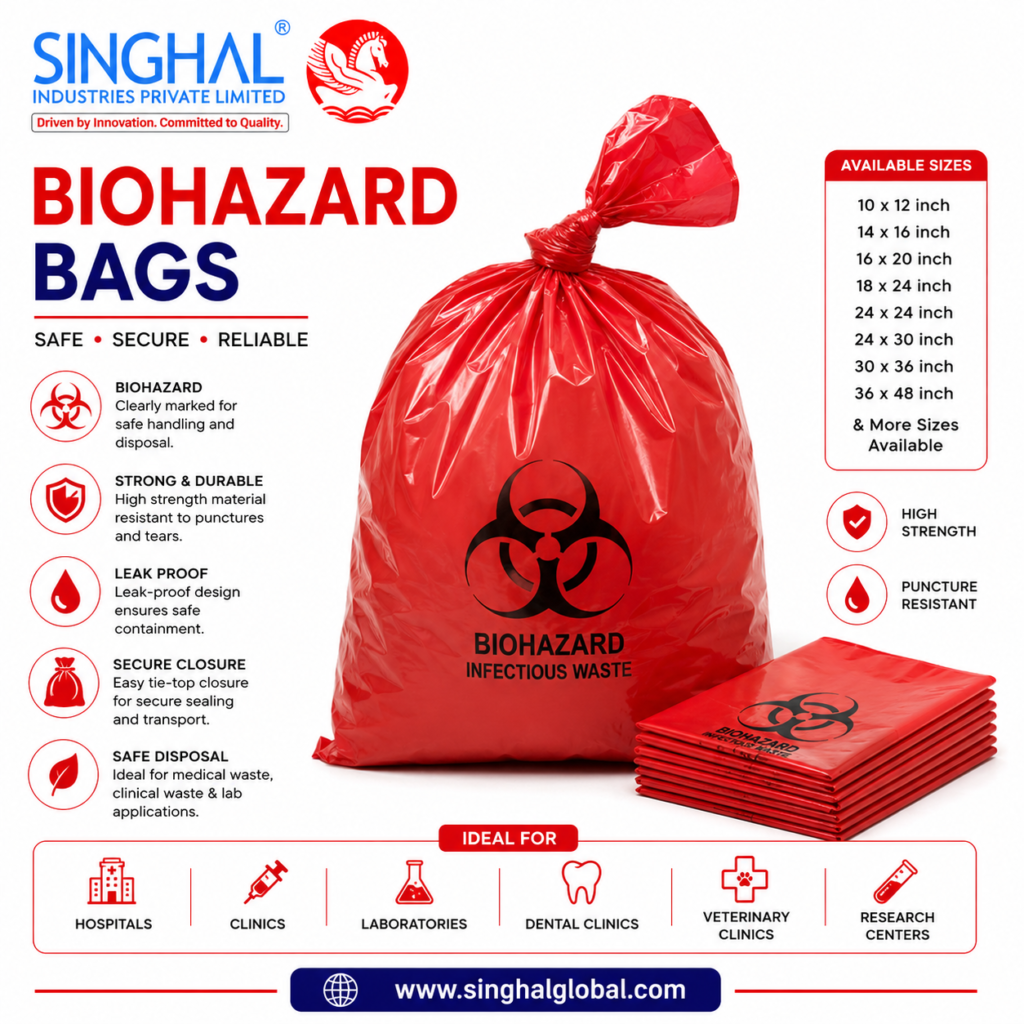
Medical waste is not considered regular waste. It can include blood, bodily fluids, dressings, sharps, laboratory specimens, and other infectious materials. The combination of this waste with general waste can pose serious hazards to the health and safety of patients, employees, cleaners, and waste carriers. The use of biohazard bags by hospitals and other healthcare institutions ensures that medical waste is segregated as soon as it is produced. A trusted Biohazard Bags Manufacturer like Singhal Industries Private Limited offers biohazard bags for safe medical waste management in India.
Importance of Segregation
Segregation involves sorting out different types of wastes at the point of origin. In a hospital, clinic, laboratory or diagnostic facility, the biomedical waste needs to be sorted and put in the right container or bag when it is generated. According to Indian guidelines on biomedical waste, waste should be segregated at the point of generation prior to storing, transporting, treating, and disposing of.
Why is this so crucial? This is because not all medical waste poses an equal level of danger. Office waste is not similar to infectious clinical waste. Puncture-proof bags are needed for sharp objects while regular bags will do for some other wastes. Mixing of wastes makes it difficult to handle them safely.
Role of Biohazard Bags
A biohazard bag is a special kind of bag that collects and contains biomedical waste. It is normally colour-coded and labelled with biohazard warning signs, and is designed in such a way that makes it resistant to tears and leakage. The role of the bag is very simple – to ensure that hazardous waste is separated from ordinary waste.
But the biohazard bag alone cannot do much if the people handling biomedical waste use it in the wrong manner and with the wrong type of waste. For instance, hazardous materials such as sharps such as needles, blades, and broken glasses should never be put inside a bag.
Principles of Colour Coding
Colour coding is one of the most essential components of the separation of medical waste. Colours enable healthcare workers to recognize easily the type of the waste. Yellow bags/containers are widely used in India to identify certain biomedical waste types, while other types of biomedical waste are red, white/translucent, and blue-coded.
Employees must be trained in recognizing these colour codes. The nurse, laboratory technician, cleaning person, or waste disposal handler will not need to guess where the used dressing or any other potentially infectious material should be placed. Labelling and posting, as well as adequate training of employees, will prevent errors. The mixing of biomedical waste and general waste is another issue that should be avoided because the contamination of large amounts of waste will result from it.
The Importance of Selecting Appropriate Biohazard Bags
Biohazard bags are not universal; they differ in a number of aspects. It is important to consider their size, thickness, durability, sealing ability, leak-proof quality, and suitability for the institution’s waste collection system. An inadequate bag can be either too small to withstand the load and burst open, or be too thin to sustain damages when transporting the wastes.
It is essential for a reliable Biohazard Bags India to provide high-quality products and detailed product specifications. For instance, Singhal Industries Private Limited is one of the best biohazard bags manufacturers in India. This company offers special bags for healthcare waste management. The quality control protocol in Singhal is extremely strict and complies with ISO 9001:2015 and ISO 13485:2016.
Handling and Storage
The most durable bag will not be able to protect one from any incidents in case of improper handling. It is recommended for the staff to use proper personal protective equipment like gloves, masks, aprons, gowns, and boots where necessary. Waste needs to be put into sealed containers and transported with extreme care to the central storage facility. Time of storage needs to be minimized so that transportation, processing, and disposal could take place within the required timeframe.
It is also important to label bags and containers with relevant information: date, kind of waste, volume, information about the sender and recipient. Barcode labels will allow tracking the waste up to its disposal. This will ensure responsibility and identification of possible issues with a bag.
Training and Awareness of Staff
Most of the waste management issues occur not due to the use of poor bags but rather due to the ignorance on how to handle it. The training should be simple, practical and regular. The staff should know how to handle specific wastes using specific bags, how to safely seal a bag, what to do if a bag breaks or leaks and whom to alert in case of emergencies.
Responsibility assignment is also beneficial. In case there are assigned individuals who will collect specific categories of waste, then accountability will improve. Hospitals, clinics, laboratories, and diagnostic centers should sometimes review their waste disposal techniques. Small things like misplacing items into wrong bags can become big problems with repeated practice.
Compliance & Proper Disposal
Biohazard bags are a part of an overall compliance mechanism. In India, all biomedical wastes need to be disposed of as per the guidelines and colour codes applicable to them. The plastic bags for biomedical waste collection need to conform to the BIS standards or Plastic Waste Management Rules. Wastes need to be treated and disposed of in authorized common biomedical waste treatment facilities or captive facilities.
The facility needs to maintain record, measure the volume of waste, and use authorized waste handlers. This is not just about compliance and avoidance of any penalty. This is about safeguarding public health, worker safety, and environment. A reputed Biohazard Bags Manufacturer can help this process with good quality bags; however, the facility needs to comply with the procedures.
Conclusion
The use of biohazard bags in segregation of medical waste in houses is not applicable; however, when it comes to hospitals, clinics, laboratories, and diagnostics centers, they become crucial. They provide the ability to segregate infections and hazards in waste, minimizing any risks related to them and ensuring the safe disposal. The most effective results can be achieved in case of using appropriate bags, following color codes, training employees, labeling of the waste and its disposal via authorized routes. Singhal Industries Private Limited is a reliable Biohazard Bags Manufacturer in India, producing biohazard bags for effective medical waste management. Segregation is not complicated and requires persistence and appropriate equipment.
FAQ
Q1. Are biohazard bags appropriate for all kinds of medical waste?
No. Biohazard bags can be used only for some types of medical waste while sharp objects should be disposed of in a puncture-resistant box. There might be different colours for different types of waste.
Q2. What is the need to segregate the medical waste at the source itself?
Segregation of medical waste at its source reduces the danger of contamination, injuries, and improper disposal of the waste itself.
Q3. How should a health care facility examine the biohazard bags before purchasing them?
The facility should take into account such features as the strength, size, thickness, leak proofness, and labeling of the bags. Asking for samples before purchasing is not bad idea.
Q4. what manner shall the biohazard bags be stored before disposal?
These should be stored in closed and labeled receptacles. These should be kept for minimum period and then should be treated and disposed of through appropriate channels as per requirement.
Q5. Who is the largest Exporters of Biohazard Bags?
It cannot be determined who are the largest exporter as it may vary according to the production and period of reporting. Some of the major exporters in the world are from India. Singhal Industries Private Limited is one of the manufacturers and exporters of biohazard bags in India.