A crew is preparing a commercial courtyard in Houston for new pavers. The pallets arrive on Tuesday, but the delivery truck cannot enter the courtyard. The access route crosses soft ground, and excavation has not started.
Material handling determines how heavy products reach their staging and installation areas. Ground compaction determines whether the specified surface base can perform as intended. Poor coordination creates extra handling, damaged work, and delays.
Start With the Jobsite, Not the Equipment List
Before booking machinery, walk the site with drawings and a delivery plan. Measure gate openings, turning space, overhead clearances, and the distance between unloading points and work zones. Identify pedestrian routes that must remain open.
Document pallet weights, dimensions, load centers, destination points, and slopes. Check existing pavement, exposed soil, drainage, and recent moisture conditions. A paved entrance in Katy and a narrow corridor in Cypress may demand different approaches.
Ask three questions early: Can the delivery truck unload where planned? Is the travel route suitable for the selected machine and load? Will excavation or base construction change that route before materials are moved?
Check underground utilities before digging, and align rental dates with the actual sequence.
Moving Construction Materials Safely and Efficiently
Palletized pavers, packaged masonry products, and bagged concrete-related materials are easier to control when delivery, unloading, and staging are designed together. But “forklift” does not describe one machine suitable for every jobsite.
A conventional vertical-mast forklift can work well on an appropriate firm, level operating surface with sufficient clearance. A telehandler uses a telescopic boom to lift or place material at height or forward of the machine. Neither should be assumed suitable for unstable ground.
Capacity is more complicated than the biggest number on a listing. A forklift’s rated load is tied to its specified load center and configuration. On a telehandler, allowable load depends on the applicable load chart, boom angle, extension, attachment, and positioning. Maximum advertised capacity is not available at every reach.
Contractors comparing forklift rentals in Houston should provide the rental team with pallet weights, dimensions, placement height, required forward reach, and ground conditions—not simply ask for a particular lifting capacity.
Employers must ensure applicable operator training and evaluation. Plan pedestrian separation, overhead clearances, and machine-specific operating procedures.
Why Proper Base Compaction Matters Before Surface Installation
Once material staging is resolved, attention turns to the surface beneath the finished walkway or patio. A paver system relies on properly prepared subgrade and the specified base course. Loose aggregate can rearrange under loading, contributing to settlement, uneven joints, and corrective work.
Crews generally compact suitable base material in controlled lifts rather than placing a thick layer and assuming vibration will reach the bottom. Lift thickness, moisture, and acceptance criteria must follow project specifications. Moisture matters: material that is excessively wet or dry may resist effective densification.
Houston-area sites can contain clay-rich soils, sandy deposits, fill, or combinations of materials. Rain and poor drainage can change conditions quickly. Assess each site’s soil and water movement.
When Does a Plate Compactor Make Sense?
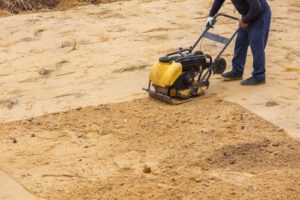
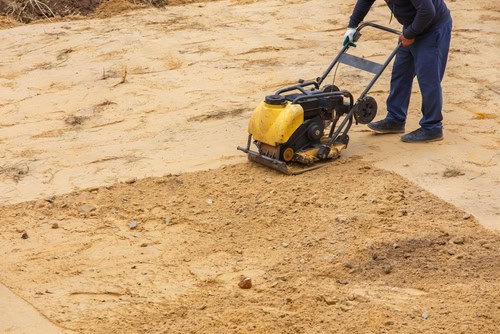
A vibratory plate compactor uses a vibrating base plate to help granular particles settle into a denser arrangement. It is commonly used for suitable crushed aggregate or gravel layers beneath pavers, pathways, and small hardscaped areas.
A forward plate compactor moves primarily in one direction and suits many relatively small, accessible work areas. A reversible plate travels in both directions and can be productive on larger applications. Equipment size and material conditions still govern the choice.
A rammer delivers concentrated impact and may be better suited to cohesive soils, including some clay or silt applications, especially in confined trenches. Larger rollers can be more productive on broad areas when site access and specifications allow. No plate compactor automatically meets every soil-density requirement.
For a small commercial walkway, contractors exploring plate compactor rental in Houston should compare plate size, base material, working width, lift thickness, and the project’s required compaction standard before selecting a unit.
Coordinating Material Handling and Ground Preparation
Start with plans and utility checks. Inspect access and ground support, organize deliveries, select lifting equipment, then excavate and prepare the subgrade and base. Compact the specified material in suitable lifts, verify acceptance as required, and proceed with bedding, paving, edge restraints, and inspections according to the design.
Consider a contractor replacing a courtyard walkway at an occupied Houston office complex. Palletized pavers may be delivered to a verified staging area beside the parking lot. Suitable material-handling equipment moves them to a safe location before excavation limits access. After excavation and drainage work, a plate compactor may prepare the specified granular base.
The crucial distinction is that a compacted paver base is not automatically an approved travel surface for a loaded telehandler. Heavy-machine ground-bearing capacity, buried structures, edge conditions, and route stability require separate evaluation.
Common Equipment Planning Mistakes That Delay Houston Projects
Choosing a lift by headline capacity. A telehandler can have sufficient nominal capacity but insufficient allowable capacity at the required reach. Check the load chart for the real load, attachment, and placement position.
Forgetting the access envelope. A machine may fit through a gate but lack room to turn with a pallet. Measure travel width, overhead obstacles, and maneuvering space with the load.
Treating every soil as granular. Repeated passes with a plate compactor will not correct an unsuitable method for cohesive clay or overly wet material. Confirm soil conditions and the specified compaction approach first.
Driving over unverified ground. Buried vaults, recently backfilled trenches, softened shoulders, and pavement edges may not support loaded equipment. Assess the travel route separately from the finished paving design.
Booking equipment before the site is ready. Delayed utility clearance, rain-affected excavation, or blocked deliveries can consume rental days without productive work. Confirm critical prerequisites and coordinate delivery windows before the equipment arrives.
Choosing Rental Equipment Based on the Actual Work
Treat construction equipment rental in Houston as a phase-specific decision. Compare load and reach requirements, surface conditions, operator qualifications, material characteristics, usable work area, and expected rental duration. Ask about current pricing and scheduling rather than assuming an advertised machine will be suitable or available.
Renting specialized machines for unloading and base preparation can avoid ownership commitments for occasional projects, but the overall cost still depends on transport, rental terms, utilization, and project timing.
Plan the Route and the Base Together
Successful site preparation is not just a matter of selecting two machines. Contractors need a material route that works without compromising excavation or paving, and a base system built for the design requirements. Verify both before ordering deliveries. Material handling gets products into position; compaction helps prepare the intended foundation. Planning the two stages together reduces avoidable access conflicts and rework.