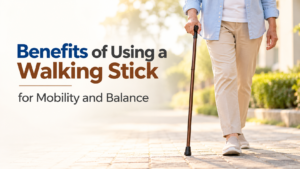
Walking is something most people do without thinking about it. However, after an injury, surgery, illness, joint problem, or a period of reduced activity, even a short walk can start to feel uncertain. You may notice that you are putting weight on one side, taking smaller steps, or holding onto furniture to feel steady.
This is where a walking stick may help you feel more supported while walking.
The benefits of using a walking stick go beyond simply having something to hold while walking. When the right type of stick is fitted correctly and used with the proper technique, it can provide an additional point of support, improve confidence, and help some people move around more safely.
However, a walking stick is not suitable for every mobility problem. Understanding when and how to use one is just as important as choosing the right walking aid.
What Does a Walking Stick Actually Do?
A walking stick provides an additional point of contact with the ground.
Normally, your two feet provide the base of support while you walk. A stick adds another point of support and may help you feel steadier while moving. This can be useful when you have balance problems, weakness, or pain affecting one leg. (1)
A walking stick can also help reduce the amount of weight placed on a weaker leg, depending on how it is used and the instructions provided by your healthcare professional.
It does not completely replace the work of your legs or correct the underlying cause of poor balance. Instead, think of it as a mobility aid that can make certain movements easier and more controlled.
Benefits of Using a Walking Stick
1. It Can Improve Stability While Walking
One of the main walking stick benefits is the additional support it provides while moving.
If you have balance difficulties, a stick can give you another point of contact with the floor. This may help you feel more stable when standing or walking, particularly when moving around your home.
However, feeling more stable does not mean the risk of falling disappears. You still need to pay attention to surfaces, wet floors, stairs, and obstacles.
2. It Can Help Reduce the Load on a Painful Leg
If pain affects one of your legs, a walking stick may make walking more comfortable, particularly while recovering from an injury or managing a joint problem.
When used correctly, the stick can help transfer some of the load away from the affected side. This may make walking more comfortable and reduce stress on the painful leg. (2)
The amount of support you need depends on your condition. If you have been given weight-bearing instructions after surgery or an injury, follow those instructions rather than deciding on your own how much weight to put through the leg.
3. It Can Support Safer Movement During Recovery
Recovery does not always mean staying in bed.
Depending on the injury or medical condition, your healthcare professional may encourage you to return to walking. A walking stick can sometimes provide support during this transition.
Using a walking stick can also affect aspects of walking, including step timing and other gait characteristics. (3)
This can be useful when moving between rooms, walking outside, or gradually increasing your activity.
The important point is that the stick should support your recovery plan rather than replace professional guidance.
4. It Can Increase Confidence When Moving Around
Balance problems can affect more than movement. After a fall or injury, you may become cautious about walking because you are worried about losing your balance.
A properly fitted walking stick can provide a sense of physical support while you regain confidence.
This does not mean you should depend on it indefinitely. If your mobility improves, your doctor or physiotherapist may reassess whether you still need the stick.
5. It Can Make Everyday Activities Easier
You may notice mobility problems most when performing everyday activities.
Getting up from a chair, walking to the bathroom, moving around the house, or going outdoors can become more difficult when one leg is painful or your balance is reduced.
A walking cane for mobility can make some of these movements easier by providing additional support.
For adults, this can be particularly useful when mild mobility limitations begin affecting everyday movement. Age alone is not a reason to use a walking stick. The need for a walking aid depends on balance, strength, pain, coordination, and the underlying health condition.
Walking Stick for Balance: Who May Benefit?
If you have mild stability problems or need some support on one side while walking, a walking stick may be worth considering.
A walking stick may be useful if you:
- Have mild balance difficulties.
- Have pain or weakness affecting one leg.
- Are recovering from an injury.
- Have difficulty walking on uneven ground.
- Feel less steady after a period of reduced activity.
- Need temporary support following advice from a healthcare professional.
A walking stick may not provide enough support if you have significant weakness, severe balance problems, or difficulty supporting your own body weight.
In these situations, a walker or another mobility aid may be more appropriate. A physiotherapist can assess your walking pattern and recommend the level of support you need.
Quick Walking-Stick Selection Guide
Not every walking stick provides the same level of support. The right choice depends on how much assistance you need and why you are using it.
Appropriate mobility-aid selection, height adjustment, and weight-bearing support can help compensate for the affected side, improve gait, reduce lower-limb joint loads, and stimulate muscle activation. Conversely, an unsuitable aid may increase energy expenditure and the effort required to walk. (4)
| If You Need | Consider |
|---|---|
| Light support for balance difficulties | Standard single-point walking stick |
| More stability while standing and walking | Multi-point or quad-base stick |
| Support because one leg is weaker | Adjustable walking stick fitted to your height |
| Temporary support after an injury or surgery | A stick recommended by your doctor or physiotherapist |
| More support because you feel very unsteady | A walker or another suitable mobility aid |
What to Check Before Choosing a Walking Stick
1. Height Adjustment
The handle should allow your elbow to remain slightly bent when you stand upright.
2. Handle Comfort
Choose a handle that you can hold securely without excessive gripping or wrist strain.
3. Base and Grip
The rubber tip should make secure contact with the floor and be suitable for the surfaces where you normally walk.
4. Strength and Weight Capacity
The stick should be easy for you to handle and rated to support your needs.
5. Your Actual Mobility Needs
A walking stick is generally intended for people who need light support. If you cannot walk safely with one, do not try to compensate by leaning heavily on it. You may need a more supportive mobility aid.
When in doubt, ask a physiotherapist or another healthcare professional to assess your walking and help you choose the right mobility aid.
Walking Stick for Elderly Adults: Is It Always Necessary?
The phrase “walking stick for elderly” often makes people think that everyone needs a walking aid after reaching a certain age.
That is not the case.
Some older adults walk independently without any mobility aid. Others may benefit from a stick because of pain, reduced strength, balance changes, or recovery from an injury.
The goal is to choose a mobility aid based on actual needs rather than using a walking stick simply because of age.
An assessment is especially important if you have recently started experiencing balance problems or have had a fall.
How to Use a Walking Stick Correctly
Knowing how to use a walking stick is just as important as having one.
If you need support because one leg is painful or weaker, you will generally hold the stick in the hand opposite your affected leg.
A basic walking pattern may look like this:
- Place the stick forward and slightly to the side.
- Move the weaker leg forward alongside the stick.
- Step through with the stronger leg.
- Repeat the sequence at a comfortable pace.
The correct technique can vary depending on your condition, strength, balance, and weight-bearing restrictions. Ask a healthcare professional or physiotherapist to demonstrate the appropriate method for you.
Check the Height
When standing upright, the handle should generally allow your elbow to remain slightly bent without forcing you to hunch your shoulder or reach down.
Your healthcare professional or physiotherapist can check the height and demonstrate the correct position.
A stick that is too high or too low can affect your posture and make walking less comfortable.
Keep the Stick Close to Your Body
Avoid placing the stick too far away from your body while stepping.
The stick should provide support without making you lean excessively to one side. Keep your movements controlled, especially when turning.
Take small steps when changing direction rather than twisting suddenly.
Walking Stick Safety Tips
A few simple habits can help make using a walking stick safer:
- Check the rubber tip regularly for wear or damage.
- Replace worn or damaged tips promptly.
- Wear footwear with good grip.
- Avoid walking on wet or uneven surfaces whenever possible.
- Keep floors and walkways free from clutter.
- Be particularly careful around bathroom floors and stairs.
- Do not use a walking stick to support more weight than it is designed to handle.
- If the stick feels unstable, have its fit and condition checked.
Remember that a mobility aid can only help when you can use it safely and correctly.
When Should You Speak to a Healthcare Professional?
A walking stick should not be used to push through unexplained or worsening mobility problems.
Speak to a doctor or physiotherapist if you:
- Have suddenly developed difficulty walking.
- Are repeatedly losing your balance.
- Have experienced a fall.
- Have new weakness or numbness.
- Have severe or worsening pain.
- Cannot comfortably support yourself with a walking stick.
- Are unsure which mobility aid you need.
If you have had surgery or a significant injury, follow the weight-bearing and mobility instructions provided by your healthcare team.
Choosing the Right Mobility Support
Choosing a mobility aid is not simply about finding something to help you walk. The right support should match your balance, strength, walking ability, and medical needs.
If you need help with movement or recovery, Cureka offers mobility and rehabilitation products to support your needs. If your doctor or physiotherapist has suggested a walking stick, choosing the appropriate style and ensuring it is fitted correctly can help you use it more safely and comfortably.
The aim is not to use a mobility aid when it is unnecessary, but to have the right amount of support when you need it.
The advantages of using a walking stick can include better balance, less pressure on a painful leg, greater confidence, and easier movement during some stages of recovery.
A walking stick is not always the right choice for everyone who has difficulty moving. Its usefulness depends on why you need support, how well you can maintain your balance, and how safely you can use the stick.
If you are considering a walking stick for yourself or a family member, start by understanding the mobility problem. A doctor or physiotherapist can help determine whether a stick is appropriate and show you how to use it correctly.
The right walking aid, matched to the individual and used with the correct technique, can make daily movement easier and support safer mobility.
Frequently Asked Questions
1. What Are the Benefits of Using a Walking Stick?
The benefits of using a walking stick can include additional support while walking, better balance, less stress on a painful or weaker leg, and greater confidence when moving. It may also make daily tasks easier for some people recovering from an injury or managing mobility difficulties.
2. Is a Walking Stick Good for Balance?
A walking stick can provide support for people with mild balance difficulties. However, it does not eliminate the risk of falling and may not provide enough assistance for people with significant balance or strength problems. A physiotherapist can help determine whether a stick is suitable.
3. Which Hand Should Hold a Walking Stick?
If you are using a walking stick because one leg is painful or weak, it is generally held in the hand opposite the affected leg. This can help the stick provide support while you walk. Your healthcare professional can demonstrate the correct technique for your condition.
4. How High Should a Walking Stick Be?
A walking stick should be adjusted so that, when you stand upright, your elbow remains slightly bent and your shoulder stays relaxed. A physiotherapist or healthcare professional can check the fit.
5. Is a Walking Stick Suitable for Older Adults?
A walking stick can be helpful for some older adults with mild balance difficulties, weakness, joint pain, or mobility problems. However, age alone does not mean someone needs a walking stick. The appropriate mobility aid depends on the person’s strength, balance, and health condition.
6. When Should I Use a Walker Instead of a Walking Stick?
A walker may be more suitable when you need greater stability than a walking stick can provide, have significant balance problems, or cannot walk safely with a single stick. If you are unsure which mobility aid you need, consult a doctor or physiotherapist.
References
- Assistive Devices for Balance and Mobility: Benefits, Demands, and Adverse Consequences (2005). https://pubmed.ncbi.nlm.nih.gov/15641004/
- Effects of Contralateral Versus Ipsilateral Cane Use on Gait in People With Knee Osteoarthritis (2015). https://pubmed.ncbi.nlm.nih.gov/25305371/
- Influence of a Walking Aid on Temporal and Spatial Parameters of Gait in Healthy Adults (2014). https://pubmed.ncbi.nlm.nih.gov/24534098/
- Biomechanical Effects of Human-Mobility Aid Interaction: A Narrative Review (2025). https://pubmed.ncbi.nlm.nih.gov/39842226/
Medical Disclaimer: This article is for general informational purposes only and does not replace professional medical advice. Consult a qualified healthcare professional to determine which mobility aid is appropriate for your needs.