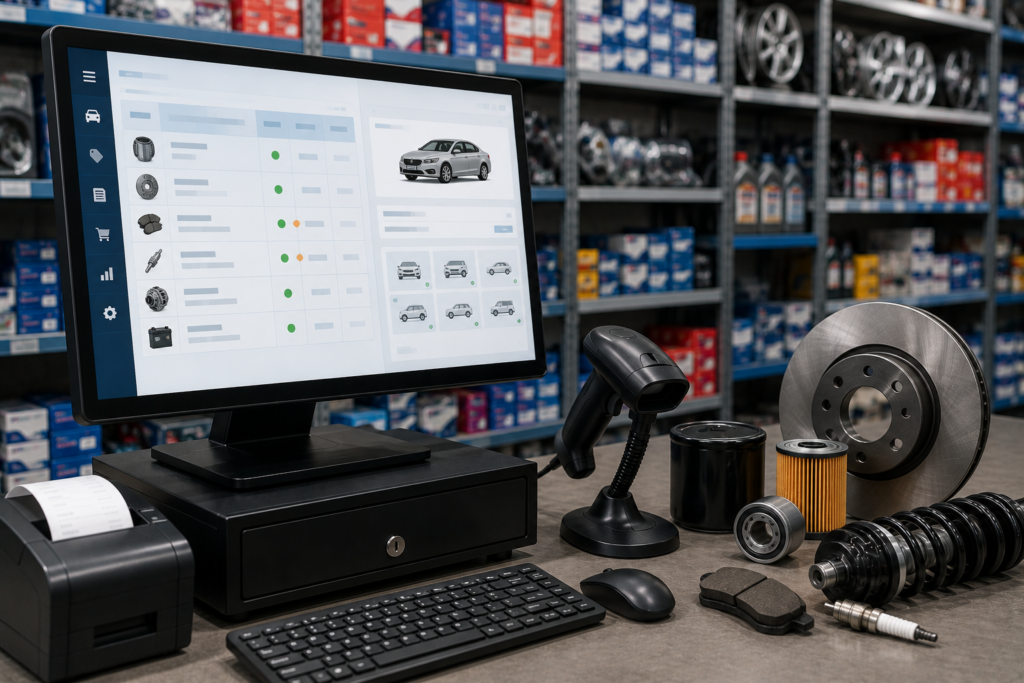
Walk into any serious auto spare parts shop and you’re looking at one of the most complex inventory environments in retail. Thousands of part numbers. Multiple brands for the same component. The same-looking filter that fits a Swift but not an i20. A brake pad that works for a Maruti but not the same-generation Hyundai. Customers who know exactly what they need and customers who only know the make, model, and year of their vehicle and expect you to figure out the rest.
Managing this complexity without the right tools is genuinely exhausting. And most generic retail billing software isn’t even close to equipped for it. A standard POS system treats every product as a standalone item with a name, a price, and a barcode. It has no concept of a vehicle fitment database, no way to search by vehicle make and model, no understanding of OEM part numbers, and no mechanism to track that the same part carries different part numbers across different brands.
The result, for spare parts retailers running on generic billing software, is a daily grind of manual lookups, pricing errors, stock mismatches, and wrong parts handed to customers — followed by returns, frustrated mechanics, and damaged shop reputation.
Automobile parts billing software exists specifically because this category of retail has requirements that no generic system can address. This article walks through exactly what those requirements are, how purpose-built software addresses them, and what to look for when choosing a system for your spare parts business.
Why Auto Parts Retail Is the Most Complex Inventory Environment in Retail
Before evaluating software features, it’s worth being precise about what makes spare parts retail fundamentally different from every other retail category. Understanding the specific challenges helps you evaluate whether a software solution actually addresses them or just looks like it does in a demo.
The Vehicle Fitment Challenge
The core complexity of spare parts retail is that most components are not universal — they’re vehicle-specific. A set of disc brake pads may look identical to the naked eye across ten different part numbers, but each one fits a different set of vehicle makes, models, years, and engine variants. Selling the wrong one to a customer isn’t just a billing problem — it’s a safety problem, a customer relationship problem, and a returns problem.
In a shop stocking parts for cars, two-wheelers, commercial vehicles, and tractors, this fitment complexity multiplies across potentially tens of thousands of SKUs from dozens of suppliers and brands.
Multiple Part Numbers for the Same Component
The same physical component — say, an oil filter for a specific engine — may be listed under:
- An OEM (Original Equipment Manufacturer) part number
- A Bosch aftermarket part number
- A Mahle aftermarket part number
- A locally branded aftermarket part number
- A generic “universal fit” part number
A customer or mechanic may ask for any one of these numbers. Your billing system needs to recognize all of them as referring to the same or functionally equivalent component, and ideally cross-reference them so the right inventory is identified regardless of which number is presented.
Superseded and Obsolete Part Numbers
OEMs regularly update part numbers through engineering changes. A part that was ordered under number ABC-123 two years ago may now be listed as XYZ-456 — the same physical component, same function, different catalog number. Without a system that tracks supersession chains, staff may search for the old number, find nothing, and tell the customer it’s out of stock — when the part is actually sitting in the stockroom under the new number.
Variable Pricing Across Customer Types
Auto parts shops typically serve multiple customer segments with different price expectations: retail customers buying a single part for their own vehicle, mechanics buying parts for multiple customer vehicles at wholesale prices, fleet operators buying in bulk, and government or institutional buyers with formal tender pricing. The billing system must support multiple price lists per product, applied automatically based on which customer type is being billed.
Supplier Diversity and Part Sourcing
Most auto parts shops source the same categories of parts from multiple suppliers — different brands, different quality tiers, different pricing. Tracking which supplier supplied which batch at what cost, and which supplier consistently delivers quality vs which one is associated with higher return rates, is data that shapes purchasing strategy over time. Generic billing software maintains no supplier-to-product intelligence beyond basic purchase records.
Core Features Every Automobile Parts Billing Software Must Have
1. Vehicle Make, Model, and Year-Based Parts Lookup
This is the defining feature that separates genuine auto parts software from general retail billing with a modified product catalog.
What vehicle-based lookup enables:
- Customer or mechanic specifies the vehicle: Maruti Swift, 2019, 1.2L petrol
- The software filters its product catalog to show only parts compatible with that specific vehicle specification
- Staff can see which brands and quality tiers are available for each part category for that vehicle
- The correct part number is identified with confidence before billing
Why this matters operationally: Eliminating wrong-part sales is not just about customer satisfaction — it directly reduces returns, credit note complexity, and the wasted time of managing exchanges. In a busy shop serving mechanics who need parts quickly to keep customer vehicles on the lift, wrong-part sales create a cascading disruption that affects multiple jobs.
What to look for in the demo:
- Can you filter products by vehicle make, model, and year simultaneously?
- Does the vehicle database cover the specific vehicle brands your customer base brings in?
- Is the vehicle database updatable as new models are added to the market?
- Can you search by engine variant (petrol/diesel/CNG) where fitment differs by fuel type?
2. OEM and Aftermarket Part Number Management
Every product in your catalog should be enterable with multiple part number identifiers:
- OEM part number: The manufacturer’s original part number as used by the vehicle brand
- Supplier/aftermarket part number: The part number assigned by Bosch, Denso, Minda, etc.
- Cross-reference numbers: Equivalent part numbers from other brands
- Internal/local part code: Your shop’s own tracking code if you use one
The practical requirement: When a mechanic presents a part number — any part number from any brand’s catalog — your system should find the matching product in your inventory. The search should work on any stored number, not just the one you arbitrarily chose as “primary.”
3. Part Supersession Chain Tracking
When an OEM updates a part number, the old number should remain searchable but redirect to the current active part number. This is called supersession tracking.
How it should work:
- Staff searches for old part number ABC-123
- System recognizes this as superseded and displays current number XYZ-456
- Staff confirms the correct, current part with the customer and bills from the current SKU
- Old number is flagged as superseded in search results rather than returning “not found”
Without this feature, every superseded part number in your catalog is a potential wrong-answer event at the billing counter.
4. Multi-Price List Management
Auto parts shops rarely have a single selling price per product. A properly built system supports:
- Retail price: For walk-in customers buying a single part
- Mechanic/trade price: For mechanics and workshops buying regularly
- Wholesale price: For bulk buyers and fleet operators
- Special pricing: For specific accounts or negotiated contracts
Implementation requirement: Price lists should apply automatically based on the customer category selected at billing, not manually entered per product per sale. When a customer tagged as “mechanic” is selected, the mechanic price should appear automatically for every product on that bill.
5. Comprehensive SKU and Inventory Management
The inventory management requirements for an auto parts shop go beyond standard retail stock tracking:
Product master structure:
- Part number (primary)
- All alternative part numbers (cross-references)
- Vehicle fitment data (make/model/year linkage)
- Brand and quality tier (OEM, OE equivalent, aftermarket)
- Category (filters, brakes, electrical, engine, body parts, etc.)
- Sub-category (oil filters, air filters, fuel filters for filters category)
- Unit of measure (piece, set, kit, litre)
- Purchase price (supplier-wise for margin tracking)
- Multiple selling prices (retail, trade, wholesale)
- Minimum stock level (for reorder alert)
- Rack/bin location within the store
Stock movement tracking:
- Sales (automatic deduction per bill)
- Purchases (addition per purchase invoice entry)
- Returns received (addition back to stock)
- Parts sent for inspection or warranty claims (temporary deduction)
- Damaged or write-off stock (permanent deduction with reason)
Low-stock alerts: Configure minimum quantities per part, and the system flags or auto-generates purchase orders when stock falls below the threshold. For fast-moving consumable parts like oil filters and air filters, running out during a busy day causes immediate service disruption to mechanics depending on you.
6. Supplier and Purchase Management
What comprehensive supplier management includes:
- Supplier-wise product catalog (which supplier stocks which parts, at what prices)
- Purchase order generation with part number, quantity, and expected delivery date
- Goods receipt entry with actual quantities received (vs ordered) for discrepancy tracking
- Supplier-wise purchase history for spend analysis and negotiation
- Supplier return management for defective or wrong parts
- Credit limit and payment terms tracking per supplier
Why multi-supplier management matters: Auto parts shops often source the same part category from multiple suppliers — different brands, different quality tiers. Knowing which supplier has consistently supplied reliable parts, which one has the best pricing for a specific part category, and which one has the shortest delivery lead time is information that shapes your purchasing and your business margins over time.
7. GST Configuration for Auto Parts
Auto parts GST is not a single rate, and correct configuration requires attention to the applicable rates across your product range:
| Part Category | Typical GST Rate | HSN Code Range |
| Vehicle parts and accessories (general) | 28% | 8708 |
| Brakes, clutch, transmission parts | 28% | 8708.30, 8708.93 |
| Filters (oil, air, fuel) | 28% | 8421.23, 8421.39 |
| Rubber parts (belts, hoses, gaskets) | 28% | 4016.93, 4016.99 |
| Electrical parts (batteries, bulbs, switches) | 12%–28% | Varies by component |
| Engine oils and lubricants | 18% | 2710 |
| Tyres and tubes | 28% | 4011, 4013 |
| Tools and workshop equipment | 18% | 8467, 8204 |
Configuration requirement: Each product in your catalog must have the correct HSN code and GST rate assigned. In an auto parts shop where a single bill might include brake pads, engine oil, and an electrical component, each item must carry its own correct rate — the software cannot apply a blanket rate without creating compliance errors.
8. Billing Workflow for Auto Parts
The billing workflow in an auto parts shop is faster and more reliable when the software is designed for it:
Efficient billing sequence:
- Identify customer (or create new customer profile)
- Apply correct price list for customer type
- Search by part number, part name, or vehicle make/model
- Confirm correct fitment with customer or mechanic
- Select quantity and verify stock availability
- Apply any applicable trade discounts
- Add additional items (repeat steps 3–6)
- Select payment mode and complete bill
- Print receipt or send digital invoice via WhatsApp
What slows this down in generic software: Steps 3 and 4 — no vehicle-based search, no cross-reference lookup, no fitment confirmation — require staff to use a separate parts catalog book or website, look up the part manually, return to the billing screen, and enter the part by name. This manual interruption adds minutes to each transaction in a category where mechanics value speed above almost everything else.
9. Returns and Exchange Management
Parts returns in auto parts retail happen for specific, well-defined reasons:
- Wrong part supplied: Part doesn’t fit the vehicle as expected
- Defective part: Part failed prematurely or was defective from supply
- Surplus return: Mechanic ordered extra parts and is returning unused ones
- Warranty return: Part is within warranty period and has failed
What the software must handle:
- Return linked to the original invoice and part number
- Reason for return captured and stored
- Stock automatically restored to inventory (for saleable returns)
- Defective stock quarantined separately (not added back to saleable stock)
- Supplier return process initiated for defective parts
- GST credit note generated correctly for B2B returns
- Customer credit or refund processed against the return
How Different Scales of Auto Parts Business Use Software Differently
Small Independent Spare Parts Shops
For a small spare parts shop serving a neighborhood or a specific vehicle segment, the priority features of dedicated auto spare parts billing software are fast part lookup, correct pricing, and accurate inventory tracking. The immediate benefit is reducing wrong-part sales and stock mismatches — the two problems that cause the most customer frustration and return handling overhead in a small shop context. Even a modest catalog of two to three thousand SKUs becomes significantly more manageable when the software provides proper search and fitment guidance.
Mid-Sized Multi-Brand Auto Parts Dealers
For a larger spare parts retailer serving multiple vehicle brands and multiple customer types — retail, mechanic, fleet — the value of purpose-built automobile parts billing software extends to multi-price list management, supplier-wise purchase tracking, and detailed sales analytics by part category and vehicle type. These capabilities allow the business owner to make data-driven decisions about which brands to stock, which vehicle segments to specialize in, and which supplier relationships to prioritize — decisions that directly affect margins and competitive positioning.
Wholesale Distributors and Multi-Location Chains
For wholesale auto parts distributors or chains with multiple retail locations, auto parts shop software deployed across all locations with centralized inventory visibility and consolidated reporting becomes the operational backbone of the business. Knowing which parts are moving across all outlets, which locations are running low on specific fast-movers, and which supplier accounts have outstanding balances — from a single management dashboard — is what makes multi-location auto parts operations manageable without a disproportionate administrative team.
Legal and Business Compliance Benefits
GST Compliance in Auto Parts Retail
The combination of high part volumes, multiple GST rates across product categories, and a significant B2B customer base (mechanics filing for ITC) makes GST compliance particularly important in auto parts retail. Software that applies correct HSN codes and rates automatically ensures every invoice is accurate and every GSTR-1 data export is filing-ready — without the manual cross-referencing that creates errors in high-transaction environments.
For mechanics and workshop owners who are GST-registered and claim ITC on parts purchases, receiving a correct tax invoice isn’t optional. Consistently providing accurate invoices builds your reputation as a preferred supplier among professional mechanics — which is one of the most reliable sources of repeat business an auto parts shop has.
Business Records for Regulatory Compliance
Auto parts shops in India that supply to fleet operators, government vehicles, or institutional buyers often operate under formal purchase orders and contract terms. Maintaining organized, retrievable records of part numbers supplied, quantities, pricing, and delivery timelines is a contract compliance requirement that digital billing software satisfies automatically.
Business Formalization and Growth
Auto parts retailers with organized digital records are substantially better positioned for:
- MSME loan and working capital credit: Auto parts retail often involves significant working capital tied up in inventory. Banks and NBFCs evaluating credit applications use GST filing consistency and organized inventory records as financial credibility indicators. Software-maintained billing and purchase records build this credibility month by month.
- Franchise and chain expansion: Automotive retail brands and franchise systems require franchisee outlets to operate with standardized, auditable billing systems. Having software already in place simplifies the onboarding requirements for franchise tie-ups.
- OEM-authorized dealership applications: Vehicle manufacturers and OEM parts suppliers evaluating potential authorized dealers assess the professionalism and organizational capability of the applicant. Digital billing records, organized inventory management, and documented supplier relationships all support a stronger dealership application.
- Fleet and institutional contracts: Large fleet operators and government departments tendering for parts supply agreements increasingly require organized supplier documentation. Software-generated records — supply history, part number documentation, GST compliance — support these applications directly.
Choosing the Right Auto Parts Billing Software: Evaluation Checklist
Use the following checklist when evaluating any automobile parts billing software:
Vehicle Fitment and Parts Lookup:
- ☐ Can I search products by vehicle make, model, year, and engine variant?
- ☐ Does the vehicle database cover the brands my customers bring in?
- ☐ Can I search by OEM part number and aftermarket part number simultaneously?
- ☐ Does the software handle part supersession chains?
- ☐ Can I store multiple cross-reference part numbers per product?
Inventory and SKU Management:
- ☐ Can I configure rack/bin location per product?
- ☐ Does it support multiple units of measure per product?
- ☐ Are low-stock alerts configurable per product?
- ☐ Can I track defective stock separately from saleable stock?
- ☐ Does it support bulk product import via Excel?
Pricing and Customer Management:
- ☐ Does it support multiple price lists per product?
- ☐ Are price lists applied automatically by customer type?
- ☐ Can I set credit limits per account customer?
- ☐ Does it maintain a complete purchase history per customer or mechanic account?
GST and Compliance:
- ☐ Can I assign HSN codes per product with correct rates?
- ☐ Does it generate GSTR-1 export data automatically?
- ☐ Does it support GST credit notes for returns?
- ☐ Is e-invoice generation supported for applicable turnover thresholds?
Supplier and Purchase Management:
- ☐ Can I track supplier-wise pricing per product?
- ☐ Does it support purchase order creation and tracking?
- ☐ Can I record and track supplier returns for defective parts?
Conclusion
Auto spare parts retail operates at a level of complexity that simply cannot be managed well with generic billing software. The vehicle fitment challenge, the multi-part-number environment, the supersession chain problem, the multi-price-list requirement, and the supplier diversity of the category all demand software built specifically for this operational environment.
The shops that run auto parts operations most effectively — with fast counter service, minimal wrong-part returns, accurate stock management, and satisfied mechanic accounts — are almost universally running on purpose-built spare parts billing software. The difference isn’t subtle. It’s visible in the speed of every counter interaction, the accuracy of every stock count, and the quality of every customer relationship.
If your auto parts shop is currently managing part lookups manually, maintaining inventory in a separate register, or using generic billing software that doesn’t understand vehicle fitment — the gap between where you are and where you could be is significant. And the cost of that gap, measured in wrong-part returns, stock errors, and customers lost to competitors who can serve them more accurately and quickly, is almost certainly larger than the cost of the right software.
Choose software built for your business, not adapted for it. The operational difference will be evident from the first day you use it.
Frequently Asked Questions
- Is it possible to manage vehicle compatibility data manually in regular billing software? It’s technically possible but practically unsustainable at any meaningful scale. You could create product names that include vehicle compatibility information (e.g., “Oil Filter – Swift 2015-2020 1.2 Petrol”), but this approach breaks down quickly when the same part fits multiple vehicles, when mechanics search by vehicle rather than part description, and when you need to update fitment information as new models arrive. Purpose-built auto parts software maintains a proper relational fitment database that standard billing tools simply don’t have the data architecture to support.
- How large can a product catalog get in automobile parts billing software? Professional automobile parts billing software is built to handle catalogs of ten thousand to several hundred thousand SKUs — the realistic size of a comprehensive multi-brand spare parts catalog. Performance should remain consistent regardless of catalog size for search, filtering, and report generation. When evaluating software, specifically ask what the maximum catalog size is and request a demo with a fully loaded catalog to verify that search speed is acceptable with a large product database.
- How does the software handle situations where the same part fits some variants of a model but not others? Good auto parts billing software allows fitment data to be specified at the variant level — not just “Maruti Swift” but “Maruti Swift 2018–2022, 1.2L K-Series petrol, manual transmission.” When a customer specifies their vehicle, the system filters to parts confirmed compatible with that specific variant, and parts with uncertain fitment for that variant are either excluded or flagged. The accuracy of this depends on the quality and completeness of the fitment database, which is why this is one of the key evaluation criteria when choosing software.
- Can automobile parts billing software handle both OEM and aftermarket parts in the same catalog? Yes, and this is a standard requirement for any serious auto parts software. Products are typically categorized by brand type (OEM, OE-equivalent, branded aftermarket, generic aftermarket), and multiple brands’ versions of the same part can coexist in the catalog with cross-references linking them. At the billing counter, when a specific vehicle and part category is identified, the software shows all available options — by brand and quality tier — allowing staff to offer the customer a choice based on their preference and budget.
- How does GST billing work when a single invoice includes parts with different tax rates? Auto parts software assigns the correct HSN code and GST rate to each product in the catalog during setup. When multiple products with different rates appear on a single invoice — for example, brake pads at 28% and engine oil at 18% — the software calculates and displays each line’s tax separately, shows the combined tax summary at the bottom of the invoice, and records the transaction with the correct rate-wise tax breakdown for GSTR-1 reporting. This happens automatically based on the product configuration, not through any manual calculation at the billing counter.
- What is the best way to handle parts that are frequently returned due to incorrect vehicle fitment? First, analyze your returns by part number to identify which parts have the highest return rates — most billing software can generate this report. High-return parts usually signal either incomplete fitment data in your catalog or a specific fitment ambiguity that needs clarification. Update the fitment data for high-return parts to be more specific (adding variant-level restrictions), train staff to confirm fitment details more carefully for those part numbers before billing, and where applicable, implement a confirmation step in the billing workflow for commonly confused parts. Over time, tracking return reasons in the software builds the institutional knowledge that reduces fitment errors systematically.