Learning to drive is about much more than passing a practical test. New drivers need to develop the judgement, awareness, vehicle control, and decision-making skills that help them manage real-world traffic safely and confidently. For learners choosing automatic driving lessons Blackburn, understanding which skills matter most can make the learning process more structured and effective.
Automatic vehicles remove the need to operate a manual clutch and select gears, allowing learners to concentrate more closely on observation, road positioning, speed control, and developing good driving habits. However, an automatic licence does not remove the need for careful training. Learners still need to understand how their vehicle behaves and how to respond appropriately to changing road conditions.
For people learning to drive in Blackburn and the wider Lancashire area, local roads can provide valuable experience across residential streets, busy urban routes, roundabouts, junctions, and higher-speed roads. Building competence across these different environments is an important part of becoming an independent driver.
Understanding the Basics of Automatic Vehicle Control
One of the first skills an automatic learner should develop is smooth and controlled use of the vehicle. Although there is no clutch pedal, drivers still need to understand how the accelerator and brake affect the car.
Automatic cars can begin moving when the brake pedal is released, particularly when the transmission is in Drive. This means learners should become comfortable with controlling the vehicle at very low speeds before progressing to more complicated traffic situations.
Important early skills include:
- Finding the correct driving position and adjusting mirrors.
- Understanding the functions of the accelerator and brake.
- Selecting Park, Reverse, Neutral, and Drive correctly.
- Moving away smoothly and safely.
- Stopping accurately at junctions and traffic lights.
- Controlling the vehicle at low speeds.
- Checking mirrors before changing speed or direction.
- Developing consistent steering control.
Another important habit is using the right foot for both the accelerator and brake rather than attempting to operate both pedals simultaneously. Consistent pedal control can make acceleration and braking more predictable.
Learners should also understand that automatic vehicles vary. Some cars respond quickly to light accelerator pressure, while others may feel more gradual. Familiarity with the specific vehicle therefore matters.
Observation and Hazard Awareness
Good driving depends heavily on what a driver notices before a problem develops. Observation is therefore one of the most important skills taught during automatic driving lessons Blackburn.
Learners should gradually develop the ability to scan the road environment rather than focusing only on the vehicle immediately ahead.
Effective observation involves looking for:
- Pedestrians near crossings and junctions.
- Cyclists and motorcyclists.
- Parked vehicles that could create hazards.
- Vehicles emerging from side roads.
- Changing traffic signals.
- Road signs and lane markings.
- School zones and residential activity.
- Vehicles approaching quickly from behind.
- Changes in road surface or weather conditions.
The goal is not simply to identify hazards but to anticipate what might happen next.
For example, seeing a parked vehicle with someone sitting inside may indicate that a door could open. A child standing close to the edge of a pavement may require a driver to reduce speed even if the child has not entered the road.
This forward-thinking approach is sometimes described as developing a “hazard perception mindset.” Drivers who consistently anticipate potential problems have more time to react.
Junctions, Roundabouts and Road Positioning
Junctions and roundabouts can be challenging for new drivers because they require several skills at the same time. A learner may need to observe traffic, choose a safe gap, select the appropriate lane, signal correctly, control speed, and maintain road position.
The key is to break the process into manageable stages.
At a junction, learners should consider:
- Observation: What traffic, pedestrians, cyclists, or other hazards are present?
- Speed: Can the vehicle be brought under control before reaching the junction?
- Position: Is the car positioned correctly for the intended direction?
- Priority: Who has right of way according to the road layout and signs?
- Decision: Is there a safe opportunity to proceed?
- Action: Can the manoeuvre be completed smoothly?
Roundabouts require similar awareness, but lane discipline becomes particularly important. Drivers should read signs and road markings early rather than making sudden decisions at the last moment.
Blackburn and surrounding Lancashire roads provide learners with opportunities to encounter different junction layouts and traffic conditions. This variety can help learners understand that driving skills need to be adapted to the environment rather than applied mechanically.
Speed Management and Safe Following Distances
Speed is not simply about staying below the posted limit. A safe driver chooses a speed appropriate for visibility, traffic, weather, road layout, and potential hazards.
For example, a road with a 30 mph limit may still require slower driving if visibility is poor, pedestrians are nearby, or vehicles are parked along both sides.
New drivers should learn to ask themselves:
Can I stop safely if something unexpected happens?
Following distance is equally important. Leaving adequate space behind the vehicle ahead provides additional reaction time and reduces the risk of sudden braking.
Drivers should increase their following distance when conditions become more difficult, including:
- Heavy rain.
- Fog or poor visibility.
- Wet or slippery roads.
- Darkness.
- Congested traffic.
- Unfamiliar roads.
- Areas with pedestrians or cyclists.
Smooth speed management also improves passenger comfort and helps drivers maintain better control of an automatic vehicle.
Manoeuvres and Low-Speed Driving
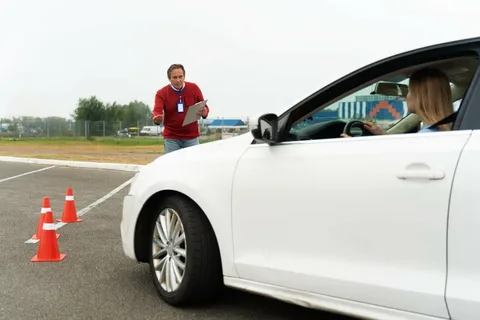
Passing a driving test requires more than simply driving along ordinary roads. Learners also need to become comfortable with manoeuvres and precise low-speed control.
Common areas of practice include:
- Parallel parking.
- Bay parking.
- Reversing manoeuvres.
- Pulling up safely.
- Moving away on different types of roads.
- Turning in confined spaces where appropriate.
- Reversing safely while maintaining effective observation.
Automatic cars can make low-speed control feel different from manual vehicles because the car may creep forward when the brake is released. Learners should therefore practise controlling this movement smoothly instead of relying heavily on the accelerator.
One useful principle is to keep the vehicle moving slowly enough that observation remains manageable. Rushing a manoeuvre can make it harder to check surroundings and correct positioning.
Parking should also involve more than fitting the vehicle into a space. Drivers should consider pedestrians, nearby vehicles, road markings, visibility, and whether the final position allows the vehicle to leave safely.
Building Confidence for Real-World Driving
A learner can understand driving rules yet still feel uncertain when facing unfamiliar traffic. Confidence should therefore come from repeated practice and good decision-making rather than simply driving more quickly.
Structured practice can gradually introduce learners to different environments, such as:
- Quiet residential roads.
- Busier urban streets.
- Multi-lane roads.
- Roundabouts.
- Complex junctions.
- Higher-speed routes.
- Parking areas.
- Roads with changing traffic conditions.
The role of an instructor is particularly useful when learners encounter situations they have not experienced before. An experienced instructor can explain why a particular decision is safer and help identify habits that may otherwise go unnoticed.
For example, a learner might consistently check mirrors but do so too late before changing position. Another may approach junctions correctly but hesitate because they have not yet developed confidence in judging safe gaps.
Providers such as Street Smart Driving School can be considered within this wider learning process for learners in Lancashire seeking structured automatic driving tuition.
Technology and Changing Driving Habits
Driving education is also evolving as modern vehicles introduce features such as parking sensors, reversing cameras, lane-assistance systems, adaptive cruise control, and automatic emergency braking.
These technologies can support drivers, but learners should understand their limitations. Driver-assistance systems are not substitutes for observation or responsible decision-making.
A reversing camera, for instance, can improve visibility but may not show every potential hazard around the vehicle. Similarly, parking sensors can provide useful warnings but do not replace direct observation.
New drivers should therefore learn both the technology and the underlying driving skill. This creates a stronger foundation for handling different vehicles in the future.
Preparing for Independent Driving
The ultimate objective of driving tuition is not simply completing a test. It is developing the ability to make safe decisions without continuous instructor guidance.
Before becoming an independent driver, learners should aim to feel comfortable with:
- Reading road signs and markings.
- Anticipating hazards.
- Maintaining appropriate speed.
- Selecting safe gaps in traffic.
- Using mirrors effectively.
- Positioning correctly.
- Managing roundabouts and junctions.
- Parking and reversing.
- Driving in different weather conditions.
- Responding calmly to unexpected situations.
It is also useful to continue learning after passing the test. New drivers gain experience gradually, and situations such as motorway driving, unfamiliar routes, night driving, and difficult weather can require additional preparation.
Conclusion
Learning to drive an automatic vehicle can simplify some aspects of vehicle operation, but safe driving still depends on observation, judgement, anticipation, and consistent vehicle control.
For learners considering automatic driving lessons Blackburn, the most valuable approach is to focus on transferable skills rather than simply memorising test routines. Understanding road positioning, hazard awareness, speed management, junctions, parking, and responsible use of vehicle technology can help create a stronger foundation for independent driving.