Market Overview
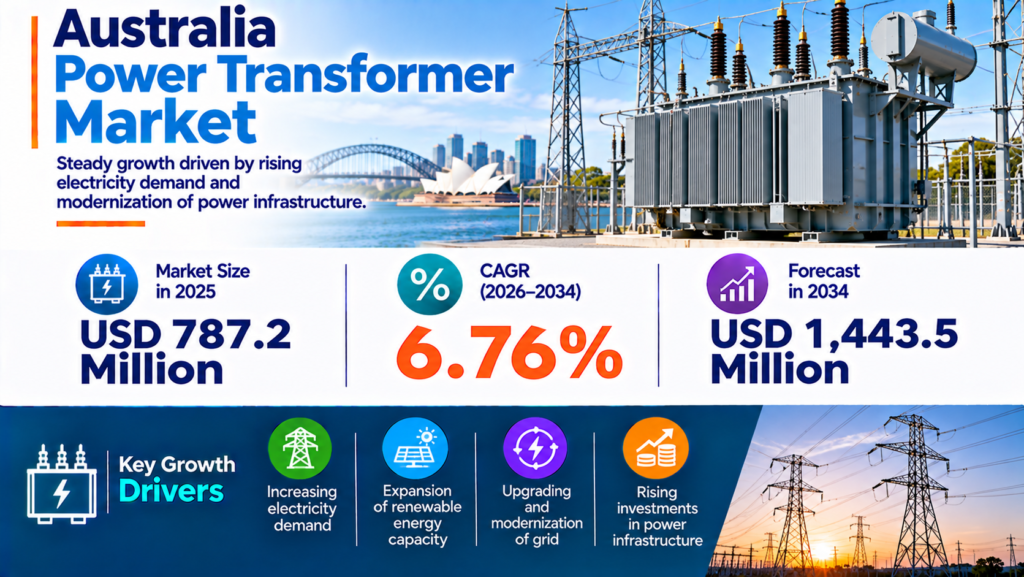
The Australia power transformer market is growing, driven by growing demand for electricity, infrastructure upgrades, renewable integration, technological advancement, government policies favoring energy efficiency and grid stability, and increasing investment in industrial and commercial sectors. The market size reached USD 787.2 Million in 2025 and is projected to reach USD 1,443.5 Million by 2034, registering a compound annual growth rate (CAGR) of 6.76% during 2026-2034. Enhanced focus on smart grid integration, high-efficiency transformers, and advanced cooling and material technologies are further shaping the Australia power transformer market share and outlook through 2034.

Request a Sample Report for In-Depth Market Insights: https://www.imarcgroup.com/australia-power-transformer-market/requestsample
Market Summary
-
Integration of renewable energy, supported by Hitachi Energy and AusNet collaborating on the Golden Plains Wind Farm project in Victoria in May 2024 with two 850 MVA 500kV power transformers, is increasing demand for advanced power transformers and intensifying competition among suppliers.
-
A competitive landscape of transformer manufacturers, technology providers, and energy infrastructure specialists including Hitachi Energy, Wilson Transformer Company, Ingeteam, and Akaysha Energy is driving innovation across smart grid, high-efficiency, and digital-ready transformer solutions.
-
Smart grid and technological advancements are propelling demand, with transformers incorporating sensors and IoT devices offering real-time monitoring, fault detection, and predictive maintenance to optimize performance and prolong equipment life.
-
Demand for high-efficiency transformers is rising due to increased emphasis on energy conservation and sustainability, with utilities, industrial consumers, and commercial buildings prioritizing low-loss equipment employing improved materials, better core construction, and improved cooling systems.
-
Government initiatives supporting research and development, safety and operational standards, and incentives for industrial and commercial electrification are reinforcing market expansion across urban and regional areas.
-
The market is segmented by core, insulation, phase, rating, application, and region for 2026-2034, with closed, shell, and berry cores, gas, oil, solid, and air insulation, and single and three phases comprising core categories.
Market Growth Drivers
Expansion of Power Generation Capacity
The growth of power generation capacity in Australia significantly contributes to the demand for transformers. As electricity production increases from traditional sources like coal and natural gas, alongside renewables such as solar and wind, there is a heightened need for dependable transmission and distribution infrastructure. Transformers play a crucial role in adjusting voltage levels, facilitating efficient power delivery from generation facilities to consumers. An increase in generation capacity also bolsters grid stability and energy reliability, especially in remote or industrial regions. Utility companies and independent power producers are investing in sophisticated transformers to manage heavier loads and integrate variable renewable energy sources, making deployment a vital aspect of Australia’s changing energy landscape.
Urbanization and Industrialization
The swift urbanization and industrialization occurring in Australia are propelling electricity usage, which subsequently heightens the demand for power transformers. Expanding cities necessitate broader residential, commercial, and infrastructure power networks, while industrial areas require dependable high-capacity transformers to support ongoing operations. This increase in electricity needs in urban and industrial areas is prompting utilities and private investors to enhance and expand distribution networks. There is a growing requirement for transformers that can manage higher loads and facilitate smart grid integration. The establishment of industrial parks, commercial centers, and urban infrastructure projects offers long-term prospects for transformer manufacturers and suppliers.
Replacement of Obsolete Transformers
The need to replace outdated and aging transformers is a vital factor influencing growth within the Australian power transformer market. Numerous existing transformers have reached the end of their operational life, resulting in heightened maintenance expenses, inefficiencies, and a greater risk of outages. Transitioning to modern, high-performance transformers improves reliability, reduces energy losses, and helps meet evolving safety and efficiency standards. Various sectors including industrial, commercial, and utility are increasingly investing in advanced transformers that offer enhanced cooling systems, low-loss materials, and digital monitoring features. Proactive replacement initiatives also support grid modernization efforts, allowing for better integration of renewable energy and smart grid technologies.
Porter’s Five Forces Analysis
Competitive Rivalry: High
-
Transformer manufacturers, technology providers, and energy infrastructure specialists including Hitachi Energy, Wilson Transformer Company, and Ingeteam are competing on efficiency, reliability, and smart grid capability.
-
Competition spans closed, shell, and berry cores across gas, oil, solid, and air insulation types and single and three phases.
-
High-efficiency designs, IoT-enabled monitoring, and advanced cooling systems are key points of differentiation.
Supplier Power: Moderate to High
-
Specialized steel, copper, insulation material, and component suppliers hold influence over production costs and transformer performance.
-
Advanced material suppliers for amorphous steel and improved insulation gain importance as efficiency requirements tighten.
-
Manufacturing capacity constraints and lead times for high-capacity transformers increase supplier leverage in project timelines.
Buyer Power: Moderate to High
-
Utilities, industrial consumers, and commercial property developers can compare and switch suppliers based on efficiency, reliability, and total cost of ownership.
-
Price sensitivity exists on capital costs, though willingness to pay premiums grows for low-loss, high-efficiency, and digital-ready transformers with lower lifecycle costs.
-
Demand for regulatory compliance, grid stability, and smart grid integration is raising expectations for technical capability and service support.
Threat of Substitutes: Moderate
-
Alternative voltage regulation technologies and distributed generation architectures provide partial substitutes for centralized transformer infrastructure.
-
Solid-state transformer technologies remain emerging substitutes for conventional oil-immersed designs.
-
Power transformers remain essential for voltage conversion and grid integration, limiting substitution for transmission and distribution applications.
Threat of New Entrants: Moderate
-
Growing renewable energy and grid modernization demand is opening routes for new manufacturers and technology providers.
-
Manufacturing capability, certification requirements, and utility qualification processes raise operational barriers.
-
Established manufacturers with proven track records and utility relationships favor incumbents, though public-private partnerships are creating new entry pathways for technology providers.
Market Segmentation
Core Insights
-
Closed
-
Shell
-
Berry
Insulation Insights
-
Gas
-
Oil
-
Solid
-
Air
-
Others
Phase Insights
-
Single
-
Three
Rating Insights
-
100 MVA to 500 MVA
-
501 MVA to 800 MVA
-
801 MVA to 1200 MVA
Application Insights
-
Residential and Commercial
-
Utilities
-
Industrial
Regional Insights
-
Australia Capital Territory & New South Wales
-
Victoria & Tasmania
-
Queensland
-
Northern Territory & Southern Australia
-
Western Australia
Regional Analysis
Australia Capital Territory & New South Wales: This region represents a significant market for power transformers in Australia, supported by urban infrastructure expansion, renewable energy project development, and grid modernization activity. In May 2024, Wilson Transformer Company completed transportation of the final 350MVA 330/33/33kV power transformer to the Waratah Super Battery Project in New South Wales, developed by Akaysha Energy, which will house the world’s largest battery with a capacity of 850 MW / 1680 MWh. In April 2025, the EnergyConnect project reached a milestone with the first power transmission through its western section, linking grids in New South Wales, South Australia, and Victoria across 900 km.
Victoria & Tasmania: Victoria & Tasmania has a growing power transformer market, supported by renewable energy project development and grid infrastructure investment. In May 2024, Hitachi Energy and AusNet collaborated on the Golden Plains Wind Farm project in Victoria, with Hitachi Energy supplying two 850 MVA 500kV power transformers to connect the wind farm to the grid. The project, with total capacity of 1,330 MW, will provide 4,000 GWh of green energy annually, powering over 765,000 homes and preventing 4.5 million tons of CO2 emissions annually. In April 2025, Ingeteam secured contracts from European Energy to supply technology for the 106 MW Lancaster solar plant in Victoria.
Queensland: Queensland ranks among the higher-demand regions, supported by urbanization, industrial development, and renewable energy project activity across the state. Expanding residential, commercial, and industrial power networks require dependable high-capacity transformers, with growing renewable energy capacity driving demand for high-voltage and variable load transformers across solar and wind installations.
Northern Territory & Southern Australia: Northern Territory & Southern Australia has significant transformer market potential, with rural electrification initiatives, remote infrastructure requirements, and renewable energy integration driving demand. The EnergyConnect project linking New South Wales, South Australia, and Victoria enhances grid stability and enables renewable energy transfers across the region, supporting demand for high-capacity transformers.
Western Australia: Western Australia has a growing power transformer market, with mining operations, remote industrial facilities, and renewable energy projects driving demand for durable transformers capable of withstanding extreme weather and fluctuating load conditions. Rural electrification initiatives and solar mini-grid deployments present opportunities for specialized transformer designs suited to intermittent power.
Competitive Landscape
The Australia power transformer market features a competitive landscape of transformer manufacturers, technology providers, and energy infrastructure specialists competing across core, insulation, phase, rating, application, and region. Competition is being shaped by efficiency, reliability, smart grid capability, advanced cooling and material technologies, and utility qualification credentials, alongside growing renewable energy integration and grid modernization requirements. The report covers market structure, key player positioning, top winning strategies, competitive dashboard, and company evaluation quadrant, along with detailed profiles of all major companies.
Key players include:
-
Hitachi Energy
-
Wilson Transformer Company
-
Ingeteam
-
AusNet
-
Akaysha Energy
-
European Energy
-
Transformer manufacturers and technology providers
Recent Industry Developments
- October 2026: Powerlink Queensland outlined plans to replace Transformer 3 at Tennyson Substation in Brisbane by October 2027, following concerns about the condition of the ageing unit and the potential risk to electricity supply. The proposed replacement has an indicative capital cost of AUD 9.69 million. The project highlights the importance of targeted transformer replacement in maintaining network reliability.
- September 2026: Hitachi Energy delivered six 500-kilovolt (kV) shunt reactors for Transgrid’s HumeLink transmission project in New South Wales. Each unit weighs more than 120 tonnes and will be installed at the Maragle, Bannaby and Gugaa substations. Although shunt reactors are not power transformers, they are closely related grid equipment that helps regulate voltage and improve the stability and reliability of long-distance electricity transmission.
- August 2026: Hitachi Energy warned that Australia’s expanding data centre sector was adding pressure to global supply chains for high-voltage electrical equipment. At an industry conference in Sydney, the company highlighted rising demand from artificial intelligence, transport electrification and the energy transition. It also noted that high-voltage transformer manufacturing lead times had increased significantly, creating potential delays for major electricity infrastructure projects.
Key Aspects Required for the Australia Power Transformer Market
-
Market Performance: The market reached USD 787.2 Million in 2025 and is projected to reach USD 1,443.5 Million by 2034, driven by growing electricity demand, infrastructure upgrades, renewable integration, and technology advancement.
-
Market Outlook: A 6.76% CAGR during 2026-2034 reflects steady expansion supported by smart grid integration, high-efficiency transformers, advanced cooling and material technologies, and public-private partnerships.
-
Growth Drivers: Expansion of power generation capacity; urbanization and industrialization; and replacement of obsolete transformers, together shaping long-term demand.
-
Competitive Landscape: Hitachi Energy, Wilson Transformer Company, Ingeteam, and other manufacturers and technology providers are competing on efficiency, reliability, smart grid capability, and utility qualification credentials.
-
Value Chain Analysis: The value chain runs from steel, copper, insulation material, and component suppliers through transformer manufacturers and technology providers to utilities, industrial consumers, and residential and commercial applications across Australian regions, supported by project developers, EPC contractors, and grid operators.
-
Industry Trends: Integration of renewable energy requiring high-voltage and variable load transformers; smart grid and technological advancements including IoT-enabled monitoring and predictive maintenance; and demand for high-efficiency transformers with low energy losses.
-
Strategic Recommendations: Invest in high-efficiency, low-loss transformer designs using advanced materials and cooling systems; develop IoT-enabled and digital-ready transformer capabilities for smart grid integration; expand capacity for high-rating transformers serving renewable energy and utility projects; and strengthen public-private partnership participation to capture grid modernization opportunities.
Note: If you need any specific information that is not currently covered within the scope of the report, we will provide the same as a part of customization.
Speak to an analyst: https://www.imarcgroup.com/request?type=report&id=32027&flag=C
Browse Other Articles:
Philippines Air Freight Market: https://articlewaves.com/philippines-air-freight-market-report-2026-2034/
Frequently Asked Questions
1. What is the size of the Australia power transformer market?
The market was valued at USD 787.2 Million in 2025 and is projected to reach USD 1,443.5 Million by 2034.
2. What is the expected growth rate of the Australia power transformer market?
The market is projected to grow at a CAGR of 6.76% during 2026-2034.
3. What is driving the growth of the Australia power transformer market?
Growth is driven by expanding electricity generation from renewable and conventional sources, rising urbanization, increasing industrialization, replacement of outdated transformers with modern high-performance units, government initiatives supporting infrastructure upgrades and grid modernization, renewable energy integration, and smart grid adoption.