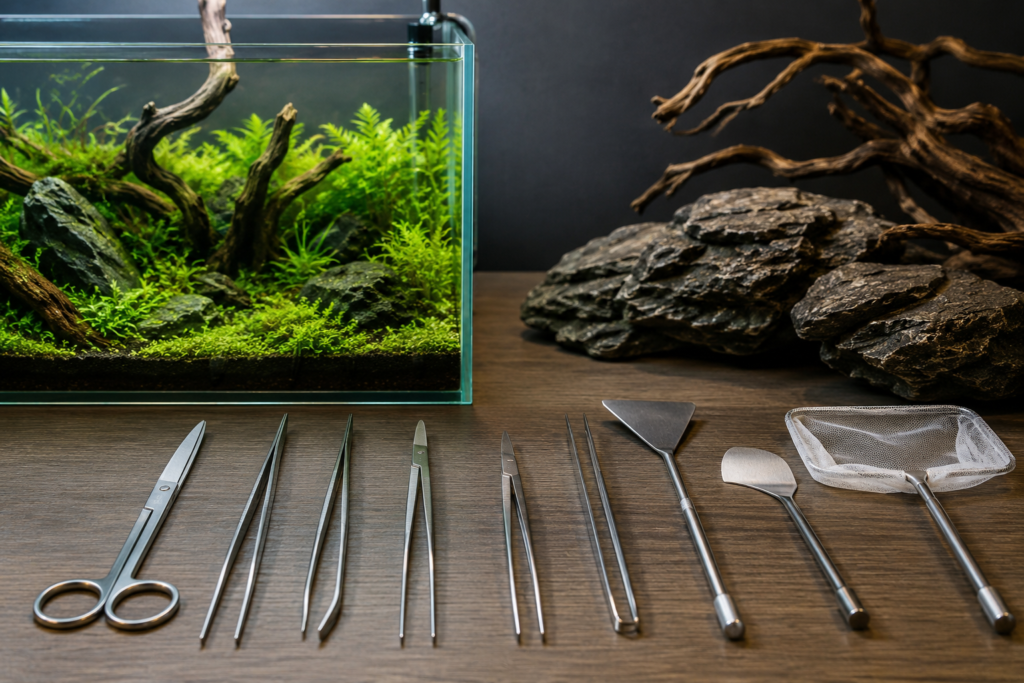
Starting your first planted tank is exciting — right up until you realise your kitchen tongs and a butter knife aren’t going to cut it. Aquascaping, the art of arranging plants, rocks, wood, and substrate into a living underwater landscape, rewards patience and precision. And precision starts with having the right aquascaping tools for beginners in Australia.
This guide walks you through exactly what to buy, what to skip, where to shop locally, and how much you should realistically budget — whether you’re setting up a 20-litre nano tank on a study desk or a full 120cm display in the living room.
What Is Aquascaping, Exactly?
Aquascaping is essentially underwater landscaping. Instead of just dropping a few plastic plants into a tank, aquascapers use live plants, driftwood, and rock to build layouts inspired by forests, mountain valleys, or Japanese garden design (the “Iwagumi” style is a classic example). It’s part hobby, part art form, and increasingly popular across Australian fishkeeping communities on Facebook and Reddit.
The catch is that good aquascaping depends heavily on tools. Trying to plant delicate stems with your fingers usually ends in torn leaves, cloudy water, and a very frustrated beginner.
Why the Right Tools Matter for Beginners
New hobbyists often assume tools are optional extras. In reality, they solve three very specific problems:
- Precision — Planting carpet species like Monte Carlo or Hemianthus by hand is nearly impossible without long tweezers.
- Plant health — Blunt scissors crush stems instead of cutting them, which invites rot and algae.
- Time and mess — The right scraper, siphon, or spatula turns a 45-minute maintenance session into a 10-minute one.
Investing a modest amount upfront in proper aquascaping tools almost always saves money later, because you’re not replacing dead plants or fighting algae outbreaks caused by decaying, poorly-trimmed leaves.
Essential Aquascaping Tools Every Beginner Needs
1. Substrate and Hardscape Tools
Before a single plant goes in, you need to shape the base layer.
- Substrate spatula/spreader — for levelling soil and creating slopes
- Substrate scoop — for adding or removing aquasoil without clouding the water
- Small garden trowel (aquarium-safe) — useful for larger tanks
2. Planting Tools
This is where most beginners under-invest, and it shows.
- Long straight tweezers (25–30cm) — for general planting
- Curved/angled tweezers — for tucking stems into tight corners
- Wide-tip tweezers — for handling rosette plants like Cryptocoryne
3. Trimming and Pruning Tools
- Curved aquascaping scissors — for shaping carpet plants
- Straight scissors — for stem plants and quick trims
- Wave/spring scissors — for detailed, precise cuts in dense layouts
4. Cleaning and Maintenance Tools
- Algae scraper (magnetic or handheld) — glass stays clear without draining the tank
- Gravel vacuum/siphon — removes waste from substrate during water changes
- Water testing kit — checks pH, ammonia, nitrite, and nitrate levels
5. Lighting and CO2 Basics
Not strictly “tools” in the handheld sense, but no beginner setup is complete without them.
- Full-spectrum LED aquarium light — supports healthy plant growth
- Basic CO2 diffuser or drop checker — helps beginners avoid algae issues linked to inconsistent CO2 levels
Quick Reference Table: Beginner Toolkit at a Glance
| Tool | Purpose | Typical AUD Price Range |
| Long tweezers | Precise planting | $12–$35 |
| Curved scissors | Carpet plant trimming | $15–$40 |
| Straight scissors | Stem plant trimming | $10–$30 |
| Algae scraper | Glass cleaning | $8–$25 |
| Gravel vacuum | Water changes | $15–$45 |
| Substrate spatula | Soil levelling | $10–$25 |
| LED light | Plant growth | $50–$250 |
| CO2 drop checker | Monitoring CO2 levels | $10–$20 |
Where to Buy Aquascaping Equipment in Australia
Australia has a growing but still fairly niche aquascaping retail scene compared to the US, UK, or Japan. When shopping for aquascaping equipment Australia-wide, you generally have three options:
- Local aquarium and fish stores — Good for basics, but specialised tools (curved scissors, aquascaping-specific tweezers) are often limited in stock.
- Australian online retailers — Increasingly popular, with faster shipping and no import delays.
- Overseas imports — Cheaper upfront, but slower, and subject to Australian biosecurity rules.
A Word on Biosecurity Law (This Actually Matters)
This is one area where beginners genuinely get caught out. Australia has strict biosecurity regulations under the Biosecurity Act 2015, enforced by the Department of Agriculture, Fisheries and Forestry. Live aquatic plants, driftwood, and rock sourced from overseas can carry pests, snails, or invasive species — and importing them without proper permits and treatment can result in confiscation or fines at the border.
Practical takeaway: Stick to Australian-sourced or pre-cleared hardscape materials and plants unless you’ve specifically checked current import conditions. It’s not just a legal formality — it protects local waterways from invasive aquatic species, which is a real ecological risk in Australia.
Ready-Made Kits vs. Building Your Own Toolkit
For total beginners, there’s a genuine debate between buying tools individually or grabbing a starter bundle.
Buying individually works well if you already know your tank size, plant choices, and layout style. You avoid paying for tools you won’t use.
Starter kits are usually the smarter move for first-timers. A well-curated set, like the wio aquascaping kits, bundles the essentials — tweezers, scissors, a scraper, and sometimes a spatula — into one purchase, which is often cheaper than buying each item separately and removes the guesswork of “what do I actually need?”
If you’re unsure where to start, browsing a curated collection of aquascaping tools designed specifically for beginners is usually faster and less overwhelming than piecing together a kit from five different listings.
Budget Guide for Beginners
| Setup Level | Tank Size | Estimated Tool Budget (AUD) |
| Starter/Nano | Up to 30L | $60–$120 |
| Standard | 40L–100L | $120–$250 |
| Advanced Beginner | 100L+ | $250–$450 |
These figures cover tools only — not substrate, plants, lighting, or the tank itself.
Common Mistakes Beginners Make
- Using kitchen tools instead of aquascaping-specific ones — leads to torn plants and cloudy tanks
- Skipping a drop checker — CO2 issues are one of the biggest causes of early algae outbreaks
- Buying the cheapest scissors available — blunt blades crush rather than cut, damaging stem plants
- Overcrowding the layout early — trimming tools only help if you’ve left room to actually trim
- Ignoring import/biosecurity rules — risks fines and introduces pests to local ecosystems
Tips for Long-Term Success
- Clean tools after each use to prevent algae spores spreading between tanks
- Replace scissors when they start bending stems instead of cleanly cutting them
- Keep a dedicated tool caddy near the tank — it genuinely speeds up maintenance
- Start with fewer, higher-quality tools rather than a large set of cheap ones
Frequently Asked Questions
- What’s the single most important aquascaping tool for a beginner? Long tweezers. Almost every layout requires precise planting, and fingers alone damage delicate root systems and leaves.
- Can I use regular scissors instead of aquascaping scissors? You can, but it’s not recommended. Standard scissors are usually too blunt or too large for the tight, precise cuts aquascaping requires, and they often crush rather than slice plant stems.
- Are imported aquascaping tools safe to buy from overseas? Metal and plastic tools (tweezers, scissors, scrapers) are generally fine to import. Live plants, driftwood, and rock are the items that fall under Australian biosecurity restrictions, so check current import conditions before ordering those specifically.
- Do I need CO2 equipment as a total beginner? Not immediately. Many beginners start with low-tech setups using easy plants that don’t require CO2 injection. A drop checker becomes more important once you move to higher-light, higher-demand plant species.
- How much should a beginner budget for aquascaping tools in Australia? For a small to mid-sized tank, expect to spend roughly $60–$250 AUD on essential tools, depending on whether you buy individually or opt for a bundled starter kit.
- Is a starter kit better value than buying tools separately? For most first-time aquascapers, yes. Kits are usually priced lower than the sum of individual items and take the guesswork out of what you actually need for your first build.
Final Thoughts
Aquascaping is one of those hobbies where the right tools genuinely change your results — not just your convenience. A beginner with proper tweezers, sharp scissors, and a decent scraper will consistently build cleaner, healthier layouts than someone working with improvised kitchen tools, regardless of how much they’ve spent on plants or hardscape.
Start small, prioritise quality over quantity, buy from Australian-based sellers where possible to avoid biosecurity headaches, and don’t be afraid to lean on a well-built starter kit if you’re not yet sure what your first layout will look like. The tank will thank you for it.