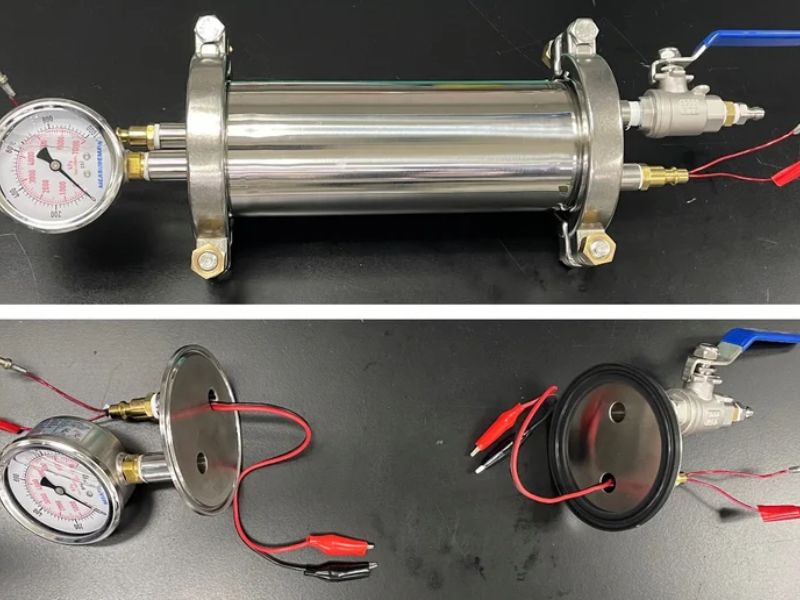
Battery research is moving toward new cell designs that can deliver better performance, improved safety, and longer operating life. Solid state batteries are an important part of this progress because they use solid electrolyte materials instead of conventional liquid electrolytes. As these batteries develop, researchers need reliable ways to test cells under controlled conditions. An Isostatic Pouch Cell Testing Vessel can support this work by helping researchers study pouch cells while applying controlled pressure during testing. Ampcera develops advanced materials, equipment, and services for next generation energy storage research. Its portfolio supports teams working with solid state batteries, sulfide electrolytes, coated cathodes, electrode processing, and prototype cell development.
Understanding the Isostatic Pouch Cell Testing Vessel
An Isostatic Pouch Cell Testing Vessel is specialized equipment designed to support controlled testing of pouch cells under pressure. Pressure can be an important variable in solid state battery research because solid materials need close contact at their interfaces.
Unlike liquid electrolytes, solid electrolytes do not naturally flow around electrode particles. Researchers may therefore need to study how pressure affects contact, resistance, cycling behavior, and overall cell performance.
A controlled testing vessel gives researchers a practical way to investigate these factors while maintaining defined experimental conditions.
Why Pressure Matters in Solid State Batteries?
Pressure can influence several parts of a solid state battery. It may affect the physical contact between the cathode, solid electrolyte, and anode. It can also influence the way particles remain connected during cycling.
The ideal pressure is not the same for every battery design. It depends on material properties, cell structure, electrode thickness, electrolyte type, and testing conditions.
Researchers can use controlled pressure experiments to understand how a cell responds under different mechanical conditions. This information can be useful when designing future battery architectures.
Key Testing Considerations
When planning pressure controlled pouch cell testing, researchers may consider:
- Applied pressure
- Pressure uniformity
- Cell dimensions
- Electrolyte chemistry
- Electrode composition
- Cycling conditions
- Temperature
- Charge and discharge rates
- Test duration
- Safety requirements
Keeping these factors controlled can make experimental results easier to compare.
How Pouch Cell Testing Supports Battery Research?
Pouch cells are useful for battery development because they can provide a practical format for testing larger electrode areas than very small laboratory cells. They can also help researchers investigate how materials behave in a more representative cell configuration.
An Isostatic Pouch Cell Testing Vessel can be useful when the research objective includes studying pressure effects on pouch cells. Researchers can examine cell behavior while controlling the mechanical environment around the pouch.
This can provide valuable information about how a solid state battery responds during charging and discharging.
What Can Researchers Learn From Controlled Testing?
Controlled pouch cell testing can help teams investigate several performance areas. These may include capacity retention, voltage behavior, resistance changes, cycling stability, and the effect of mechanical pressure.
Researchers can compare cells under different pressure conditions and identify trends. For example, they may examine whether a particular pressure range improves contact between solid components or whether excessive pressure creates other problems.
The results can guide later material and cell design decisions.
Ampcera’s Role in Solid State Battery Development
Ampcera focuses on materials and solutions for next generation battery research. Its product range includes sulfide solid electrolytes, coated cathode materials, electrode processing services, electrolyte film processing, and research equipment.
The company’s approach connects materials with practical battery development needs. This can be useful for teams that need to study not only individual materials but also how those materials behave in complete cell structures.
An Isostatic Pouch Cell Testing Vessel can complement advanced battery materials by providing a controlled platform for pouch cell evaluation.
Working With Sulfide Solid Electrolytes
Sulfide solid electrolytes are widely studied for solid state battery applications because many compositions can provide strong lithium ion transport. However, these materials can also have specific handling and processing requirements.
When a sulfide electrolyte is combined with a cathode and other cell components, interface behavior becomes important. Pressure can influence how these solid materials maintain physical contact.
Researchers can therefore evaluate electrolyte and electrode combinations under controlled mechanical conditions to better understand their behavior.
The Importance of Cathode Materials
Cathode selection is another important part of solid state battery development. NMC materials are widely researched for their energy potential, while surface coatings can be used to study and manage cathode electrolyte interactions.
Ampcera offers coated cathode materials, including lithium niobium oxide and lithium zirconium oxide coated NMC products. These materials can be evaluated alongside solid electrolytes in experimental cell designs.
Using compatible materials is important because battery performance depends on interactions between multiple components rather than one material alone.
From Materials to Complete Cells
Battery development often starts with powder characterization and material testing. Researchers then move toward electrode fabrication, cell assembly, and performance testing.
Ampcera provides services that support several of these steps. Its dry electrode processing service can help prepare cathode composite materials and dry processed electrode samples. Its sulfide electrolyte film service supports the processing of solid electrolytes into films or membranes for research and prototype applications.
Once materials are incorporated into cells, controlled testing becomes important for understanding their practical behavior.
Why Testing Conditions Should Be Consistent?
Consistency is essential in battery research. If pressure, temperature, cell assembly, or testing conditions change between experiments, it may become difficult to determine what caused a difference in performance.
A controlled testing setup can help researchers reduce unnecessary variation. Teams can define pressure levels, cycling schedules, and other parameters before beginning an experiment.
An Isostatic Pouch Cell Testing Vessel can contribute to this controlled approach when pressure is an important part of the test design.
Benefits of Pressure Controlled Pouch Cell Testing
There are several reasons researchers may consider pressure controlled pouch cell testing.
Potential benefits include:
- Controlled mechanical conditions
- Better study of solid solid interfaces
- Repeatable pressure application
- Support for pouch cell research
- Evaluation of pressure dependent performance
- Useful data for cell design
- Support for prototype development
These benefits depend on the specific equipment, material system, and test procedure. Researchers should define their testing goals before selecting equipment.
What Should Researchers Consider Before Testing?
Before using an Isostatic Pouch Cell Testing Vessel, teams should understand the requirements of their cell design. The vessel should be suitable for the cell dimensions, intended pressure range, operating temperature, and testing procedure.
Researchers should also establish clear test plans. This may include baseline cells, multiple pressure conditions, repeated tests, and defined cycling protocols.
A good experimental plan makes it easier to identify meaningful changes and avoid drawing conclusions from a single test.
Moving Toward Prototype Development
Laboratory research is an important first step, but battery developers eventually need to understand how materials behave in larger and more practical cell formats.
Pouch cell testing can help bridge the gap between small laboratory experiments and more advanced prototypes. It allows researchers to investigate material combinations, electrode structures, and operating conditions in a useful cell format.
Ampcera’s combination of advanced materials, processing services, and research equipment can support teams as they move through different stages of development.
Frequently Asked Questions
What is an Isostatic Pouch Cell Testing Vessel used for?
An Isostatic Pouch Cell Testing Vessel is used to support controlled pouch cell testing where pressure is an important experimental variable. It can help researchers study how pressure affects solid state battery behavior.
Why is pressure important for solid state batteries?
Solid state batteries contain solid materials that need close physical contact. Pressure can influence interfaces and may affect resistance, cycling behavior, and mechanical stability.
Can pouch cells be used for solid state battery research?
Yes. Pouch cells can provide a useful format for evaluating solid state battery materials and cell designs. The appropriate testing setup depends on the specific research objective.
Does higher pressure always improve performance?
No. Higher pressure does not automatically produce better results. The suitable pressure depends on the materials, cell architecture, and operating conditions. Researchers should test different conditions carefully.
What materials can be tested in pouch cells?
The materials depend on the cell design. Solid electrolytes, cathode materials, anodes, conductive additives, and protective coatings can all be part of experimental solid state battery cells.
Building a Reliable Battery Testing Workflow
Successful battery development requires a connection between material selection, processing, cell assembly, and testing. Researchers can gain better insights when each stage is carefully controlled and documented.
An Isostatic Pouch Cell Testing Vessel can be one part of this workflow for teams studying pressure dependent pouch cell behavior. Combined with suitable solid electrolytes, engineered cathodes, controlled electrode processing, and repeatable cycling tests, it can support a more structured research process.
Ampcera’s focus on advanced battery materials and supporting technologies helps researchers explore different stages of solid state battery development. The company provides solutions that can support material evaluation, electrode preparation, prototype development, and cell testing.
Conclusion
Solid state battery development involves many connected challenges. Researchers need to understand material properties, interfaces, pressure effects, processing conditions, and long term cell behavior.
An Isostatic Pouch Cell Testing Vessel provides a practical way to study pouch cells under controlled pressure. This can help researchers investigate mechanical conditions and their relationship with electrochemical performance.
Ampcera supports this broader development process through advanced solid electrolytes, coated cathodes, electrode processing, electrolyte films, and battery research equipment. By combining material innovation with practical testing solutions, Ampcera helps research teams explore new battery designs and move closer to reliable next generation energy storage technologies.