Air Traffic Management benefits from satellite-based navigation technologies that support more accurate aircraft positioning and flexible flight routes.
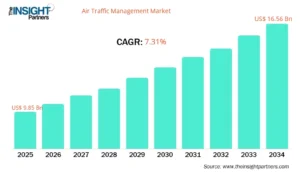
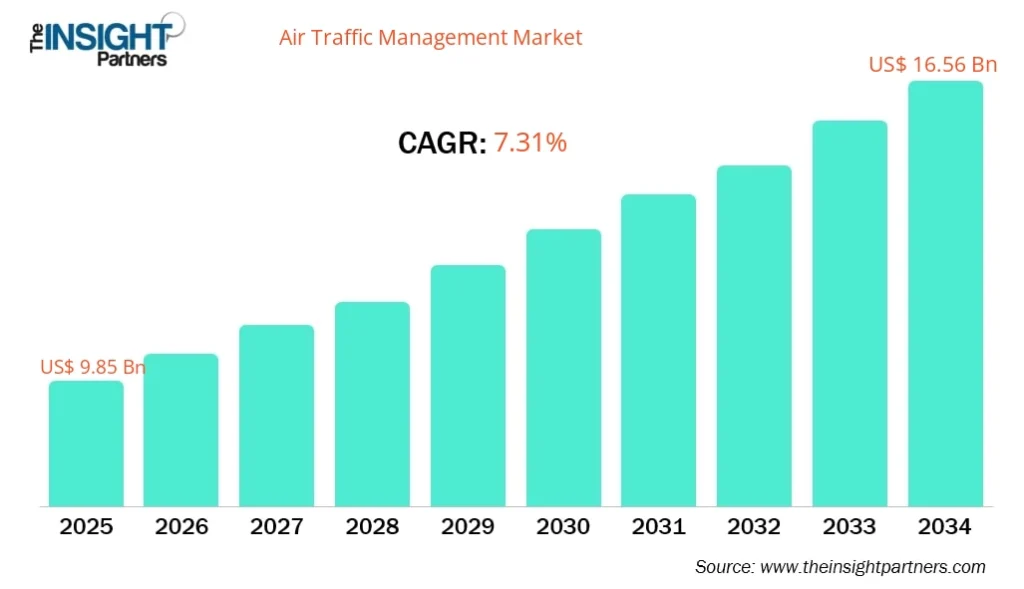
The Air Traffic Management Market size is projected to reach US$ 9.85 Billion in 2025 and is expected to reach US$ 16.56 Billion by 2034. The market is expected to register a CAGR of 7.31% during the forecast period.The market is expanding as civil aviation authorities, air navigation service providers (ANSPs), defense organizations, and airport operators modernize airspace architecture to handle record passenger volumes, enhance operational safety, and reduce flight delays.Growth is supported by government mandates, trajectory-based operations, space-based surveillance, and ongoing investments in digital airport infrastructure.
What is driving the market?
Rising passenger air traffic, increasing airspace congestion, and government-led modernization programs serve as the primary growth drivers. Aviation authorities are compelled to replace legacy analog systems with automated, digital air traffic control platforms to optimize flight trajectories, minimize fuel burn, and prevent bottleneck delays. Additionally, the accelerated deployment of Unmanned Aircraft System Traffic Management (UTM) and Advanced Air Mobility (AAM) networks demands next-generation, cloud-based traffic management capabilities alongside traditional air traffic control.
The industry is moving beyond localized ground radar infrastructure toward unified digital airspace ecosystems.Suppliers are investing heavily in satellite-based navigation and surveillance (such as space-based ADS-B), automated conflict detection tools, and AI-driven flow management solutions.High capital investment requirements, long hardware procurement cycles, and rigid safety certification processes remain key market constraints.
Get a PDF Sample- https://www.theinsightpartners.com/sample/TIPRE00005933
Which region leads?
Asia Pacific leads the global market, capturing an estimated 34%–38% share in 2025, while also standing out as the fastest-growing region with a projected CAGR of 8.1%–8.9%. Market expansion is propelled by rapid urbanization, expanding middle-class passenger demand, massive airport construction projects, and substantial government investments in national airspace upgrades. China and India represent major growth hubs as swelling domestic flight frequencies necessitate advanced air navigation and surveillance systems.
North America accounts for approximately 28%–32% of total revenue, anchored by extensive fleet operations and large-scale deployment programs like the Federal Aviation Administration’s NextGen.Europe holds an estimated 26%–30% share, driven by single-sky harmonization programs such as SESAR and mandatory shifts toward automated trajectory management.
Which segment leads?
By Component
- Hardware
- Software
- Service
By Application
- Air Traffic Services
- Air Traffic Flow Management
- Airspace Management
- Aeronautical Information Management
By End User
- Military
- Commercial
Which companies are prominent?
The market is characterized by key global defense integrators, navigation specialists, and specialized technology vendors. Prominent participants in the air traffic management landscape include:
-
Advanced Navigation and Positioning Corporation
-
BAE Systems PLC
-
Harris Corporation
-
Honeywell International, Inc.
-
Intelcan Technosystems Inc.
-
Lockheed Martin Corporation
-
Raytheon Company
-
SAAB AB
-
Saipher ATC
-
Thales Group
These market leaders compete across radar and surveillance fabrication, communication link deployment, digital tower management, cloud software suites, and UTM integration. Strategic differentiation depends on system reliability, multi-system interoperability, AI automation capabilities, and compliance with stringent international aviation safety standards.
What is changing in 2026?
The market is transitioning rapidly from traditional ground-based surveillance to cloud-native, data-driven air traffic orchestration. Flight operations increasingly rely on real-time satellite data, digital controller-pilot data links (CPDLC), and remote digital towers that replace physical control structures at regional and remote airports. Implementation deadlines under major modernization frameworks are compelling air navigation service providers to adopt standardized digital interfaces and certified cybersecurity architectures.
Air traffic control centers are accelerating the adoption of predictive analytics to automate routine conflict detection and route optimization, reducing controller workload.Hardware procurements are increasingly tied to software flexibility, allowing ANSPs to upgrade algorithms and security protocols via digital patches rather than complete infrastructure overhauls.
What are the major investment opportunities?
The strongest investment opportunities lie in remote/digital tower technologies, space-based ADS-B tracking, software virtualization, and UTM infrastructure.Upgrading regional airports with digital camera arrays and remote sensors offers high cost-efficiencies compared to constructing traditional brick-and-mortar control towers. Software developers producing AI-driven traffic flow optimization tools and predictive weather-rerouting algorithms are positioned for recurring subscription and licensing models.
Additional opportunities exist in dual-use civil-military traffic management platforms, advanced cybersecurity layers for connected airspace, and low-altitude drone tracking networks.Emerging economies across Asia Pacific, the Middle East, and Latin America offer high-growth expansion potential as governments modernize aging air safety infrastructure to support rising fleet numbers.
Related Reports-
About The Insight Partners
The Insight Partners is a leading market research and consulting firm delivering actionable insights through in-depth industry analysis and strategic intelligence. The firm supports clients across various industries in making informed business decisions by providing comprehensive market forecasts, competitive assessments, and growth opportunities.
Contact Us:
If you have any queries about this report or if you would like further information, please contact us:
Contact Person: Ankit Mathur
E-mail: sales@theinsightpartners.com
Phone: +1-646-491-9876
Also Available in : Korean| German| Japanese| French| Chinese| Italian| Spanish