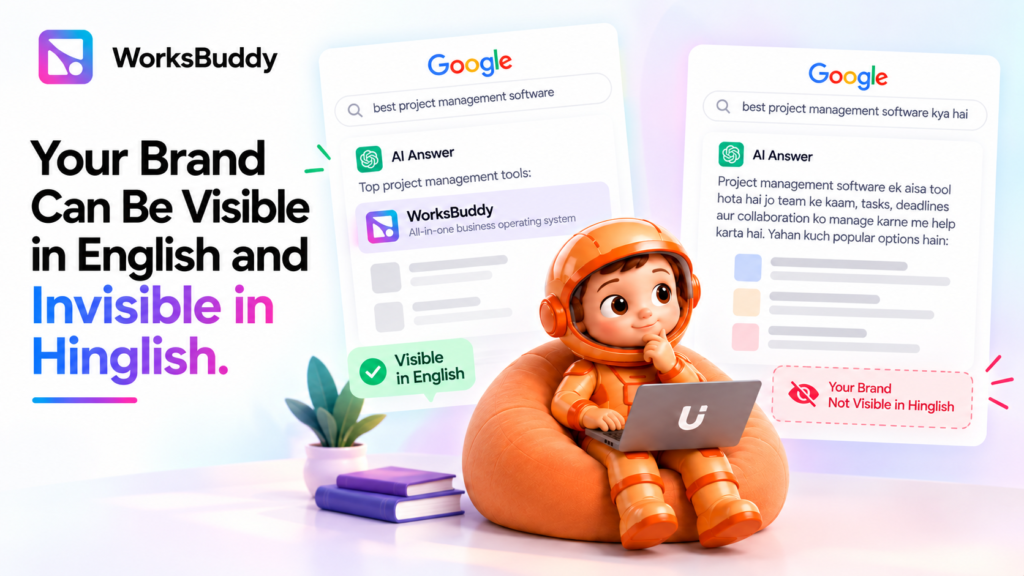
AI brand visibility can change by language and phrasing, creating a new challenge for companies selling across multilingual markets.
Ask an AI assistant in English, “What’s a good CRM for a small sales team,” and a company might appear confidently in the answer, backed by years of English-language content, reviews, and comparison articles.
Ask the same assistant almost the same question in Hinglish, the mix of Hindi and English that hundreds of millions of people actually use to search, type, and speak every day, and that same company can vanish entirely. Not because the product is any different. Because the AI system has almost nothing written in that register to draw from.
This is not a hypothetical gap. For any business selling into India, or into any market where customers move fluidly between English and a regional language, it’s likely already happening, quietly, in conversations the business will never see.
Two searches, two different companies
Consider a founder in Pune looking for accounting software. In English, they might type something close to a textbook query: “best accounting software for small business India.” In Hinglish, the same question, asked the way they’d actually say it out loud to a friend, might look more like “chhoti company ke liye accounting software kaunsa best hai” or a dozen other natural phrasings that mix English product terms with Hindi grammar and connecting words.
To a person, these are obviously the same question. To an AI system building its answer from the content available to it, they can pull from almost entirely different pools of source material.
The English query draws on a market flooded with English-language SaaS content: comparison articles, review sites, product pages, blog posts, all written in the formal or semi-formal English that dominates B2B content globally. The Hinglish query draws on a much thinner, messier layer of content, much of it written by different creators for different purposes, often less structured, sometimes barely indexed at all in ways an AI system’s underlying sources can cleanly parse.
A brand that has invested heavily in English content marketing can be the confident, repeated answer to the first query and a complete stranger to the second, despite the two buyers wanting exactly the same product.
Why this happens: AI systems answer from what exists, not what’s true
It’s tempting to assume an AI system somehow “knows” a brand and should recognize it regardless of the language a question arrives in. That’s not how these systems work.
An AI-generated answer is built from the sources available to the system for that specific query, in that specific language and phrasing. Google has described its AI features as using query fan-out, issuing multiple related searches across different sources before assembling a response. OpenAI has explained that ChatGPT search draws on third-party search providers and publisher content connected to the query. In both cases, the system is reading what exists in the language and phrasing it was asked in, not translating a broader understanding of a brand across languages on its own.
If a business has published almost nothing in Hinglish, or in Hindi more broadly, there is very little for the system to draw from when a buyer asks in that register. The brand isn’t being excluded on purpose. It’s simply not present in the material the system is working with for that specific conversation.
This is the same dynamic that produces inconsistent AI visibility even within a single language. Semrush’s study of 50,000 brands across 1,094 topic areas found that only 15.2% of topics had a clear topic owner, meaning visibility already varies significantly depending on exactly how a question is phrased, even before language enters the picture. Add a second language and a mixed register like Hinglish into that mix, and the variation compounds. A brand isn’t managing one visibility problem. It’s managing a separate one for every language and phrasing pattern its actual customers use.
Hinglish is not a translation problem
The instinctive fix, translate the existing English content into Hindi, misses what’s actually happening, and it’s worth being direct about why.
Hinglish isn’t simply Hindi. It’s a distinct, organic way that people communicate, mixing English vocabulary, especially for business and technology terms, with Hindi grammar, sentence structure, and connecting words. Nobody searching in Hinglish is typing formal Hindi with English words swapped in. They’re typing the way they’d actually text a colleague or ask a question out loud, which is neither pure Hindi nor formal English but something with its own natural rhythm.
A literal translation of an English blog post into formal Hindi doesn’t necessarily help an AI system answer a Hinglish query well, because the register doesn’t match how the question was actually asked. What closes the gap is content genuinely written in the way buyers actually phrase things, which is a different exercise than translation. It requires understanding the specific vocabulary a Hinglish-speaking buyer uses for a category, the questions they ask, and the phrasing patterns that are common in that register, none of which shows up automatically from converting existing English content word for word.
This is also why the gap tends to be invisible until a business specifically goes looking for it. A marketing team checking their brand’s AI visibility in English sees a reasonable result and reasonably assumes the brand is broadly visible. Nobody runs the same check in Hinglish unless they specifically think to, and most teams don’t, because their existing tools and habits were built entirely around English-language search behavior.
Why this matters more for some businesses than others
Not every company needs to worry equally about this gap. It matters most for businesses with three overlapping traits.
Selling into markets where code-switching is the norm. India is the clearest example, where a huge share of day-to-day communication, especially around business, technology, and services, naturally mixes English and Hindi. But the same dynamic exists wherever a market regularly blends a local language with English for professional or technical topics.
Competing in a category where buyers research conversationally. The more a purchase decision depends on a buyer describing their specific situation to an AI system, rather than typing a short, formal keyword, the more the exact phrasing and language of that description matters, and the more a Hinglish-speaking buyer’s natural query differs from an English one.
Relying heavily on organic and AI-assisted discovery rather than direct sales. A company whose growth depends substantially on being found and recommended, rather than a dedicated outbound sales motion reaching every prospect directly, has more to lose from being invisible in an entire language register its buyers are actually using.
For a business that meets even two of these three, the Hinglish visibility gap isn’t a minor edge case. It’s a meaningful share of the actual conversations happening about their category, conducted in a language the business likely has almost no presence in.
What closing the gap actually requires
Fixing this isn’t a single content project. It’s an ongoing discipline, built around a few concrete habits.
Test in the language your buyers actually use, not just the language your content is written in. A brand’s own team almost always researches and writes internally in English, even when serving a market that searches predominantly in Hinglish or a regional language. That mismatch means the team’s own instincts about visibility are being formed in the wrong language entirely.
Create content that reflects natural phrasing, not translated phrasing. This usually means working with people who genuinely think and write in Hinglish, rather than translating existing English assets, since the goal is matching how a real question gets asked, not converting vocabulary.
Monitor visibility by language on an ongoing basis, not as a one-time check. AI-generated answers shift as new content is published and existing sources are reweighted. A brand that closes the gap once and stops checking can quietly lose that ground again without anyone noticing until a customer mentions a competitor by name.
This is exactly the kind of gap that’s difficult to catch with a general-purpose tool built around a single language. It requires an AI brand visibility tool built specifically to test how a brand appears across different languages and phrasings, not just different keywords within one language.
Making the invisible visible
This is the layer WorksBuddy built Ranko to address directly. Rather than assuming visibility in one language means visibility everywhere a brand’s buyers actually search, Ranko is designed as AI visibility software that tests the real questions buyers ask, in the language and phrasing they actually use, across AI engines like ChatGPT, Gemini, Claude, Copilot, and Perplexity.
For a business selling into India or any multilingual market, that means testing a category question in English and testing the Hinglish version a real buyer would actually type or say, side by side, and seeing whether the same brand shows up in both. Where it doesn’t, that gap becomes visible and specific, rather than a vague sense that “AI visibility” needs attention somewhere.
That specificity matters. “We should work on our AI visibility” is hard to act on. “We’re the top recommendation in English for this category, and completely absent when the same question is asked in Hinglish” is a clear, addressable problem with a clear starting point.
Conclusion
A brand can do everything right in English, build strong content, earn credible mentions, show up consistently when an AI system is asked in that language, and still be a complete stranger to a meaningful share of its own buyers, simply because those buyers asked the question differently.
That gap doesn’t show up in a typical visibility check, because most visibility checks are run in the same language the checking team already thinks in. It only becomes visible when a business specifically tests for it.
If your customers move between English and Hinglish, or any other mix of languages, the way most of India actually does, see how Ranko tracks AI visibility across languages and phrasings, not just the one your content happens to be written in.