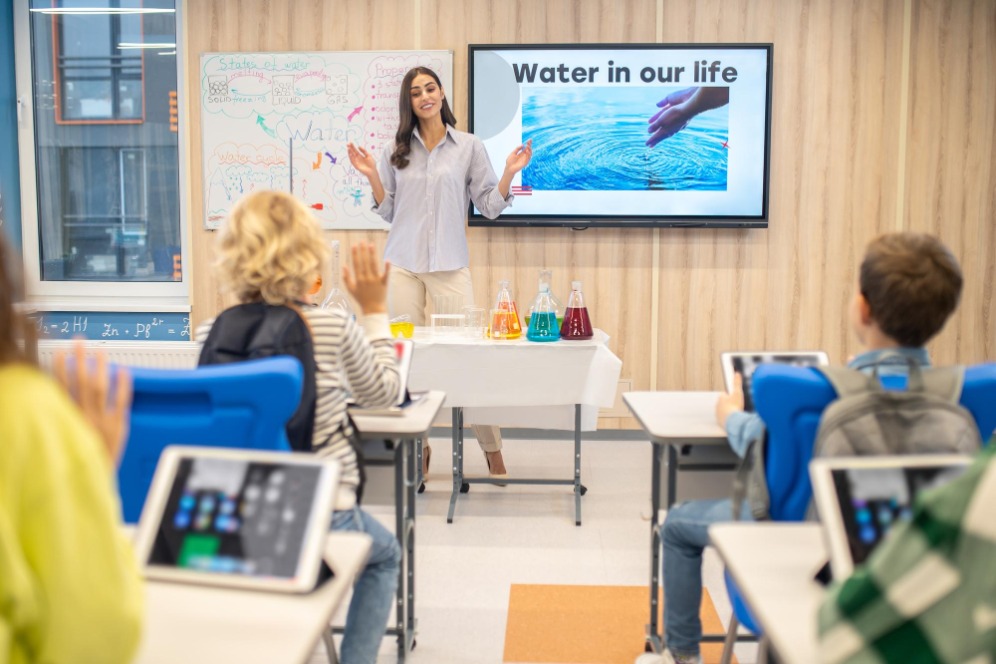
Interactive classrooms with smart technology create engaging and effective learning experiences.
A classroom is not only four walls and a whiteboard, but it’s a part of how your child learns and grows. According to a World Bank study, the physical environment where learning happens can explain up to 16% of a student’s academic progress. University of Salford backed this number with an independent study.
Thus, modern learning facilities on a campus are primary enablers of holistic development and provide the necessary foundation for students to thrive across all dimensions of growth.
This guide describes what an advanced learning environment includes and how to look beyond appearance when comparing campuses.
Why Do Physical Learning Environments Matter?
Before moving to what modern facilities include, it’s worth understanding why these are an important part of the learning environment.
The “Third Teacher”: What the Research Actually Shows?
The classroom design directly shapes the learning outcomes, and this idea isn’t new. The physical learning environments are treated as a core lever for improving education outcomes according to the RIGHT + framework developed by the World Bank with the World Health Organization and UNESCO.
Thoughtfully designed spaces encourage exploration, foster independence, and provoke curiosity without the need for direct adult instructions. Such spaces speak to the children and shape their behavior.
Beyond Test Scores: Attendance, Wellbeing, and Behavior
The impact of an advanced learning environment is not limited to grades. Several studies on school building conditions have linked environmental factors such as air quality, natural lighting, and acoustics to attendance and behavior.
Schools that studied the effects of natural daylight on classrooms found that the students who are more exposed to daylight progress noticeably faster in reading and math than those in poorly lit rooms. Schools with fewer maintenance and air-quality issues consistently report lower average daily attendance than ones with better facilities.
Simply, modern education support keeps students in their seats and able to concentrate, which are the most important initial requirements for learning and growing.
What Defines a Modern Facility Today?
The term “modern” is used too often in school marketing. A truly modern facility covers several major categories, and a strong school usually invests across all of them.
Smart Classrooms and Digital Infrastructure
Smart classrooms are the ones that include interactive displays, reliable connectivity, and digital classrooms that are built for two-way engagement. These are where students not only listen to lessons, but actively engage and participate in them.
Interactive learning tools such as collaborative software and real-time feedback systems are becoming the real differentiators between modern classrooms and the ones that are simply being repainted.
Flexible, Collaborative Learning Spaces
Fixed rows of desks are a legacy design choice, but aren’t always functional. Flexible and modular furniture that can be rearranged for group work, independent study, or presentations supports multiple teaching methods.
Research from the National Education Association found that a majority of students (78% in a national survey) reported better concentration with flexible seating options. This figure rose to 88% among students with mental health-related concerns.
This highlights that flexible seating arrangements are not only a comfort upgrade but a real accessibility factor.
Science Labs, Makerspaces, and STEM-Ready Rooms
Practical spaces such as science labs, STEM labs, and markerspaces provide students with chances to apply concepts in real life. Labs that are designed well prioritize:
Adaptability: The same space supports biology, chemistry, and robotics.
Safety: Proper ventilation, secured storage, and clear safety protocols.
Accessibility: For students with different physical requirements.
These spaces become more important when they are built for flexibility rather than for a single narrow use case.
School Libraries and Resource Centers
The modern school library does not look like the rows of bookshelves anymore. Today’s libraries are collaborative resource hubs. These are used for research, quiet study, and group project work and are often integrated with digital resources along with physical collections.
A school library’s design tells a lot about whether independent learning is truly supported or treated as a secondary or less-priority thing.
Wellbeing and Sports Facilities
Sports and well-being-focused spaces, such as quiet rooms and outdoor activity areas, tie directly back to the attendance and behavior research above. Dedicated decompression and physical activity spaces support similar outcomes that lighting and air quality do.
Students who are physically comfortable and are given room to reset can better concentrate upon returning to the classroom.
The UAE Context: Facilities Built for Local Realities
Wondering “what modern school facilities need to mean in the Gulf region, where the real evaluation criteria for local parents should start.
Climate-Responsive Design: Heat, Air Quality, and Cooling Efficiency
Air quality and temperature control are central to the UAE context. These determine whether a school facility functions for most of the school year. Efficient and well-maintained cooling systems, shaded outdoor learning areas, and strong indoor air quality management directly affect the attendance and concentration outcomes discussed above.
UAE schools need to treat climate-responsive design as a core infrastructure due to extreme weather conditions. Applying daylight and air-quality research to UAE-specific learning environments is important to achieve the desired learning outcomes.
KHDA and ADEK Inspection Standards
The quality of facilities is a part of school inspection and rating frameworks set by
The Knowledge and Human Development Authority (KHDA) in Dubai, and the Department of Education and Knowledge (ADEK) in Abu Dhabi. This gives UAE parents a locally verifiable benchmark.
The published inspection rating of a school is an appropriate starting point to assess whether its facilities meet a set standard. So, you no longer need to rely solely on a campus tour.
Designing for a Multicultural, Multilingual Student Body
The UAE’s classrooms serve a diverse and multilingual student population. One of the most underaddressed factors in facility design is:
- Flexible group spaces for varied teaching approaches
- Resource centers stocked for multiple languages and curricula
- Social spaces that support cross-cultural interaction
These factors are particularly non-negotiable to the schools operating in this region.
How to Evaluate a School’s Facilities?
Knowing what to actually check on a school visit helps parents better assess and understand the facilities it offers.
Questions to Ask on a School Tour
- Are classrooms flexible, or fixed in a single desk-and-rows layout?
- Is the school library an active study/resource hub, or an underused room?
- How is indoor air quality and cooling managed, especially during peak summer months?
- Are science labs and makerspaces used across multiple subjects, or sitting idle outside specific class times?
- What is the school’s current KHDA or ADEK inspection rating, and does it specifically comment on facilities?
- Are there dedicated wellbeing or quiet spaces separate from general classrooms?
Red Flags vs. Genuine Investment
Not every modern-looking campus reflects meaningful investment in learning. Some schools focus on cosmetic upgrades that improve first impressions, while others invest in facilities that directly support student outcomes. Use the table below to tell the difference.
| Area | Red Flag (Cosmetic Investment) | Genuine Investment |
| Classrooms | Traditional rows of fixed desks with little flexibility | Flexible furniture and layouts that support collaboration, independent work, and different teaching styles |
| Learning Spaces | Library is mostly decorative or rarely used. | Library functions as an active research, reading, and study hub throughout the school day. |
| STEM Facilities | Science labs and makerspaces are only used for scheduled lessons | Labs and makerspaces are integrated into multiple subjects and project-based learning |
| Air Quality & Comfort | Little information about ventilation or cooling systems | School can explain its ventilation, air filtration, and climate-control measures for student wellbeing |
| Student Wellbeing | No dedicated wellbeing or quiet spaces | Purpose-built counselling rooms, wellbeing areas, or sensory spaces are available. |
| Technology | Smartboards installed mainly for marketing. | Technology is embedded into everyday teaching with clear learning objectives. |
| Safety & Maintenance | Building looks new, but maintenance standards are unclear | Regular maintenance schedules, lab safety procedures, and transparent facility management |
| Evidence of Quality | Marketing relies on photos and brochures. | Strong inspection reports (KHDA/ADEK), transparent policies, and measurable facility improvements |
A polished campus creates a good first impression, but a best British school with modern facilities, such as the Hope English School, can explain how its facilities improve teaching, student wellbeing, and learning outcomes. Such schools also back those claims with evidence rather than appearance alone.
Modern Facilities and Long-Term Student Success
It’s now clear that modern educational facilities are not a single feature; they are a combination of environmental factors such as air quality, lighting, design, and digital infrastructure. These features directly affect the time a student spends at a school. All these work collectively to drive the academic outcomes that stand out.
For example, a school with excellent labs but poor air quality, or strong technology but overcrowded classrooms, is doing half of the job. The strongest facilities address the full range, including physical comfort, flexibility, digital readiness, climate resilience, and multicultural design, specifically in the UAE.
The benefits of modern education facilities are better concentration, higher attendance, and stronger academic progress. A modern British school in the UAE should combine international design standards with facilities that suit the country’s climate and support its diverse student community.
FAQs:
What makes a school facility “modern”?
Modern amenities are about functionality as much as appearance. Look for flexible learning spaces, interactive technology, quality science and STEM labs, healthy indoor environments, and dedicated wellbeing areas.
Do advanced facilities really improve academic performance, or is it just marketing?
Yes. Independent research has found that modern learning environments contribute to better academic performance, attendance, and focus. However, facilities work best as a complement to skilled teachers and effective classroom practices.
What should parents look for when touring a school’s facilities?
Ask about air quality and cooling management, furniture flexibility, how often labs and libraries are actually used, and the school’s current KHDA or ADEK inspection rating rather than relying on visual impressions alone.
How do smart classrooms support different learning styles?
Interactive displays and digital classroom tools allow teachers to shift between visual, collaborative, and independent learning formats within the same lesson, supporting a wider range of student needs than a traditional fixed classroom setup.
Are the latest facilities more important than teacher quality?
No, advanced facilities support learning, but they cannot replace good teaching. Research shows they improve the learning environment, helping teachers deliver better outcomes.