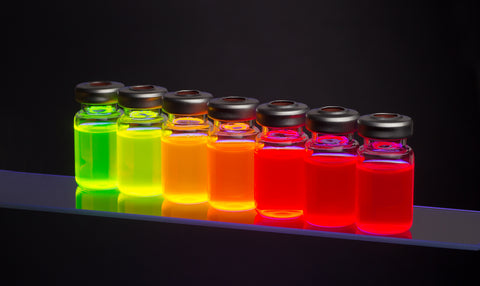
Search for gold nanoparticles for sale and you will find dozens of options. Sizes vary, surface chemistries vary, and so does the quality behind each vial. Most listings look alike until a batch behaves differently in your assay. At NNCrystal US Corporation, we have spent years making nanomaterials with our greener synthesis methods, and we have seen which choices help a project and which cause delays. This guide shows how to match the material to your work before you order.
Start With What Your Project Needs
Before you compare gold nanoparticles for sale, write down three things: the job the particles must do, the environment they will sit in, and how you will measure the result. A lateral flow test, a catalysis study, and an imaging experiment all use gold. Each asks for something different from it.
Size and Optical Response
Size drives nearly everything. Small gold spheres, around 15 to 20 nm, absorb light near 520 nm and look ruby red. As the diameter grows, the peak shifts and the color moves toward purple. When particles clump together, the shift is even sharper, which is why so many colorimetric tests rely on it.
Our standard non-functionalized gold nanocrystals cover 5 nm to 90 nm, and a second line covers 100 nm to 400 nm. Pick the range that fits your detection method first, then narrow the exact diameter.
Solvent and Stability
Think about where the particles will live. If your protocol runs in aqueous buffer, water-soluble colloidal gold is a natural starting point. Check how your buffer’s salt level and pH might affect stability. Gold that is perfectly stable in pure water can behave very differently in a salty medium.
Plain, Reactant-Free, or Functionalized?
This is the choice that trips up most first-time buyers. It helps to ask one question: do I need to attach something to the gold, or do I only need the gold itself?
When Bare Gold Is Enough
If you plan to build your own surface chemistry, start with a clean base. Our reactant-free gold nanoparticles are made without leftover reactants from the synthesis. That matters when residual chemicals could interfere with a sensitive surface study or a custom coating. A reactant-free option is also available in the larger 100 nm to 400 nm range.
When You Need a Ready-Made Surface
Functionalized gold saves weeks of bench work. Our catalog includes biotin, amine, carboxylated, methylated, and NHS activated versions.
Matching the Surface to Your Molecule
A quick way to choose:
- Biotin gold binds streptavidin, so it suits detection and capture assays built around that pairing.
- NHS activated gold reacts with primary amines on proteins and antibodies. Our NHS activated gold nanoparticle kit is built for this kind of conjugation.
- Carboxylated gold is usually coupled to amines through standard carbodiimide chemistry.
- Amine gold gives you the opposite handle for carboxyl-bearing molecules.
- Methylated gold offers a surface with no reactive group, which helps when you want to avoid unwanted binding.
If you are unsure about ligands, our team’s article on the surface science of nanocrystals explains why the coating matters as much as the core.
Shape Matters Too
Not every project calls for a smooth sphere. Gold NanoUrchins have a spiked surface that gives them more surface area and sharper features than a sphere of similar size. Researchers working in sensing and imaging often explore this shape for that reason. If you want to attach biomolecules to it, the NHS activated NanoUrchins save you the activation step.
Questions to Ask Before You Buy
A good supplier answers plain questions plainly. Before you place an order for gold nanoparticles for sale, ask these:
- How tight is the size distribution? A narrow spread gives you cleaner, more repeatable results.
- How are the particles made? Process matters for purity and for batch-to-batch consistency.
- Can the surface be changed for me? Our custom orders service covers custom wavelengths, solvents, and compositions when the catalog does not fit.
- What does the ordering process look like? Our ordering information page and FAQ answer the most common questions.
If you are comparing materials beyond gold, our buying guide for choosing quantum dots uses the same practical approach.
Choosing the right nanogold comes down to knowing your size range, solvent, surface, and shape before you buy. If you would like help narrowing the list, browse our full range of gold nanoparticles for sale or contact our team at contact@nn-labs.com or toll-free at 877-701-0662. Tell us about your project and we will point you to the gold nanoparticles for sale that fit it, or build something custom if nothing on the shelf does.