Market Overview
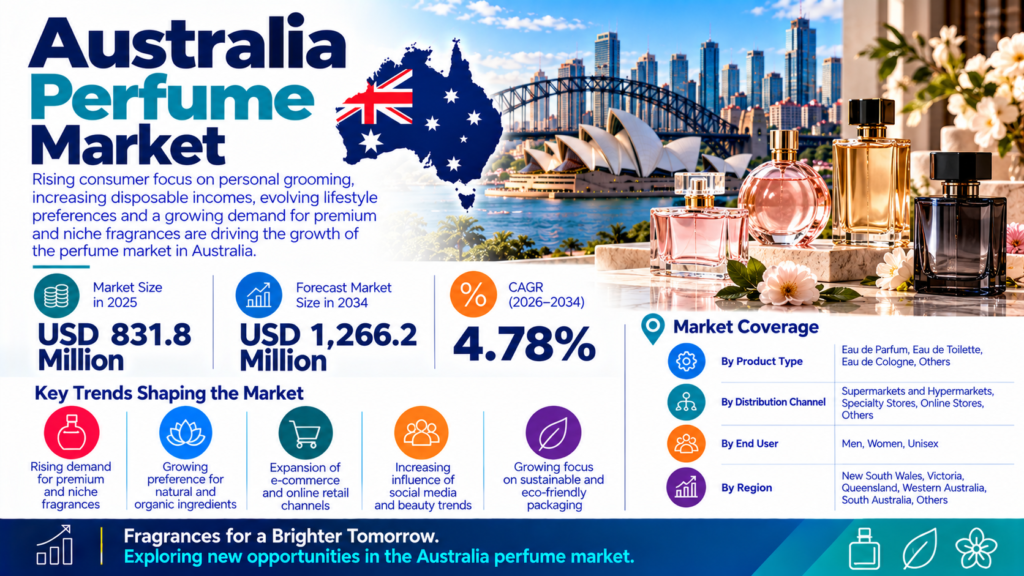
The Australia perfume market is growing steadily, driven by premiumisation and prestige gifting, the rise of niche, indie, and Australian-founded fragrance houses, e-commerce and social media-led discovery, and the recovery of international travel and duty-free spending. The market size reached USD 831.8 Million in 2025 and is projected to reach USD 1,266.2 Million by 2034, registering a compound annual growth rate (CAGR) of 4.78% during 2026-2034, with the market valued at USD 871.6 Million in 2026 and USD 1,050.5 Million in 2030, shaping the Australia perfume market share and outlook through 2034 across premium and mass perfume products, and female, male, and unisex fragrances.
Request a Sample Report for In-Depth Market Insights: https://www.imarcgroup.com/australia-perfume-market/requestsample
Market Summary
- Premium perfume products lead by type with about 58.7% share in 2025, growing at an estimated 5.3% CAGR, while mass products hold about 41.3%, growing at about 3.9%.
- Female fragrances hold about 49.6% of the market, male fragrances about 34.8%, and unisex fragrances about 15.6%, the fastest-growing category at an estimated 6.1% CAGR.
- Australian Capital Territory & New South Wales leads regionally with about 39.6% share in 2025.
- Gifting peaks around birthdays, Christmas, and Valentine’s Day, and post-pandemic recovery between 2022 and 2025 revived fragrance gifting.
- Travellers can bring in perfume valued up to AU$900 per adult, supporting duty-free spending.
- Finished perfume is imported mainly from France, the United States, and China.
- High import dependence, regulatory compliance, counterfeits, and mass-segment price pressure remain the main constraints.
- The market is segmented by perfume type, category, and region across five Australian regions, with forecasts for 2026-2034.
Market Growth Drivers
Premiumisation and Prestige Gifting
Consumers are trading up to premium and designer fragrances, and perfume remains a popular gift. Seasonal peaks around birthdays, Christmas, and Valentine’s Day support strong sales and encourage brands to launch limited editions and gift sets.
Niche, Indie, and Australian-Founded Brands
A growing set of niche and local fragrance houses is attracting consumers looking for distinctive scents and stories. Retail partnerships are giving these brands greater reach and credibility.
E-commerce and Social Media Discovery
Online shopping, social media, and virtual scent-matching tools help consumers discover and buy fragrances without testing in store. Brands are investing in digital content, samples, and online personalisation.
Travel Recovery and Duty-Free Spending
The return of international travel has revived duty-free sales, particularly in tourism-linked areas. Travellers’ ability to bring in perfume up to AU$900 per adult adds to airport and inbound retail demand.
Market Restraints and Challenges
- Import dependence: Reliance on imports exposes the market to freight costs, currency swings, and supply disruption.
- Regulatory burden: Ingredient registration and compliance under the Australian Industrial Chemicals Introduction Scheme (AICIS) add cost and lead time for new launches.
- Counterfeit and grey-market products: These undercut authorised pricing and damage brand trust.
- Mass-segment saturation: Private-label and budget alternatives compress prices.
Market Opportunities
- Sustainable and refillable packaging.
- Personalisation and fragrance wardrobing services.
Porter’s Five Forces Analysis
Competitive Rivalry: High
- Global luxury groups, designer licence holders, niche houses, and private-label brands compete on brand, scent, price, and retail presence.
- Exclusive retail partnerships and gifting campaigns are key battlegrounds.
Supplier Power: Moderate
- Brands depend on a small number of fragrance houses, ingredient suppliers, and packaging makers, and imports expose them to freight and currency movements.
- Prestige brands often control their own formulations, reducing supplier leverage.
Buyer Power: Moderate to High
- Consumers can compare prices online and switch brands, and retailers such as department stores and specialty beauty chains influence shelf space and promotions.
- Brand loyalty in prestige fragrance gives leading names some protection.
Threat of Substitutes: Low to Moderate
- Body sprays, scented body care, and candles can substitute for some purchases.
- Perfume’s personal and gifting role keeps demand resilient.
Threat of New Entrants: Moderate
- Contract manufacturing and online sales lower barriers for new niche brands, but brand building, regulatory compliance, and retail access are costly.
Market Segmentation
Perfume Type Insights
- Premium Perfume Products: About 58.7% share in 2025, with an estimated CAGR of about 5.3%.
- Mass Perfume Products: About 41.3% share in 2025, with an estimated CAGR of about 3.9%.
Category Insights
- Female Fragrances: About 49.6% share in 2025, with an estimated CAGR of about 4.5%.
- Male Fragrances: About 34.8% share in 2025, with an estimated CAGR of about 4.9%.
- Unisex Fragrances: About 15.6% share in 2025, the fastest-growing category, with an estimated CAGR of about 6.1%.
Regional Insights
- Australian Capital Territory & New South Wales: About 39.6% share in 2025.
- Victoria & Tasmania: About 24.1% share in 2025.
- Queensland: About 18.3% share in 2025.
- Western Australia: About 10.4% share in 2025.
- Northern Territory & Southern Australia: About 7.6% share in 2025.
Regional Analysis
Australian Capital Territory & New South Wales (about 39.6%): The largest regional market, led by Sydney’s boutiques, department stores, and duty-free retail. A large, affluent population and strong tourism flows support demand across premium and mass fragrances.
Victoria & Tasmania (about 24.1%): Melbourne’s specialty beauty retail and niche perfumery scene drive demand, with a strong culture of independent brands, boutique retailers, and fragrance discovery.
Queensland (about 18.3%): Tourism-linked duty-free spending and growth in metropolitan retail support demand, helped by a rising population and strong visitor numbers.
Western Australia (about 10.4%): Resource-sector incomes and Perth retail support demand, with distance from eastern hubs making online shopping and local retail important.
Northern Territory & Southern Australia (about 7.6%): E-commerce access and regional retail are the main routes to market, with South Australia’s urban centres supporting steady demand and the Northern Territory’s smaller population relying more heavily on online purchasing.
Competitive Landscape
The Australia perfume market growth is led by global luxury and beauty groups, supported by designer licence holders and a growing set of niche and local houses. Competition is shaped by brand heritage, scent portfolios, retail presence, gifting campaigns, duty-free access, and digital engagement. Niche brands are gaining visibility through retail partnerships, while major groups defend their positions through flagship launches and boutique networks.
Key players include:
- CHANEL: The market leader, with brands such as N°5, Coco Mademoiselle, Chance, and Coco Noir, boutiques in Sydney, Melbourne, Brisbane, and Parramatta, and a duty-free presence.
- L’Oréal Groupe: A strong challenger, with brands including Yves Saint Laurent, Armani Beauty, and Lancôme.
- Coty Inc.: A strong challenger, with brands including Hugo Boss, Calvin Klein, and Burberry.
- Niche houses: Grandiflora and Tsu Lange Yor, supported by MECCA partnerships.
Recent Industry Developments
November 2026: Myer announced a multi-million-dollar redevelopment of its Sydney Beauty Hall, introducing more than 40 beauty brands across approximately 4,500 square metres. New fragrance additions include Guerlain, Prada Beauty, Dolce & Gabbana, Ex Nihilo, Van Cleef & Arpels and Mind Games, strengthening the retailer’s premium and niche fragrance portfolio.
November 2026: French fragrance house Diptyque announced the opening of its first-ever Sydney boutique, expanding its Australian retail presence. The new store will provide customers with access to the brand’s fragrance collections and immersive retail experience.
October 2026: Australian fragrance retailer Scent Room launched 26 new extrait de parfum fragrances from 22 international fragrance houses. The release included collections from Clive Christian, Hermès, Issey Miyake, Memo Paris and Boadicea the Victorious, with nine brands making their debut on the retailer’s platform.
September 2026: French niche fragrance house Marc-Antoine Barrois entered the Australian market through an exclusive department-store partnership with David Jones. Its fragrance collection, including Ganymede, Encelade, B683 and Tilia, became available through David Jones stores nationally, its online platform and selected niche perfumeries.
September 2026: Australian fragrance retailer Scent Room introduced nine new extrait de parfum fragrances, including creations inspired by international brands such as Xerjoff, Roja Parfums, Amouage, Kilian Paris and Yves Saint Laurent. The releases were handcrafted in Sydney at a 30% fragrance concentration.
Key Aspects Required for the Australia Perfume Market
- Market Performance: The market reached USD 831.8 Million in 2025 and is projected to reach USD 1,266.2 Million by 2034, driven by premiumisation, niche brands, and travel recovery.
- Market Outlook: A 4.78% CAGR during 2026-2034 reflects steady growth, with premium and unisex fragrances growing fastest.
- Growth Drivers: Premiumisation and prestige gifting; niche, indie, and Australian-founded brands; e-commerce and social media discovery; and travel recovery and duty-free spending.
- Competitive Landscape: CHANEL leads, with L’Oréal Groupe and Coty Inc. as strong challengers and niche houses such as Grandiflora and Tsu Lange Yor gaining visibility.
- Industry Trends: Growth of unisex fragrances; local and niche brands; virtual scent-matching; and refillable and sustainable packaging.
- Strategic Recommendations: Strengthen premium and unisex portfolios; invest in digital discovery and sampling; partner with specialty retailers; and address counterfeits and supply-chain risk.
Note: If you need any specific information that is not currently covered within the scope of the report, we will provide the same as a part of customization.
Speak to an analyst: https://www.imarcgroup.com/request?type=report&id=32027&flag=C
Browse Other Articles:
Australia Carbon Credit Market: https://articlewaves.com/australia-carbon-credit-market-forecast-report-2026-2034/
Frequently Asked Questions
1. What is the size of the Australia perfume market?
The market reached USD 831.8 Million in 2025 and is projected to reach USD 1,266.2 Million by 2034.
2. What is the expected growth rate of the Australia perfume market?
The market is projected to grow at a CAGR of 4.78% during 2026-2034.
3. What is driving the growth of the Australia perfume market?
Growth is driven by premiumisation and prestige gifting, niche and Australian-founded fragrance brands, e-commerce and social media discovery, and the recovery of international travel and duty-free spending.