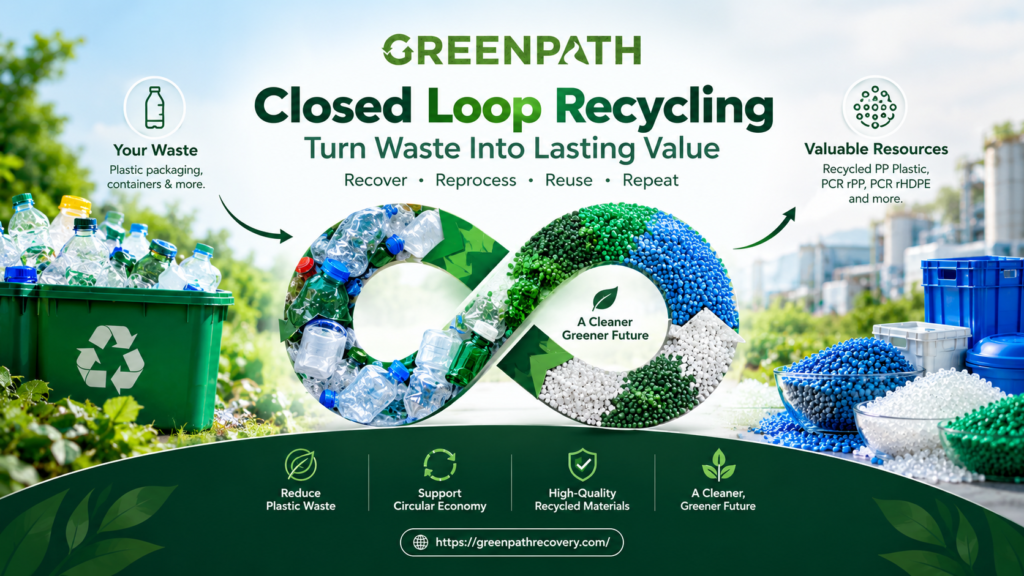
Businesses today are under increasing pressure to manage waste responsibly, use resources efficiently, and adopt more sustainable operating practices. Traditional waste management often focuses on disposing of unwanted materials, but a more resource-efficient approach is to recover and reuse them. Closed Loop Recycling offers a practical way to transform waste into valuable resources that can re-enter the manufacturing process.
For companies that generate plastic waste through packaging, production, distribution, or commercial operations, this approach can support waste reduction and more responsible material sourcing. By recovering suitable plastics and returning them to productive use, businesses can contribute to a circular economy while making better use of existing resources.
GreenPath Recovery helps businesses explore commercial recycling solutions that support material recovery and more sustainable plastic management.
What Is Closed Loop Recycling?
Closed Loop Recycling is a recycling approach in which recovered materials are processed and reused to manufacture new products, ideally returning to the same or a similar application. Instead of following a one-way path from production to disposal, materials circulate through a repeatable system.
For example, a business may collect used plastic packaging, separate it by polymer type, and send it to a recycling facility. After sorting, cleaning, and processing, the recovered plastic can become recycled resin or another usable material for manufacturing.
The recycled material can then be incorporated into new products, depending on its quality, processing requirements, and intended application.
A typical process involves:
- Collection: Gathering used plastic materials from commercial operations and other appropriate sources.
- Sorting: Separating plastics by type, color, and material characteristics.
- Processing: Cleaning, shredding, grinding, or converting the material into a usable form.
- Quality control: Checking the recovered material for contamination and consistency.
- Manufacturing: Using suitable recycled material to produce new goods.
- Recovery and reuse: Collecting eligible products or materials again when they reach the end of their useful life.
Effective recycling depends on coordination between businesses, recycling providers, material processors, and manufacturers.
Why Closed Loop Recycling Matters for Businesses
Implementing Closed Loop Recycling can help businesses move beyond basic waste disposal toward a more resource-conscious operating model.
One major advantage is the potential to reduce the amount of recoverable plastic sent to landfills or other disposal facilities. Recovering suitable materials also creates opportunities to reduce dependence on virgin plastic, although the actual benefits depend on the material, recycling process, and manufacturing application.
This approach can also improve waste management practices by encouraging businesses to identify valuable material streams instead of treating all waste as a single category.
Companies may benefit from:
- Better segregation and recovery of recyclable materials
- More efficient use of plastic resources
- Opportunities to incorporate recycled content into suitable products
- Progress toward internal waste-reduction targets
- Stronger coordination between waste management and procurement teams
However, recycling does not automatically guarantee lower costs or a smaller environmental footprint. Transportation, processing requirements, contamination, and material quality all influence the results.
Understanding Recycled PP Plastic
Polypropylene, commonly known as PP, is a versatile thermoplastic used in packaging, containers, caps, closures, automotive components, and numerous industrial products.
Recycled PP Plastic is produced by recovering and processing polypropylene materials so they can be used again in suitable manufacturing applications. Depending on the source material and processing method, it may be available as regrind, flakes, or recycled pellets.
For businesses that generate polypropylene waste, separating PP from other plastic types can improve the potential for material recovery. Mixed polymers and contaminants may affect processing efficiency and the quality of the resulting recycled material.
The use of Recycled PP Plastic can help manufacturers incorporate recycled content into appropriate products while supporting more efficient resource use.
Its suitability depends on factors such as mechanical properties, color, contamination levels, processing consistency, and the requirements of the finished product. Applications involving food contact or other regulated uses may require additional testing, approvals, and compliance with applicable regulations.
What Is PCR rPP?
PCR rPP refers to post-consumer recycled polypropylene. It is made from polypropylene products that have already been used by consumers and subsequently collected for recycling.
This differs from recycled polypropylene derived from manufacturing scrap, which may be classified as post-industrial recycled material.
Producing PCR rPP generally involves collecting suitable PP waste, sorting it from incompatible materials, cleaning it, and processing it into a form that manufacturers can use.
For businesses seeking to increase post-consumer recycled content, PCR rPP can provide an option for applications where the material meets the required specifications.
Quality assurance is particularly important because post-consumer plastics can vary in color, composition, contamination, and performance. Manufacturers should evaluate recycled resin against their technical requirements rather than assuming all recycled PP will perform identically.
When properly matched to the application, PCR rPP can support material recovery initiatives and help maintain the value of polypropylene within the supply chain.
The Role of PCR rHDPE in Circular Manufacturing
High-density polyethylene, or HDPE, is another widely used plastic found in bottles, containers, caps, and industrial products. Its strength and versatility make it suitable for numerous manufacturing applications.
PCR rHDPE refers to post-consumer recycled high-density polyethylene. It is produced from recovered consumer HDPE products that undergo sorting and processing before being reused.
Within a recycling program, keeping HDPE separate from polypropylene can help maintain material quality and improve the efficiency of downstream processing.
Businesses that generate both PP and HDPE waste can establish separate collection systems to support the recovery of each polymer. This creates opportunities to direct different material streams toward appropriate recycling processes and manufacturing applications.
Although PCR rHDPE and PCR rPP are both recycled plastics, they have different material properties and are not interchangeable in every application. Manufacturers should select materials according to performance requirements, processing conditions, and product specifications.
How Businesses Can Build an Effective Closed-Loop Program
A successful Closed Loop Recycling program starts with understanding the materials a business uses and the waste it generates.
1. Conduct a Waste Assessment
Identify the types, quantities, and sources of plastic waste produced across your facilities. This helps determine which materials can be collected separately and recovered efficiently.
2. Improve Material Segregation
Separate polypropylene, HDPE, and other compatible material streams wherever practical. Clear labeling and staff training can reduce contamination and improve the quality of collected plastics.
3. Partner With a Reliable Recycling Provider
Choose a commercial recycling partner that understands your material types, collection requirements, processing options, and quality expectations. Discuss logistics, reporting, and the potential end uses of recovered materials.
4. Set Measurable Goals
Track how much plastic is collected, how much is accepted for recycling, and how much material is successfully recovered. These measurements help businesses assess program performance and identify areas for improvement.
5. Review Results Regularly
Evaluate contamination rates, collection efficiency, and changes in material volumes. Use the findings to improve procedures and strengthen the recycling program over time.
Challenges and Best Practices
Although Closed Loop Recycling offers significant opportunities, practical challenges can affect its success. Contaminated materials, mixed polymers, inconsistent supply, and changing demand for recycled resin may limit recovery options.
Businesses can address these issues by improving source separation, maintaining consistent collection procedures, and working with recycling partners to understand material specifications.
It is also important to recognize that plastics cannot always be recycled indefinitely without changes in quality or additional processing. Some applications may require blending recycled and virgin materials, while others may not be suitable for recycled content at all.
Setting realistic expectations and selecting appropriate end uses helps make recycling programs more practical and effective.
Conclusion
Closed Loop Recycling provides businesses with a practical framework for recovering valuable materials and returning them to productive use. By improving collection, sorting, processing, and material selection, companies can reduce avoidable plastic waste and support more circular supply chains.
Materials such as Recycled PP Plastic, PCR rPP, and PCR rHDPE can contribute to these efforts when they meet the requirements of their intended applications.
For businesses looking to improve plastic waste management, GreenPath Recovery offers a starting point for exploring commercial recycling solutions that prioritize material recovery and responsible resource use.
The long-term value of recycling comes from more than collecting waste. It comes from building reliable systems that help suitable materials remain useful for as long as practical. With a well-managed program and the right recycling partners, businesses can turn discarded plastics into valuable resources and take meaningful steps toward a more sustainable future.
