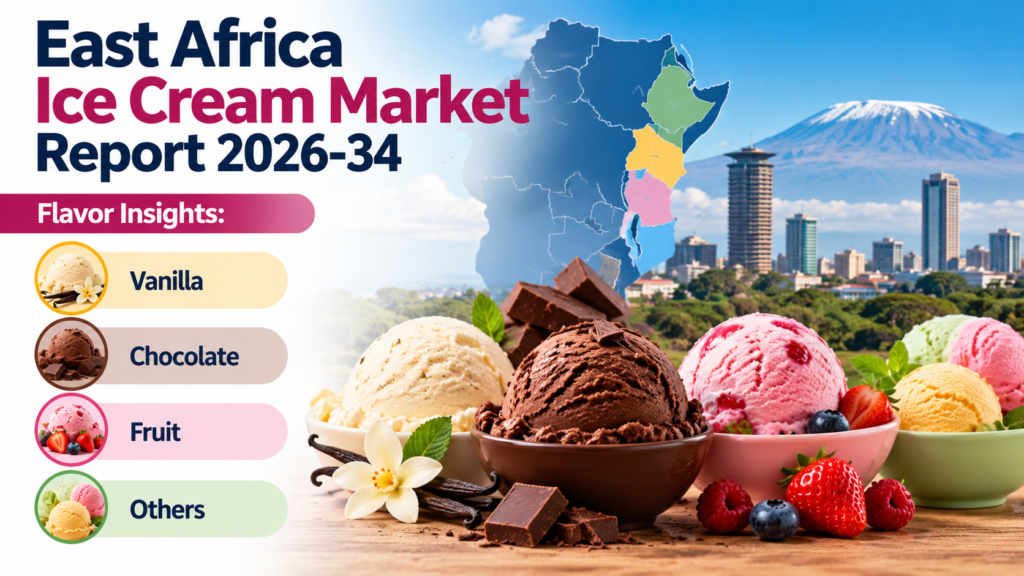
The East Africa ice cream market is supported by rising disposable incomes, rapid urbanization, and expanding modern retail and cold chain infrastructure. Per-capita consumption in Kenya is still estimated at well below 0.5 liters per year, which leaves substantial headroom for volume growth. East Africa ice cream market size increased from USD 348.8 Million in 2025 to USD 365.3 Million in 2026. Looking forward, IMARC Group expects the market to reach USD 527.9 Million by 2034, exhibiting a growth rate (CAGR) of 4.71% during 2026-2034. Additionally, local flavor innovation and the growth of supermarkets, convenience stores, and ice cream parlors continue to shape consumer preferences and widen product availability across the region.
How AI is Reshaping the Future of East Africa Ice Cream Market?
- AI-powered demand forecasting helps manufacturers and distributors predict outlet-level demand for cones, cups, and sticks, which matters in a market dominated by single-portion impulse purchases and where freezer placement and distributor coverage determine sales.
- Machine learning is improving cold chain management by optimizing delivery routes, monitoring freezer temperatures through connected sensors, and reducing spoilage. This is valuable in a region where the number of cold chain operators in Kenya has grown from one to four and in Uganda to two.
- AI-driven analysis of social media and point-of-sale data helps brands identify local flavor preferences, such as tropical fruit and chocolate variants, and tailor promotions for urban youth in cities like Nairobi, Kampala, Dar es Salaam, and Addis Ababa.
- Smart procurement and milk sourcing analytics support dairy-based producers in managing supply volatility across cooperatives, where individual cooperatives serve between 500 and 2,500 smallholder farmers.
- AI-assisted product development is accelerating the launch of lactose-free, low-sugar, and plant-based formulations that appeal to health-conscious urban consumers, a niche that is small but growing.
Grab a sample PDF of this report: https://www.imarcgroup.com/east-africa-ice-cream-market/requestsample
Market Growth Factors
The East Africa ice cream market is driven by rising disposable incomes and urbanization, which are increasing spending on treats and convenient dessert options. As more consumers move to cities, demand grows for ready-to-eat frozen products sold through kiosks, supermarkets, and convenience stores. Ice cream in the region remains heavily weighted toward affordable single-portion, dairy-based impulse products in cones, cups, and sticks, supported by on-the-go consumption and limited home freezer ownership among lower and middle income households. At the same time, family-sized and take-home tubs are gaining interest as household incomes and refrigeration access improve.
Strong dairy foundations and investment in processing capacity are strengthening supply. Kenya’s dairy products market is valued at about USD 2.9 Billion, giving ice cream makers a deep local milk base. Glacier Products, owner of the Dairyland brand, operates what it describes as the largest ice cream manufacturing plant in East and Central Africa at Limuru, with distribution across Kenya, Tanzania, Uganda, South Sudan, Ethiopia, and Rwanda. Around 80% of the milk the company sources comes from local small-scale farmers, linking market growth directly to rural livelihoods. Regional players such as Azam Dairy in Tanzania and Mihan Dairy in Ethiopia also use local distribution networks to expand access.
Government and regional frameworks are supporting quality and trade. The East African Community maintains the EAS 70:2023 specification for dairy ice cream, which sets requirements for composition, sampling, and test methods and helps harmonize standards across member states. Cold chain investment is also accelerating, with private equity funds launching temperature-controlled logistics assets in the region and the key economies of Kenya, Tanzania, Ethiopia, Uganda, and Rwanda focusing on integrated logistics ecosystems.
Evolving tastes and premiumization are creating new opportunities. Consumers are showing growing interest in Western-style desserts, artisanal offerings, and bold flavors, while manufacturers are introducing low-fat, sugar-free, and dairy-free options. Café partnerships, premium 500 ml tubs, and design-led novelties are broadening the competitive landscape beyond traditional vanilla and chocolate.
Market Segmentation
Flavor Insights:
- Vanilla
- Chocolate
- Fruit
- Others
Category Insights:
- Impulse Ice Cream
- Take-Home Ice Cream
- Artisanal Ice Cream
Product Insights:
- Cup
- Stick
- Cone
- Brick
- Tub
- Others
Distribution Channel Insights:
- Supermarkets and Hypermarkets
- Convenience Stores
- Ice Cream Parlors
- Online Stores
- Others
Country Insights:
- Ethiopia
- Kenya
- Tanzania
- Uganda
- Sudan
- Rwanda
- Others
Recent Developments & News
- October 2026: Dairyland launched BLACKISH, a 500 ml peppermint chocolate flavor billed as Kenya’s first black ice cream, moving it from a limited edition trial into a full-scale premium product aimed at retail, hospitality, and distribution partners.
- September 2026: The Global Center on Adaptation released an investment brief on cold chain storage for dairy in Tanzania, highlighting financing opportunities that support dairy and frozen food supply chains.
- November 2025: Belgian development finance institution BIO granted an EUR 8 million loan to Glacier Products Ltd, the Kenyan maker of Dairyland ice cream, to modernize and expand production capacity and strengthen quality standards across its dairy supply chain.
If you require any specific information that is not covered currently within the scope of the report, we will provide the same as a part of the customization.
About Us
IMARC Group is a global management consulting firm that helps the world’s most ambitious changemakers to create a lasting impact. The company provides a comprehensive suite of market entry and expansion services. IMARC offerings include thorough market assessment, feasibility studies, company incorporation assistance, factory setup support, regulatory approvals and licensing navigation, branding, marketing and sales strategies, competitive landscape and benchmarking analyses, pricing and cost research, and procurement research.
Contact Us
IMARC Group,
134 N 4th St. Brooklyn, NY 11249, USA,
Email: sales@imarcgroup.com,
Tel No: (D) +91 120 433 0800,
United States: +1-201971-6302