Metabolomics provides researchers with a detailed view of small molecules involved in biological processes. These metabolites can reveal valuable information about cellular activity, biochemical pathways, and changes occurring within biological systems. However, detecting thousands of molecular features is only the beginning. Researchers also need reliable methods to determine which metabolites are present and, in many studies, how much of each metabolite exists in a sample.
A metabolomics standards library can help address this challenge by providing well-characterized reference compounds that researchers can use to support metabolite identification, method development, and quantitative analysis.
What Is a Metabolomics Standards Library?
A metabolomics standards library is a collection of characterized chemical standards representing metabolites relevant to metabolomics research. These standards provide known reference points that can be compared with signals detected in experimental samples.
Depending on the library and analytical workflow, standards may include amino acids, organic acids, fatty acids, sugars, nucleotides, and other biologically relevant metabolites.
Researchers can analyze these known compounds using technologies such as liquid chromatography-mass spectrometry (LC-MS) and compare their analytical properties with compounds detected in unknown samples.
This comparison can provide stronger evidence for metabolite identification than relying on a single analytical characteristic alone.
Why Metabolite Identification Can Be Difficult
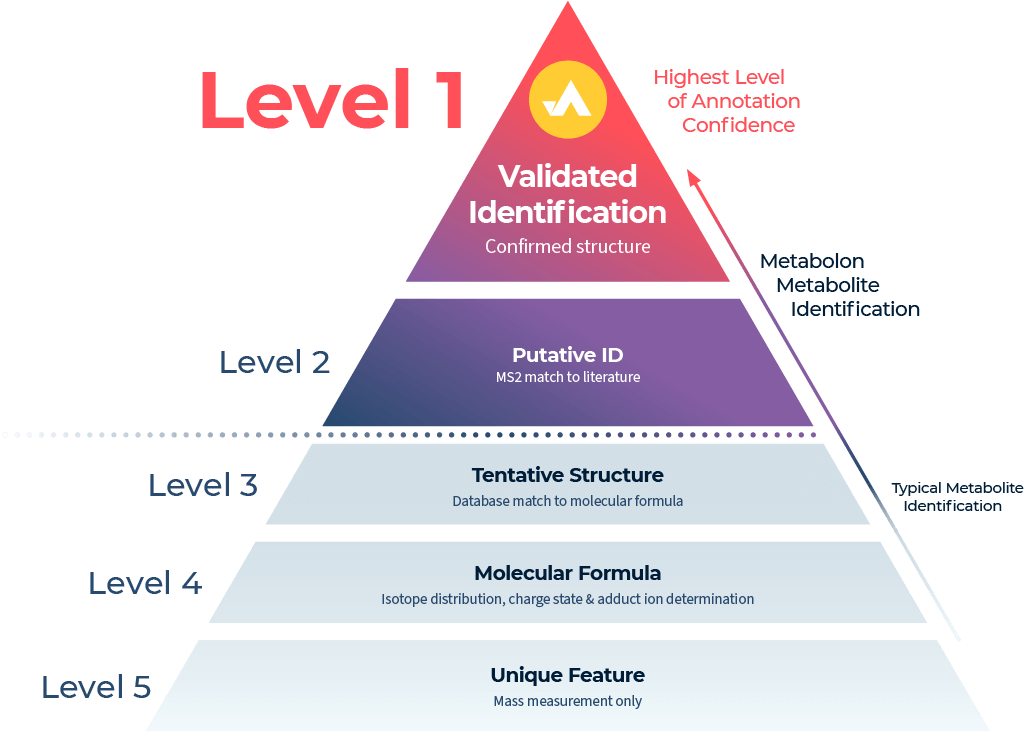
Modern mass spectrometry instruments can detect large numbers of molecular features in biological samples. However, an detected feature does not automatically provide a confirmed metabolite identity.
Different molecules may have similar molecular masses, and structural isomers can make identification even more challenging.
Researchers may therefore consider multiple analytical characteristics, including:
- Accurate mass
- Retention time
- Isotope patterns
- Fragmentation behavior
- MS/MS spectra
- Chromatographic characteristics
Authentic standards provide experimentally measured information that can be compared directly with unknown compounds.
A well-designed metabolomics standards library therefore provides researchers with valuable reference materials for improving confidence in metabolite assignments.
Supporting LC-MS Metabolomics
LC-MS is widely used in metabolomics because it combines chromatographic separation with sensitive mass detection.
Reference standards can support several stages of an LC-MS experiment.
During method development, researchers can use known metabolites to optimize chromatographic separation, determine retention times, establish detection parameters, and investigate fragmentation behavior.
During sample analysis, experimental signals can then be compared with the data generated from authentic standards.
This can be particularly useful when multiple compounds have similar masses but different chromatographic or fragmentation characteristics.
Improving Confidence in Metabolite Identification
One of the major benefits of using reference standards is improved confidence in compound identification.
Database searches based only on molecular mass may generate several possible identities for the same detected feature. Additional experimental evidence is often required to narrow those possibilities.
When researchers analyze authentic standards under comparable experimental conditions, they can compare multiple characteristics of the unknown compound with the known reference.
For example, matching accurate mass, retention time, and fragmentation behavior can provide stronger evidence than matching mass alone.
This makes standards libraries valuable resources for laboratories seeking more reliable metabolite annotations.
Supporting Quantitative Metabolomics
Metabolomics research is not always limited to determining whether a metabolite is present. Many experiments require researchers to measure metabolite concentrations or compare abundance across samples.
Reference standards can contribute to quantitative workflows by providing known concentrations that can be used to establish calibration relationships.
Researchers may prepare several concentrations of a metabolite standard and measure the corresponding instrument response. This information can then be used to create a calibration curve.
Signals from experimental samples can be compared with the calibration data to estimate metabolite concentrations.
For more rigorous quantitative workflows, researchers may also use stable isotope-labeled internal standards.
The Role of Stable Isotope-Labeled Standards
Stable isotope-labeled standards are especially useful in mass spectrometry-based metabolomics.
These compounds contain stable isotopes such as carbon-13 or nitrogen-15. They have chemical properties similar to their corresponding metabolites but can be distinguished by their different masses.
When added to samples at known concentrations, isotope-labeled standards can help researchers account for variability introduced during sample preparation and instrumental analysis.
They may help compensate for factors such as:
- Extraction variability
- Sample preparation losses
- Ionization differences
- Matrix effects
- Instrument response changes
For this reason, isotope-labeled standards are commonly used when accurate quantitative measurements are required.
Standards Libraries and Method Development
Developing a reliable metabolomics method requires extensive testing and optimization.
Researchers need to determine whether the selected chromatographic and mass spectrometry conditions can adequately detect and separate the metabolites of interest.
A metabolomics standards library provides known compounds that can be used during this development process.
Researchers can evaluate retention behavior, peak shape, sensitivity, fragmentation conditions, and other analytical characteristics before analyzing complex biological samples.
Using standards during method development can make it easier to identify analytical limitations and optimize experimental conditions.
Applications Across Metabolomics Research
Standards libraries can support many areas of metabolomics research.
For example, researchers studying cellular metabolism may use standards to investigate changes in amino acids, organic acids, or energy-related metabolites.
Lipid-related studies may require fatty acid or lipid reference materials, while nutritional research may examine metabolites associated with dietary intake or metabolic pathways.
Other applications can include:
- Biomarker research
- Pharmaceutical research
- Clinical research
- Nutritional studies
- Toxicology
- Microbiology
- Plant metabolomics
- Environmental research
The specific standards required depend on the biological system, analytical platform, and research question.
Improving Reproducibility
Reproducibility is an important consideration in metabolomics.
Differences in sample preparation, chromatography, instrumentation, and data processing can make comparisons between experiments challenging.
Reference standards provide known analytical benchmarks that researchers can use to monitor experimental performance.
For example, laboratories can periodically analyze known standards to check whether retention times, peak intensities, or other analytical characteristics remain consistent.
These quality-control procedures can help researchers identify potential analytical problems before they affect large numbers of research samples.
What to Consider When Selecting a Standards Library
Not every metabolomics experiment requires the same reference materials. Researchers should select standards based on the objectives of their study.
Important considerations may include:
- Metabolites of interest
- Analytical platform
- Compound purity
- Chemical stability
- Concentration requirements
- Availability of isotope-labeled standards
- Compatibility with LC-MS or other techniques
- Storage and handling requirements
- Documentation and traceability
A library that closely matches the metabolites and analytical methods used in a study can provide greater practical value than a broad collection of unrelated compounds.
From Detection to Reliable Measurement
Modern analytical instruments can generate enormous amounts of data, but more data does not automatically mean more reliable biological information.
Researchers must be able to connect detected signals with accurately characterized compounds.
This is where standards libraries become particularly valuable.
They provide experimental reference points that can help transform unknown analytical features into more confidently identified metabolites. When combined with calibration approaches and suitable internal standards, they can also support quantitative measurements.
Final Thoughts
A metabolomics standards library is an important resource for researchers working with complex metabolomics data. By providing characterized reference compounds, standards libraries can support metabolite identification, LC-MS method development, quantitative analysis, and analytical quality control.
In iroatech They can also help researchers compare experimental observations with known compounds using characteristics such as accurate mass, retention behavior, and fragmentation patterns.
As metabolomics research continues to generate increasingly complex datasets, high-quality reference standards remain valuable for turning analytical signals into more reliable and interpretable scientific measurements.