hardscape landscape architecture
Commercial real estate developments face increasingly strict environmental regulations regarding stormwater management, runoff volumes, and nonpoint source pollution. Large-scale corporate campuses, retail centers, and industrial facilities present expansive impervious surfaces—including roof structures, concrete walkways, and asphalt parking zones—that prevent natural rainfall infiltration. During peak storm events, unmanaged runoff overburdens municipal drainage systems, accelerates soil erosion, and transports heavy metals and hydrocarbons into surrounding aquatic ecosystems.
To comply with regional Municipal Separate Storm Sewer System (MS4) permits and national environmental mandates, commercial developers are turning away from traditional, single-purpose concrete retention ponds. Instead, modern site design relies on the advanced disciplines of hardscape landscape architecture to integrate stormwater management directly into the usable spatial layout of the site. Partnering with a specialized commercial landscape hardscaping service allows developers to transform regulatory compliance constraints into high-value, aesthetically striking public plazas and durable infrastructure assets.
The Hydrodynamics of Impervious Surfaces vs. Permeable Hardscapes
In an undeveloped natural landscape, up to 50% of precipitation naturally infiltrates the subsoil, recharging deep aquifers while surface runoff remains under 10%. On a typical commercial site with traditional concrete or asphalt paving, impervious cover often exceeds 80%, causing surface runoff to spike to over 55% of total rainfall volume. This dramatic hydrological shift creates massive peak flow surges that require expensive underground vault detention systems if not treated at the surface level.
To balance these hydrological forces, experts in hardscape landscape architecture specify Permeable Interlocking Concrete Pavers (PICP) and open-graded aggregate reservoir bases. Unlike traditional paving, PICP systems utilize engineered aggregate-filled joints (typically ASTM #8 angular stone) that allow surface water to drain through the pavement surface at rates exceeding 100 inches per hour—far exceeding the intensity of extreme 100-year storm events.
Subsurface Reservoir Engineering & Aggregate Filtration Physics
Directly beneath the permeable paver surface lies a multi-tiered, open-graded aggregate subbase designed to act as both a structural load-bearing platform and a high-volume stormwater detention reservoir. This subbase completely eliminates fine sand or soil particles, utilizing uniform-sized angular stone to achieve an open void ratio of 30% to 40% for subsurface water storage.
Water passing through the permeable surface fills the void spaces within the ASTM #2 base stone, holding the stormwater temporarily until it can naturally infiltrate into the surrounding native subsoil.
For commercial sites constructed over low-permeability native clay soils (where infiltration rates are under 0.5 inches per hour), civil engineers install perforated subgrade underdrain pipes connected to municipal storm connections. This hybrid configuration provides primary physical filtration—removing sediment, total suspended solids (TSS), and heavy metals—before slowly discharging clarified water at controlled, pre-development flow rates.
Integrating Bioretention Swales & Structural Concrete Containment
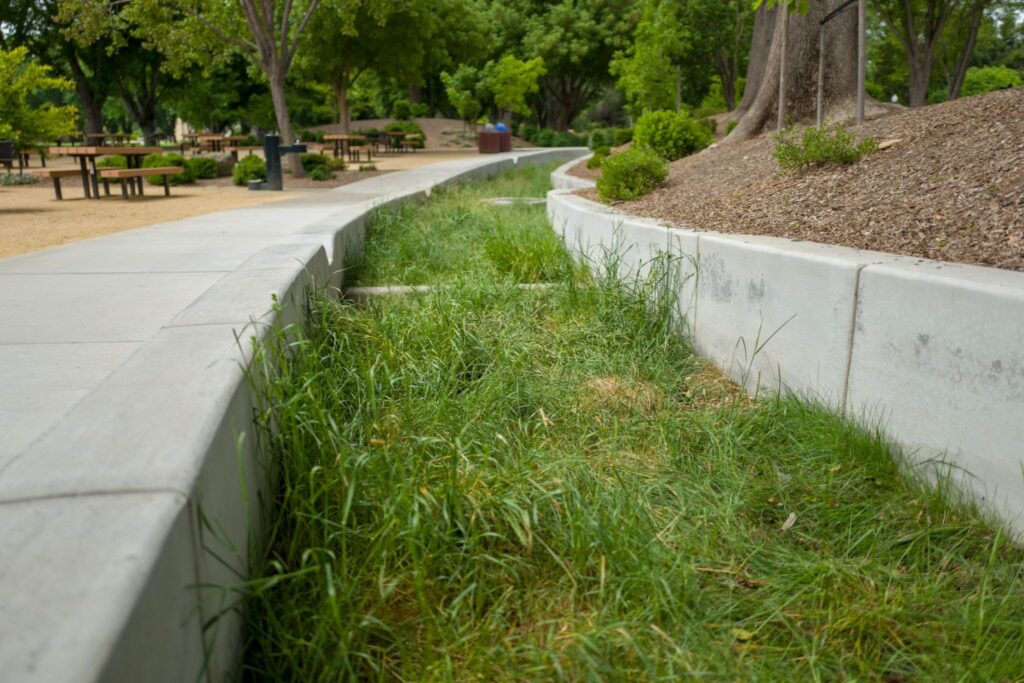
Managing commercial stormwater extends beyond flat parking surfaces to the surrounding terrain and pedestrian plazas. Comprehensive commercial design merges heavy hardscape structures with bio-engineered natural features like bioswales, rain gardens, and dry detention basins.
When directing large volumes of runoff through bioswales, high-velocity water movement can cause severe soil scouring and channel erosion. Contracting a certified commercial landscape hardscaping service guarantees the precise placement of structural check dams, stone rip-rap aprons, and cast-in-place concrete weir structures. These heavy structural elements break the kinetic energy of fast-moving water, distributing the flow evenly across bioretention media where specialized vegetation and soil microbes absorb nutrients, nitrogen, and phosphorus.
Technical Execution Protocols for Commercial Hardscaping
Developing heavy-duty commercial hardscape environments requires rigorous quality assurance testing, heavy equipment coordination, and strict material compliance:
-
Subgrade Soil Load Testing: Testing subsoil California Bearing Ratio (CBR) to verify structural load capacity under wet subgrade conditions.
-
Geotextile Membrane Stabilization: Installing woven or non-woven geotextiles along the bottom and sides of the open-graded aggregate reservoir to prevent soil migration.
-
Laser-Guided Base Compaction: Spreading ASTM #2 reservoir base aggregate in 6-inch lifts and compacting using heavy dual-drum vibratory rollers to achieve mechanical interlock without crushing stone edges.
-
Edge Restraint Anchor Embedment: Casting continuous reinforced concrete curb edge restraints along all permeable paving borders to withstand lateral thrust forces from commercial vehicular traffic.
-
Infiltration Verification Testing: Executing surface infiltration tests using ASTM C1781 double-ring infiltrometer protocols prior to final site turnover.
Long-Term ROI of Engineered Commercial Hardscapes
For commercial property owners and corporate asset managers, investing in advanced stormwater hardscape engineering yields significant financial advantages. Replacing subgrade concrete vault detention tanks with dual-purpose permeable paver plazas or parking facilities dramatically reduces site excavation costs, maximizes usable above-ground commercial square footage, and minimizes municipal stormwater utility fees.
Entrusting your commercial development to verified leaders in hardscape landscape architecture guarantees that every element—from aggregate void ratios to structural weir wall construction—is executed to commercial civil engineering standards. Utilizing an experienced commercial landscape hardscaping service ensures full environmental compliance, prevents structural flooding liabilities, and creates an aesthetically impressive, environmentally resilient commercial property built to deliver lasting capital returns.