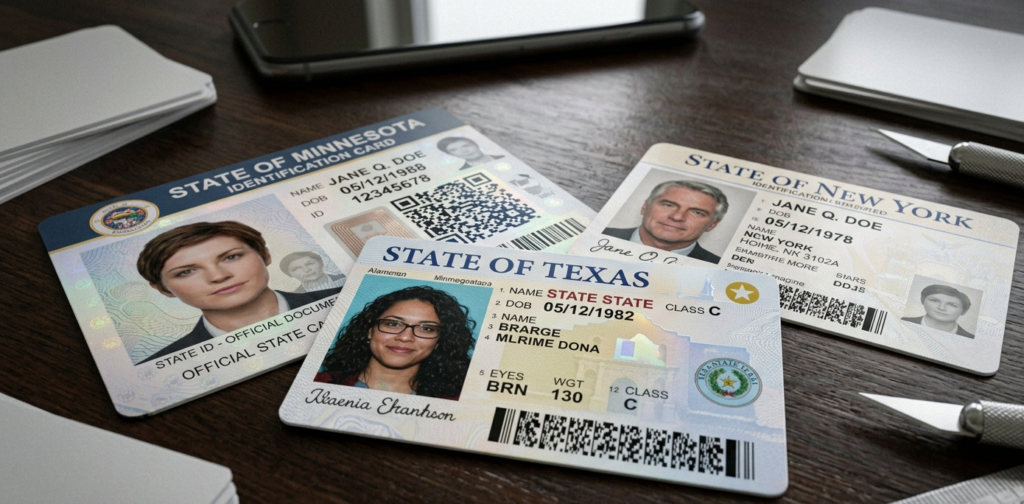
I’ve spent years staring at documents most people never think twice about. Driver’s licenses. Passports. National identity cards. You hand them over at an airport counter, a dispensary, a bar—for three seconds, maybe five—and then you’re on your way. That transaction feels trivial. It isn’t.
What’s actually happening in those seconds is a live negotiation between decades of accumulated security engineering and an adversary that never sleeps. The game is older than most people realize, and the stakes have never been higher.
When Paper Was the Enemy
Let’s go back. Mid-20th century identity documents were, by today’s standards, embarrassingly vulnerable. A laminated card with a photo. Offset-printed ink. Maybe a serial number. The security model was essentially: don’t look too closely.
Early forgers worked with X-Acto knives and photo substitution. It was crude. It was effective. Governments responded with better laminates and UV-reactive inks that glowed under blacklight—which felt futuristic in 1975. The problem? UV lamps became consumer products within a decade.
That’s the rhythm of this game. Every countermeasure gets commoditized. Every tool designed for inspectors eventually lands in a hardware store.
The Polycarbonate Gamble That Changed Everything
Somewhere in the late 1990s, document engineers made a decision that reshuffled the board entirely: ditch paper. Move to polycarbonate substrate.
This wasn’t a cosmetic upgrade. Polycarbonate cards are manufactured by fusing multiple polymer layers under heat and pressure into a single, monolithic slab. There are no seams to exploit. No laminate layer to peel back and reseat after swapping a photo. The document is the security feature, structurally.
Then came laser engraving—and this is where things get genuinely clever. Rather than printing data onto a card surface, laser systems burn information into the polycarbonate itself. The laser carbonizes the material at microscopic depths, creating tactile and visual data that can’t be chemically erased without destroying the card’s structural integrity. Try to bleach a laser-engraved field and you don’t get a blank surface. You get obvious damage.
I’ve seen attempts to work around this. They’re not pretty. The forensic evidence left behind is, in a dark way, almost artistic—if you know what you’re looking at.
Ghost Images and the Art of Redundancy
Here’s a feature most people have never consciously noticed on their own ID: the ghost image. It’s a smaller, secondary photograph of the cardholder, typically printed in a translucent or watermarked style somewhere on the document face.
Ghost images serve a specific and elegant purpose. The primary photo is the obvious target for any manipulation attempt. The ghost image is the verification trap. Altering one without touching the other is extremely difficult. Altering both in matching, artifact-free quality is harder still. When a document examiner finds discrepancies between the two—different lighting angles, mismatched pixel densities, inconsistent aging artifacts—that’s the thread that unravels everything.
UV ghost images take this further. They’re invisible under normal light. Under ultraviolet illumination, they emerge: secondary portraits, security patterns, sometimes the issuing authority’s watermark rendered in photographic detail. The inks used here are proprietary. They aren’t commercially available. That’s the point.
Kinegrams: The Feature You Can’t Fake with a Printer
If polycarbonate was a structural revolution, Kinegrams were an optical one. A Kinegram is a type of diffractive optically variable image device—DOVID in the trade—that produces different visual effects depending on the angle of illumination. Tilt a modern passport and watch the holographic panel shift. That shift isn’t decoration.
The manufacturing process for a legitimate Kinegram requires industrial-grade laser interference equipment to create the original optical master, followed by electroforming to produce a stamping shim, followed by hot stamping onto the document at pressures and tolerances civilian fabrication shops can’t replicate. The capital cost to bootstrap that process is prohibitive. The knowledge barrier is nearly as steep.
That said—and I want to be precise here—nearly prohibitive isn’t impossible. Academic research into DOVID replication has demonstrated partial success under controlled conditions. The gap between “demonstrated in a lab” and “deployed in volume at street level” remains significant, but it’s not infinite.
The Verification Side of the Problem
I want to flip the perspective for a moment, because the production of secure documents is only half the equation. Verification is where the rubber meets the road—and where, frankly, the system routinely fails.
Consider a hypothetical: a mid-sized event venue, 800 attendees per night, two door staff working under ambient lighting with handheld UV lamps and a visual checklist. Under those conditions, what’s the realistic detection rate for a high-quality forgery? Not a novelty-shop fake—a sophisticated one with correct substrate texture, working UV features, and plausible laser-engraved data? I’d argue the detection rate is uncomfortably low.
The challenge isn’t that security features don’t work. They do. The challenge is that their effectiveness is capped by the weakest verification link in the chain. An auto reader at a border crossing—scanning the machine-readable zone, checking cryptographic signatures in the chip, cross-referencing a biometric database—is a fundamentally different inspection than a doorman with a flashlight.
This is a systemic design problem, not a technology problem.
Chip-Level Identity and the New Battleground
The last decade has shifted significant attention to the electronic layer. RFID and NFC chips embedded in modern passports and national ID & Fake State ID cards carry digitally signed biographical and biometric data. The signature is verified against a country’s public key infrastructure. Cloning a chip is, in theory, possible—but the cryptographic signature can’t be faked without compromising the issuing authority’s private keys.
So the attack surface moves. Instead of forging the physical document, sophisticated actors target the enrollment process—the moment before the document is issued. Fraudulent identity creation at the source. Ghost identities seeded into national databases. That’s the frontier right now, and it’s a significantly harder problem to engineer around than a UV ink formulation.
FAQ
Q: Do those UV light pen things actually work for catching fakes?
Honestly? Sometimes. For low-effort fakes, yeah, UV checking catches a lot. But any competent forgery operation is going to source substrate and inks that respond under UV—not necessarily correctly, but something fluoresces. What you’re really checking is whether the pattern matches what’s expected. Most bar staff aren’t trained on what that pattern should actually look like for a given state and year. So the tool works; the training doesn’t always follow.
Q: Is laser engraving actually that hard to replicate? Couldn’t a decent laser cutter do it?
Consumer and prosumer laser cutters operate at surface level—they’re burning or cutting material from the top down. True laser engraving inside polycarbonate for ID purposes uses focused beam depth control to carbonize material at specific subsurface layers without visible surface damage. Getting that right requires calibration and equipment that’s genuinely not off-the-shelf. The depth consistency you’d need? A desktop Glow forge isn’t getting you there.
Q: What’s the deal with the magnetic stripe on older IDs—is that actually a security feature?
Not really, no. Magnetic stripes on driver’s licenses mostly carry readable data for point-of-sale age verification systems—the same data that’s printed visibly on the card face. It’s not encrypted in any meaningful sense. It’s a convenience feature that got retrofitted with security-adjacent branding over time. The real security lives in the physical document construction, not the stripe.
Q: Are holographic overlaminates the same as Kinegrams?
Related but not identical. Standard holographic overlaminates use a reflective foil layer with a pre-embossed pattern—they’re optically variable but relatively simple in structure. Kinegrams are a specific, higher-complexity class of DOVID with precisely engineered diffraction patterns that produce controlled image shifts, color changes, and depth effects under specific viewing conditions. The Kinegram is to a standard holo-overlay what a turbine engine is to a propeller—same broad category, wildly different engineering complexity.
Q: If biometric chips are so secure, why do we still need physical security features at all?
Because chip readers aren’t everywhere and physical inspection is still the primary verification method at the vast majority of real-world touchpoints. Chips can also be damaged, deactivated, or simply not scanned by underfunded inspection infrastructure. Physical security features are the fallback that works without any additional equipment—just trained eyes and maybe a light source. Removing them before chip infrastructure is truly universal would be a catastrophic backward step.