There’s a particular kind of urgency that descends when a crane shuts down unexpectedly. The operator radios in. The supervisor checks the schedule. Someone starts making phone calls. Meanwhile, the project clock keeps running and billable hours evaporate with each passing minute.
The difference between a quick recovery and a prolonged outage often hinges on one thing — whether the necessary replacement part was already sitting on a shelf somewhere in your facility. Stocking everything manufacturers produce is neither feasible nor wise, though. Every square foot of warehouse has a cost, and every dollar tied up in dormant inventory is a dollar not working elsewhere.
What separates well-managed operations from those constantly scrambling is a stocking strategy built on data and foresight. That strategy tells you exactly which items justify permanent shelf space and which should only be purchased when actual failure demands it. Building this system for your Grove machines requires upfront diligence, but it transforms unpredictable disruptions into manageable events.
The following practices will help you construct and maintain that system.
Identify the Vital Few That Drive Most of Your Emergencies
The Pareto Principle — the observation that roughly eighty percent of consequences flow from twenty percent of causes — applies with remarkable consistency to heavy equipment maintenance. A disproportionate share of your emergency responses can be traced to a small subset of components.
These dominant offenders are overwhelmingly consumables and wear items. Hoses that flex until they crack. Seals that harden and lose their ability to hold pressure. Filters that clog and restrict flow. Small electrical switches that corrode or wear out from vibration. Keeping these in perpetual supply is the single most cost-effective action you can take.
Consider what’s actually at stake when a hydraulic line fails at the start of a workday. If the replacement exists in your parts room, the repair wraps up quickly and the crane earns revenue for the rest of the day. If it doesn’t, you’re looking at multiple days of lost productivity while you track down a delivery. The economics of that decision are not subtle.
Concentrate Your Efforts on the Components That Degrade Fastest
Every system on your Grove equipment faces different levels of mechanical punishment. Targeting your inventory investment toward the assemblies that deteriorate most rapidly yields the greatest reliability improvement per dollar spent.
Hydraulic circuits consistently demand the most attention. Hoses develop fatigue cracks from repeated flexing. O-rings lose their resilience under thermal cycling. Cylinder internals accumulate wear that eventually demands new seals. Maintain a rotating supply of the most frequently needed hose sizes and seal kits matched to your specific models.
Filters present an equally straightforward opportunity. Engine oil, fuel, and hydraulic return filters follow predictable consumption schedules. Their individual cost is minimal, and purchasing in volume is simply good practice. The frustration of halting a routine service because a basic filter wasn’t in stock is entirely preventable with modest planning.
Smaller electrical parts also warrant permanent placement in your storeroom. Boom-mounted limit switches regulate winch travel by interfacing with the machine’s control computer. Exposed to the elements and constant vibration, they have a limited operational life by nature. Having several spares accessible in the cab or a nearby tool trailer removes this failure from the emergency category.
Start With the Guidance Your Manufacturer Already Provided
The operator’s manual that accompanied your crane includes a recommended spares list compiled by the engineers who designed the machine. These recommendations aren’t speculative — they draw on engineering analysis, warranty claim patterns, and performance data collected across extensive fleets worldwide.
Turn to the preventative maintenance chapter and the associated parts recommendations. Treat this as your foundational stocking list. It identifies what the people who know the machine best believe you’re most likely to need.
The crucial refinement comes from cross-referencing those suggestions with your actual experience. If the manual recommends an extra hydraulic pump as critical Grove crane parts but yours has never failed across a decade of operation, reallocate that budget and space. If it recommends surplus boom alignment hardware and your crews consume them with regularity, stock them generously. Manufacturer guidance creates the baseline; your operational history sharpens it.
Mine Your Own Repair Data for Patterns
No predictive resource surpasses your own maintenance history. Your work order records capture the specific failure modes your equipment produces under the particular conditions you operate in.
Pull at least two years of repair logs and sort them by component and frequency. Search for repetition that indicates systemic need. Did a particular relay fail three times during the winter season? Did one machine consume tensioner seals at an unusual rate compared to its peers?
Apply a straightforward decision rule. A single failure might be an outlier. Two or more failures of the same component within a compressed timeframe suggest a reliable pattern. Promote those items to your priority stocking list without delay.
Also consider the age distribution across your fleet. Older machines burn through wiring, sensors, and structural hardware at higher rates than newer ones. A recently commissioned unit mostly requires routine service items. Your shelf contents should reflect what each age group actually consumes rather than applying a one-size-fits-all template.
Recognize That Lead Times Dictate Stocking Priorities
How quickly a replacement can reach your facility varies enormously depending on its origin, manufacturer, and complexity. Understanding these variations is fundamental to deciding what belongs on your shelf versus what can be ordered only when needed.
Many common Grove crane parts are stocked by regional dealers and can be collected or delivered within hours. For those readily accessible items, maintaining an extensive personal reserve may not represent the best use of your storage capacity and capital.
Other components present a radically different procurement timeline. Specialized valves, particular boom segments, or control modules sourced from overseas manufacturers can require weeks or months to deliver. When you know a specific component carries a four-week lead time, keeping a spare in your own storeroom is a straightforward business decision. No operation can maintain credibility by telling a client that their project is on hold for a month while an international shipment makes its way through customs.
Make it standard practice to confirm current lead times with every supplier on a regular basis. Structure your highest-priority holdings around whichever items carry the longest procurement cycles. This single discipline prevents the most painful and expensive disruptions from ever taking root.
Prevent Stock From Deteriorating Silently
An inventory that goes unmanaged will eventually fail you. Stored components age and degrade regardless of whether anyone handles them. Rubber seals craze and harden. Electrical terminals develop corrosion. Lubricants separate in their containers and lose effectiveness.
Implement a strict First-In, First-Out rotation protocol. When new stock arrives, position it behind the older material so that the oldest units get consumed first. This prevents components from quietly passing their service life on the shelf.
Every six months, conduct a thorough walkthrough of your parts room. Any item that has been sitting untouched for three years deserves honest evaluation. The machine it was originally purchased for may no longer be in your fleet, or your operational profile may have evolved. Remove what no longer serves a purpose rather than allowing it to silently consume capital and valuable shelf space.
Build a Partnership That Goes Beyond Transactions
Self-sufficiency in parts management is a practical impossibility. The global supply chain for heavy equipment components spans multiple continents and is subject to disruption at countless points.
Your parts distributor fills the gaps that even the most meticulously curated stockpile cannot cover. Seek out a partner with genuine depth of knowledge about Grove crane parts — someone who can engage meaningfully with your technical needs from experience rather than product catalogs.
Share your fleet composition, operating conditions, and maintenance history. An informed supplier can help you refine your critical list, alert you to factory backorders before they create problems, and propose workable alternatives when original equipment faces extended unavailability.
Those partnerships become invaluable during emergencies. A critical component failure on a Friday afternoon requires someone who takes immediate action and secures overnight shipment — not an automated response suggesting you call back during regular business hours.
Align Your Crew With the Process
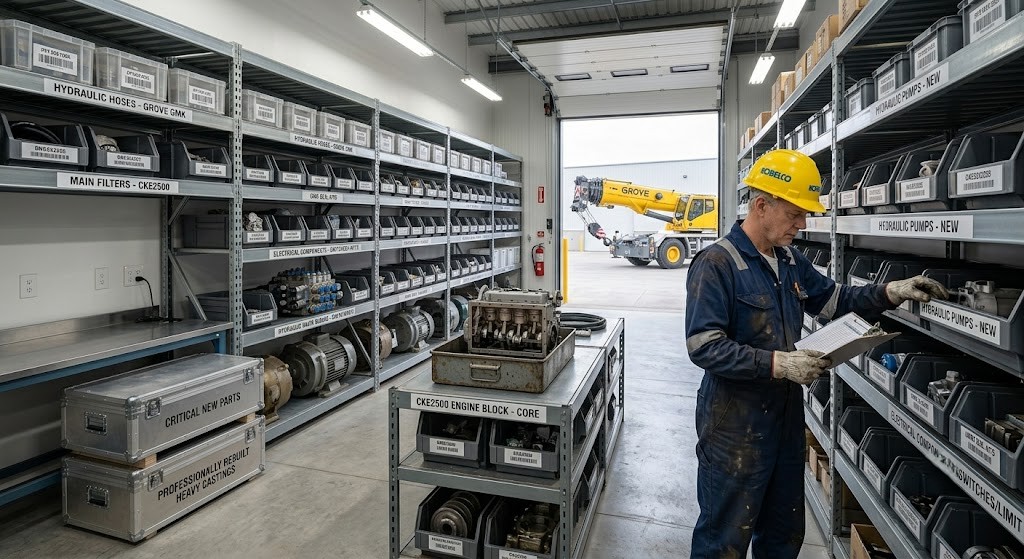
No inventory strategy functions without consistent human execution. Every technician on your team needs to know the layout of the parts room, understand where specific items live, and follow the same procedure for documenting what they remove.
The most critical habit is honest, immediate reporting of every retrieval. When the last item leaves its designated bin, that fact must be captured. An empty bin that nobody reports creates a dangerous illusion of readiness, and the next failure involving that part becomes an emergency order with significant delays.
Simplify the recording process as much as possible. Barcode scanners, sign-out sheets, or lightweight digital tools all reduce friction and improve compliance. Pair this with automatic reorder triggers that generate purchase requests when stock drops below predetermined thresholds, ensuring gaps are identified before they become crises.
Balance the Financial Tension
At its core, inventory strategy requires navigating the tension between two competing financial forces. Carrying costs — storage space, insurance, and immobilized capital — push toward keeping less. Downtime costs — lost revenue, contractual penalties, and reputational erosion — push toward keeping more.
A perfect resolution doesn’t exist. You will stock items that never get consumed, and you will periodically encounter an empty shelf at the worst possible moment. Every operation grapples with these realities.
What you can achieve is a consistent reduction in both types of misses. By analyzing your failure patterns, respecting procurement timelines, and concentrating your investment on the components most prone to failure, you create a system where preparation outweighs surprise. Predictability gradually displaces chaos.
When a hose bursts on a Thursday morning, your technician walks to the parts room, pulls the exact replacement, and has the crane earning revenue before the afternoon shift begins. That seamless, uneventful outcome represents the true objective — reliable uptime that sustains your equipment’s productivity and your operation’s financial resilience across every project you undertake.