Benefits of Cloud-Based Payroll Solutions for Growing Companies
As businesses grow, managing payroll becomes increasingly complex. From handling employee salaries and tax deductions to ensuring compliance with labor regulations, payroll administration can consume significant time and resources. Traditional payroll systems often struggle to keep pace with expanding workforce requirements, making cloud-based payroll solutions an attractive option for growing companies.
Cloud-based payroll software offers businesses a modern, efficient, and scalable way to manage payroll processes. By leveraging secure online platforms, companies can automate payroll tasks, reduce administrative burdens, and improve overall operational efficiency. Here are the key benefits of cloud-based payroll solutions for growing businesses.
- Enhanced Accessibility and Flexibility
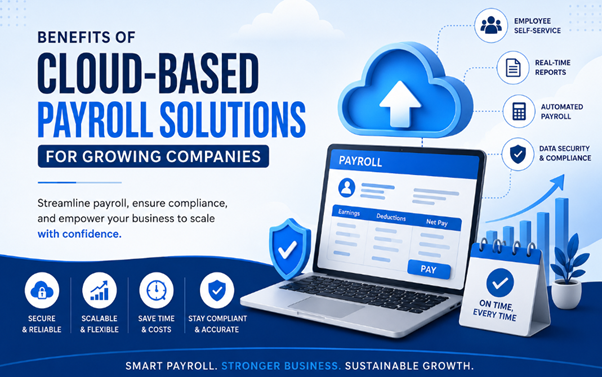
One of the most significant advantages of cloud-based payroll systems is the ability to access payroll information anytime and from anywhere. Business owners, HR managers, and payroll administrators can securely log in to the platform using a computer, tablet, or smartphone.
This flexibility is particularly valuable for organizations with remote employees, multiple office locations, or hybrid work environments. Employees can also access their pay stubs, tax documents, and payroll information through self-service portals, reducing the need for manual assistance from HR teams.
- Increased Payroll Accuracy
Payroll errors can lead to employee dissatisfaction, compliance issues, and financial penalties. Cloud-based payroll solutions automate calculations for wages, overtime, bonuses, deductions, and tax withholdings, significantly reducing the risk of human error.
Automated systems ensure that payroll is processed accurately and consistently, helping businesses maintain employee trust while minimizing costly mistakes. Many cloud payroll platforms also provide validation checks and alerts to identify potential issues before payroll is finalized.
- Improved Compliance Management
Payroll regulations and tax laws frequently change, making compliance a major challenge for growing companies. Cloud-based payroll providers regularly update their systems to reflect the latest tax rates, labor laws, and reporting requirements.
This automatic updating process helps businesses stay compliant without constantly monitoring legislative changes themselves. Features such as automated tax filing, compliance reporting, and audit trails further reduce the risk of penalties and legal complications.
- Scalability to Support Business Growth
As companies expand, payroll requirements become more complex. New hires, additional departments, multiple pay schedules, and changing compensation structures can quickly overwhelm traditional payroll systems.
Cloud-based payroll solutions are designed to scale alongside business growth. Whether a company has ten employees or several thousand, cloud platforms can accommodate increasing payroll demands without requiring major infrastructure investments. This scalability allows businesses to adapt quickly while maintaining efficient payroll operations.
- Cost Savings and Reduced Administrative Burden
Traditional payroll systems often require significant investments in software licenses, hardware, maintenance, and IT support. Cloud-based payroll platforms operate on a subscription model, eliminating many of these upfront costs.
By automating repetitive payroll tasks, businesses can also reduce administrative workloads and free HR teams to focus on strategic initiatives such as talent management and employee development. The reduction in manual processing can lead to substantial long-term cost savings.
- Enhanced Data Security
Payroll data contains sensitive employee information, including salaries, tax records, bank account details, and personal identification information. Protecting this data is critical for every organization.
Reputable cloud-based payroll providers invest heavily in advanced security measures such as data encryption, multi-factor authentication, secure backups, and continuous monitoring. These security features often exceed what many small and mid-sized businesses can implement internally, providing greater protection against cyber threats and data breaches.
- Faster Payroll Processing
Manual payroll processing can be time-consuming, especially as employee numbers increase. Cloud-based payroll systems automate many payroll functions, including calculations, direct deposits, tax reporting, and record keeping.
This automation significantly reduces payroll processing time and ensures employees receive accurate payments on schedule. Faster payroll cycles help improve operational efficiency and employee satisfaction.
- Employee Self-Service Capabilities
Modern employees expect easy access to their payroll information. Cloud payroll systems typically include employee self-service portals where staff can view pay stubs, update personal information, access tax forms, and manage direct deposit details.
These self-service features reduce HR inquiries and administrative tasks while empowering employees to manage their own information conveniently and securely.
- Real-Time Reporting and Analytics
Data-driven decision-making is essential for growing businesses. Cloud-based payroll platforms provide real-time reporting and analytics that offer valuable insights into payroll expenses, labor costs, overtime trends, and workforce planning.
Business leaders can generate customized reports instantly, helping them make informed financial and staffing decisions. Improved visibility into payroll data supports better budgeting and long-term strategic planning.
- Seamless Integration with Other Business Systems
Many cloud-based payroll solutions integrate with accounting software, human resources platforms, time-tracking tools, and employee benefits systems. These integrations streamline data flow across departments and eliminate duplicate data entry.
By connecting payroll with other business applications, companies can improve efficiency, enhance accuracy, and create a more unified workforce management process.
Conclusion
For growing companies, payroll management must evolve alongside business expansion. Cloud-based payroll solutions provide the flexibility, scalability, automation, and security needed to support modern workforce demands. By improving payroll accuracy, simplifying compliance, reducing administrative costs, and enhancing employee experiences, cloud payroll platforms help businesses operate more efficiently and focus on sustainable growth.
Organizations that adopt cloud-based payroll technology position themselves to manage future growth confidently while maintaining accurate, secure, and compliant payroll operations.