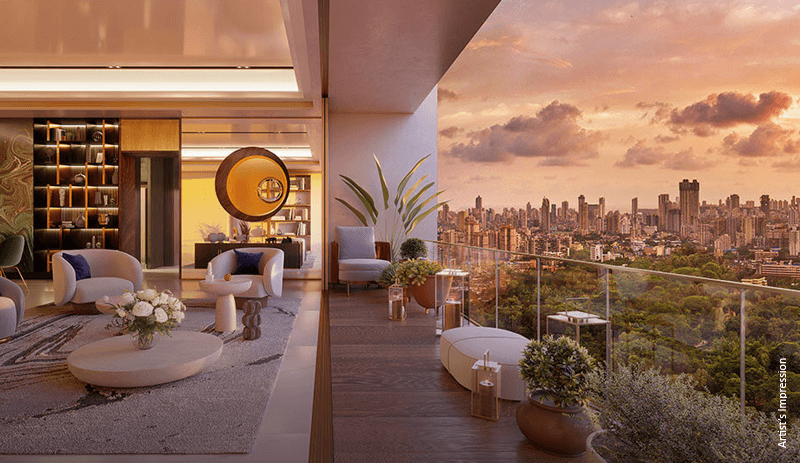
Redevelopment changes more than a building’s appearance. For homebuyers, it gives them a choice for a newly planned apartment within an established neighbourhood. For existing occupants, it raises questions about what will improve when they return.
Across redevelopment projects in South Mumbai, seven themes are worth noticing. They concern how the development is planned and delivered.
1. Upgrading Homes Without Giving Up the Neighbourhood
One of redevelopment’s strongest attractions is the possibility of improving a home while retaining familiar surroundings.
Residents may want better modern services without moving away from their everyday connections. Sugee Group describes this continuity as a central aim of its redevelopment work: upgrading living conditions while preserving residents’ relationship with their neighbourhood.
For new buyers, they can consider the redevelopment as a modern home in an area whose streets and services already exist.
2. Greater Attention to Usable Layouts
Efficient planning is an important part of the redevelopment proposition. Sugee Group’s stated approach includes layouts intended to improve usable space, ventilation and natural light.
For residents, it can improve various aspects of their household. For buyers, it means comparing how rooms function rather than judging the configuration alone. Ask for dimensioned plans and place your furniture on them.
- Premium Features Within Established Residential Settings
Redevelopment can also introduce a different specification and amenity offering into a familiar location.
Sugee Samruddhi, for example, combines three- and four-bedroom residences with decks and a terrace-level swimming pool near Chhatrapati Shivaji Maharaj Park. Its official website describes Sugee Group’s broader focus as residential redevelopment offering premium and luxury housing in established Mumbai neighbourhoods.
This illustrates how the redevelopment conversation can extend beyond replacement accommodation to the overall residential experience.
However, premium positioning should not replace practical questions. Compare the room sizes, specifications and recurring charges. A deck or pool is valuable when it suits the household and is supported by clear delivery and maintenance arrangements.
4. Building Services Becoming Part of the Upgrade
The benefits of redevelopment are not confined to the apartment interiors.
Parking, lifts, security systems and common spaces form part of Sugee Group’s stated redevelopment approach, alongside improvements to infrastructure and safety standards. These features can change the everyday experience of using a building.
This is relevant for residents whose needs have changed since they first moved into their existing home. The route from the street to the apartment may matter as much as another room. Buyers should inspect these arrangements on the plans.
5. Amenities Being Assessed Alongside Their Ongoing Cost
Among luxury residential projects in Mumbai, amenities are often a prominent part of the presentation. Redevelopment proposals can bring those facilities into existing residential settings, too.
The more useful comparison is which facilities residents will use and what maintaining them involves.
Samruddhi’s terrace-level swimming pool provides one example of a facility buyers can examine in this way. Questions should cover access and estimated charges.
MahaRERA’s buyer guidance also recommends examining common facilities and amenities. They advise reading the promised offering alongside the contractual documents.
6. A More Documented View of Construction Progress
The finished-building image is only one part of an under-construction purchase. Buyers also have a regulatory source of information to consult.
MahaRERA requires quarterly project updates and states that failure to provide them violates Section 11 of the Real Estate (Regulation and Development) Act, 2016.
That creates an important distinction between promotional progress updates and the disclosures buyers should examine through official records.
For redevelopment buyers, the practical approach is to compare the construction position, approvals and registered timeline. Ask about discrepancies and retain relevant documents.
Digital access does not remove the need for professional advice or site visits. It gives buyers another way to question the information presented during the sale.
7. The Transition Process Becoming Part of the Proposition
Redevelopment affects existing occupants before they ever enter the new building. Temporary accommodation and the agreed construction period are therefore central to the project.
Sugee Group’s published process describes an initial proposal covering proposed plans, carpet area, transit rent, corpus, amenities and construction period. It also emphasises coordination with societies throughout the transition.
These details show why execution needs to be assessed alongside design. Residents need to understand what happens while construction is underway, while new purchasers need clarity about their own delivery terms.
Have the relevant agreements independently reviewed. A well-presented future home cannot compensate for uncertainty about the journey to possession.
What These Trends Mean for Homebuyers
The common thread is liveability: making a home and building work better while retaining the advantages of an established location.
That does not mean every redevelopment offers the same benefits. The arrangements can differ.
Use these themes to structure questions rather than assume a project meets them. Sugee Group presents redevelopment as a combination of planning, quality, compliance and community continuity; buyers and societies should examine those commitments at the individual-project level.
Frequently Asked Questions
Does redevelopment always mean larger apartments?
Do not assume so. Check the proposed carpet area, dimensions and relevant agreement. The usefulness of the layout matters alongside its size.
Are amenities guaranteed by the brochure?
Review the written commitments, approved information and agreement. Clarify what is included, where it is located and when it is expected to be available.
How can buyers check progress?
Review the project’s available MahaRERA disclosures, including quarterly updates, and compare them with the developer’s information. Follow up on gaps before making further decisions.