Airport Walkway echoes with the steady clatter of spinner wheels rolling onto the metal entry plate. An automated voice politely reminds passengers to hold the handrail and watch their step at the exit. Families with strollers cluster together, keeping small children safely centered between the yellow borders. Within moments, the belt delivers them directly in front of their departure gate.
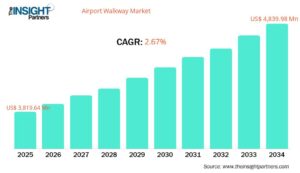
The global Airport Walkway market is poised for steady expansion over the next decade as aviation authorities worldwide accelerate terminal modernization programs and build large-scale transit hubs to accommodate rising passenger volumes. According to recent industry projections, the Airport Walkway Market is expected to register a compound annual growth rate (CAGR) of 2.67% from 2026 to 2034, with the market size expanding from US$ 3,819.64 Million in 2025 to US$ 4,839.98 Million by 2034.
As international airports evolve into sprawling, multi-terminal complexes, walking distances between security checkpoints, boarding gates, and intermodal transit links have grown substantially. Moving walkways also known as travelators have transitioned from optional amenities into mission-critical infrastructure essential for optimizing passenger flow, minimizing connection times, and improving accessibility for elderly travelers and passengers with reduced mobility.
Key Market Drivers and Infrastructure Trends
Several converging operational and technological factors are sustaining investment in horizontal and inclined airport walkway systems:
-
Global Airport Modernization and Greenfield Projects: Major infrastructure upgrades across North America, Europe, and the Asia-Pacific region are driving demand for both new installations and terminal retrofits. High-profile developments such as terminal expansions at New York’s JFK International Airport, European hub upgrades at Heathrow and Frankfurt, and greenfield aviation projects in India including Navi Mumbai and Noida International Airports are integrating high-capacity passenger conveyor networks to handle surging air traffic.
Get a PDF Sample- https://www.theinsightpartners.com/sample/TIPRE00020699
-
Sustainability and Energy-Efficient Engineering: Airport operators are increasingly prioritizing low-carbon terminal operations. Modern moving walkways now feature regenerative drives, variable-frequency motors, and optical load-sensing technology that automatically slows or pauses belts during periods of low foot traffic, significantly reducing electricity consumption and operational wear.
-
Smart Connectivity and Predictive Maintenance: Because unplanned downtime in high-traffic concourses creates severe bottlenecks, manufacturers are embedding Internet of Things (IoT) sensors and AI-assisted diagnostics into walkway drive systems. Continuous real-time monitoring of belt tension, motor temperature, and vibration allows facility teams to schedule predictive maintenance before mechanical failures occur.
-
Stringent Safety and Accessibility Standards: Regulatory compliance remains a primary catalyst for replacing aging equipment. Next-generation systems incorporate smooth pallet transitions for wheelchairs and luggage carts, touchless emergency braking, obstruction detection, and enhanced fire-protection standards.
Competitive Landscape
The global Airport Walkway market features established engineering and vertical-transportation leaders competing on system reliability, energy efficiency, modular installation, and long-term service contracts. Key players operating in the market include:
-
Analogue Holdings Limited
-
Otis Worldwide
-
Stannah
-
FUJITEC CO., LTD
-
thyssenkrupp AG
-
Hitachi, Ltd
-
HYUNDAIELEVATOR CO.,LTD
-
KONE Corporation
-
Mitsubishi Electric Corporation
-
Schindler
Leading suppliers are actively expanding their airport mobility portfolios with intelligent monitoring platforms and low-downtime modular designs. Recent industry initiatives highlight a strong focus on digital fleet management, quieter drive mechanisms, and rapid retrofit solutions tailored to live airport environments where construction disruption must be kept to a minimum.
Future Outlook
Looking ahead toward 2034, the Airport Walkway market will increasingly intersect with broader smart-airport ecosystems. As aviation hubs adopt biometric boarding, automated baggage handling, and real-time crowd analytics, moving walkways will become fully integrated data nodes within terminal management systems. AI-driven passenger flow monitoring will allow walkways to dynamically adjust operating speeds based on real-time flight arrival surges and gate congestion.
Furthermore, emerging aviation markets across Asia-Pacific and the Middle East will represent major growth frontiers as governments invest heavily in regional air connectivity and mega-hub construction. Simultaneously, mature aviation markets in North America and Europe will generate steady aftermarket and modernization revenue as airports replace legacy equipment with energy-regenerative, sensor-equipped systems. Despite challenges such as high upfront capital expenditure and complex safety certification requirements, the imperative to deliver seamless, accessible, and sustainable passenger transit ensures sustained demand for airport walkway technologies through 2034.
Related Reports-
Airport Security Market Share, Size & Demand by 2034
Airport Walkway Market Size, Growth & Demand by 2034
About The Insight Partners
The Insight Partners is a leading market research and consulting firm delivering actionable insights through in-depth industry analysis and strategic intelligence. The firm supports clients across various industries in making informed decisions by providing comprehensive market forecasts, competitive assessments, and growth opportunities.
Contact Us:
If you have any queries about this report or if you would like further information, please contact us:
Contact Person: Ankit Mathur
E-mail: sales@theinsightpartners.com
Phone: +1-646-491-9876
Also Available in : Korean| German| Japanese| French| Chinese| Italian| Spanish