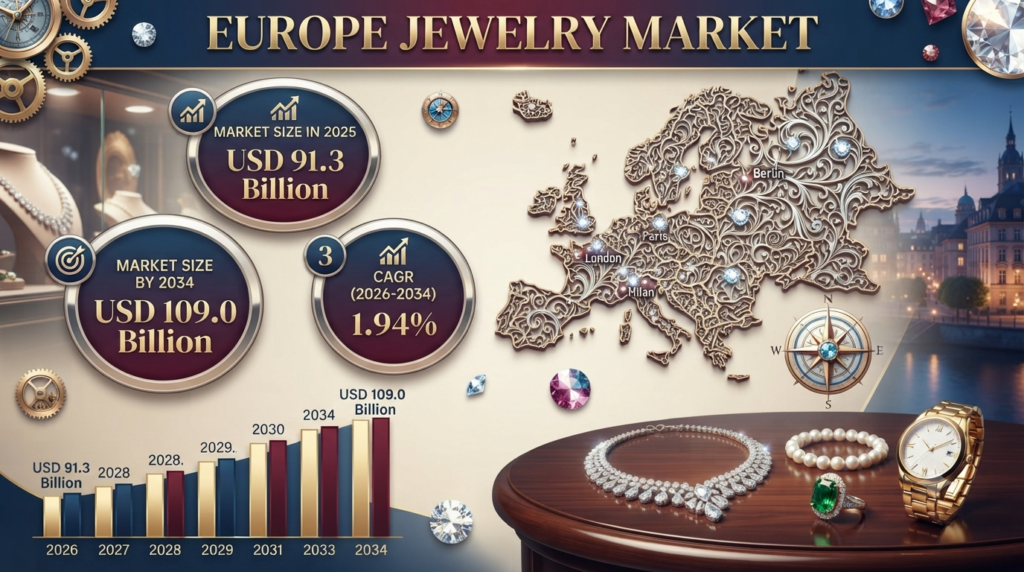
The Europe jewelry market is witnessing steady growth driven by rising demand for lab-grown diamonds, the expansion of online retail channels with virtual try-ons, and continuous innovation in design and personalization. The market size reached USD 91.3 Billion in 2025 and is projected to reach USD 109.0 Billion by 2034, exhibiting a compound annual growth rate (CAGR) of 1.94% during 2026-2034. Europe was the most visited continent in 2024, attracting 747 million visitors according to the UN World Tourism Organization (UNWTO), which supports strong demand for jewelry as souvenirs, gifts, and luxury keepsakes in fashion capitals such as Paris, Milan, and London. The market is strategically important to the region’s luxury and fashion economy, as it combines heritage craftsmanship, globally recognized luxury houses, and a growing base of independent designers and e-commerce retailers.
The Europe jewelry market is poised for gradual but resilient expansion, supported by sustainability-led demand for lab-grown diamonds and recycled metals, tourism-driven sales, and the growth of online and omnichannel retail. With a projected CAGR of 1.94% through 2034, the market offers opportunities for established luxury houses and new entrants focused on personalization, ethical sourcing, and digital engagement.
EUROPE JEWELRY MARKET SUMMARY
The Europe jewelry market encompasses a wide range of ornamental products, including necklaces, rings, earrings, bracelets, and other accessories, crafted from gold, platinum, diamonds, and other materials for personal adornment, gifting, investment, and cultural occasions. The ecosystem includes raw material suppliers, designers and manufacturers, luxury houses, mid-range and fashion jewelry brands, independent artisans, retailers (boutiques, online platforms, and travel retail), and end consumers. Key highlights of the market include:
- Market Size and Forecast: Valued at USD 91.3 Billion in 2025 and expected to reach USD 109.0 Billion by 2034 at a CAGR of 1.94% during 2026-2034 (historical period: 2020-2025).
- Product Segments: Necklace, ring, earrings, bracelet, and others, with rings (engagement rings and wedding bands) representing one of the most favored categories.
- Material Segments: Gold, platinum, diamond, and others, with gold favored for daily wear, gifting, and investment, and diamonds led by engagement ring demand.
- Country Coverage: Germany, France, the United Kingdom, Italy, Spain, and others.
- Key Demand Drivers: Heightened requirement for affordable lab-grown diamonds, design innovation and customization, influencer and celebrity marketing, rising tourism, and expansion of online and offline retail platforms.
- Sustainability Focus: Growing consumer preference for ethical sourcing, conflict-free diamonds, lab-grown stones, and recycled gold and metals.
PORTER’S FIVE FORCES ANALYSIS – EUROPE JEWELRY MARKET
The competitive dynamics of the Europe jewelry market can be analyzed using Porter’s Five Forces framework.
Porter’s Five Forces Analysis – Europe Jewelry Market
- Competitive Rivalry: Moderate to High. Global luxury houses, mid-range brands, fashion jewelry companies, and local artisans compete across price tiers, while brands differentiate through craftsmanship, heritage, design innovation, and sustainability credentials. Business implication: Companies must invest in distinctive collections, storytelling, celebrity and influencer collaborations, and strong digital presence to defend share.
- Supplier Power: Moderate. Jewelers depend on a limited pool of sources for gold, platinum, and natural diamonds, while the rise of lab-grown diamonds and recycled metals gives manufacturers alternative sourcing options. Business implication: Companies should diversify sourcing, secure traceable and recycled material supply, and build long-term supplier partnerships.
- Buyer Power: Moderate to High. Consumers can easily compare prices, designs, and ethical credentials online, and lab-grown diamonds give buyers access to larger stones at lower price points. Business implication: Brands must offer transparent pricing, customization, free shipping and easy returns, and personalized shopping experiences to retain customers.
- Threat of Substitutes: Moderate. Lab-grown diamonds, moissanite, colored gemstones, and affordable fashion jewelry substitute for traditional fine jewelry, while other luxury goods and experiences compete for discretionary spending. Business implication: Companies should articulate the lasting emotional and investment value of jewelry and embrace alternative stones within their portfolios.
- Threat of New Entrants: Moderate. Barriers are high in luxury and high jewelry (brand heritage, craftsmanship, and exclusivity), but lower for independent designers, direct-to-consumer brands, and online-only players using social media and pop-up retail. Business implication: Established players should protect their positions through brand equity, craftsmanship, and omnichannel experiences, while monitoring agile niche entrants.
Competitive Rivalry – Moderate to High (Healthy)
- Multi-tier competition spans luxury houses (Cartier, Bulgari, Dolce & Gabbana), mass-premium brands (Pandora), and regional entrants (Malabar Gold & Diamonds), driving differentiation through design innovation, sustainability, and digital offerings rather than purely price competition.
- Pandora’s June 2024 launch of its first lab-grown diamond jewelry in the EU, Bulgari’s Aeterna collection of more than 500 pieces, and Malabar Gold & Diamonds’ June 2023 London showroom opening reflect active strategic repositioning that is strengthening the overall market ecosystem.
Request for Sample Report: https://www.imarcgroup.com/europe-jewelry-market/requestsample
MARKET GROWTH DRIVERS:
Several key factors are propelling the expansion of the Europe jewelry market. The rising demand for lab-grown diamonds is a major catalyst, as these stones share the physical and chemical properties of natural diamonds without the ethical and environmental concerns linked to mining. They allow consumers to buy larger, higher-quality stones at lower prices, appealing to eco-conscious buyers. In June 2024, Pandora introduced its lab-grown diamond jewelry in the EU, launching four collections (Talisman, Infinite, Nova, and Era) in Denmark, with prices starting at DKK 1,899 (USD 275). Additionally, innovation in design and customization is attracting a new generation of buyers, with minimalist, geometric, and asymmetrical styles, unconventional material combinations (gold with ceramics, wood, and 3D-printed components), and options such as engraving, birthstones, and mix-and-match pieces.
MARKET GROWTH DRIVERS:
The Europe jewelry market is also benefiting from increasing tourism activities and the expansion of retail platforms. Europe attracted 747 million visitors in 2024 (UNWTO), and travelers purchase jewelry as souvenirs, gifts, and luxury keepsakes, with duty-free shopping at airports and luxury districts drawing international buyers seeking tax-free deals. Seasonal tourism peaks such as summer vacations and holiday travel further enhance sales. Retail expansion is strengthening reach: Eurostat reported that retail trade volume rose 0.5% in the eurozone and 0.3% in the EU in September 2024 compared with August 2024, while luxury brands open new boutiques and independent designers use pop-up shops. Online platforms with virtual try-ons, customization, free shipping, and easy returns make purchasing more convenient. Furthermore, influencer and celebrity marketing raises desirability among younger, fashion-aware consumers who follow social media endorsements and exclusive collections.
EUROPE JEWELRY MARKET SEGMENTATION
Segmentation analysis provides a detailed view of the Europe jewelry market by category:
- Product Insights: Necklace, Ring, Earrings, Bracelet, Others.
- Material Insights: Gold, Platinum, Diamond, Others.
- Country Insights: Germany, France, United Kingdom, Italy, Spain, Others.
COMPETITIVE LANDSCAPE
The Europe jewelry market features a diverse competitive landscape, with luxury houses offering exquisite designs and premium materials, mid-range and fashion jewelry firms making stylish pieces accessible to younger and budget-conscious buyers, and local artisans and independent designers adding unique, handcrafted options. Sustainability is a growing focus, with key players promoting ethical sourcing, lab-grown diamonds, and recycled metals, while e-commerce portals widen market reach. Key companies operating in the market include:
- Pandora A/S
- Cartier (Richemont)
- Bulgari (LVMH)
- Dolce & Gabbana
- Malabar Gold & Diamonds
Strategic developments are shaping the competitive arena, notably Dolce & Gabbana’s July 2024 unveiling of its Alta Gioielleria collection, “These Pieces Embody Italy,” in Sardinia, Bulgari’s May 2024 Aeterna launch in Rome for its 140th anniversary, and Pandora’s entry into lab-grown diamond jewelry in the EU.
REGIONAL ANALYSIS:
Country dynamics within the Europe jewelry market are shaped by distinct craftsmanship traditions, consumer preferences, and luxury infrastructure:
- Germany: Known for high-quality craftsmanship and minimalist designs; consumers value durability and precision and favor reputable brands. Gold and silver are popular, with high interest in ethical and sustainable pieces, and engagement rings and wedding bands support sales as jewelry is viewed as a long-term investment.
- France: A major hub for luxury jewelry with a strong presence of big brands; Paris remains the center of jewelry fashion. Diamonds, gold, and platinum are highly sought after for special occasions, online shopping is growing, and sourcing and sustainability are becoming key purchase factors.
- United Kingdom: Home to numerous luxury brands and budget-friendly fashion jewelry, with London as a luxury hub. Engagement rings and wedding jewelry are common, diamonds are the top preference, and customizable, retro-themed designs and independent designers appeal to younger buyers.
- Italy: Famous for exquisite craftsmanship and artistic design; 18K gold is a staple, and handmade, intricate pieces are favored. Local artisans and family-owned businesses are sought after alongside luxury houses.
- Spain: Combines tradition with modern fashion; gold is widely preferred, while silver and gemstone pieces are gaining popularity among younger buyers. Bold statement designs, handcrafted pieces for locals and tourists, and affordable fashion jewelry in urban areas drive demand.
- Others: Remaining European countries contribute through luxury retail, tourism-led purchases, and growing online jewelry shopping.
RECENT INDUSTRY DEVELOPMENTS
December 2024: The Vicenzaoro Jewelry Show 2025 was set to launch in Italy, aiming to welcome 1,300 top brands and showcase the latest in luxury jewelry, gemstones, and advanced technology. It is considered the biggest event in Europe for the gold, jewelry, and watch sectors.
May 2024: SKYlink, a leading travel retail distributor, teamed up with Eurotrade to introduce the Marlay jewelry collection at Munich Airport Terminal 2, Germany, the brand’s largest travel retail debut with 67 stock keeping units (SKUs).
May 2024: Bulgari introduced its high-end collection Aeterna in Rome to celebrate its 140th anniversary, featuring more than 500 pieces including high jewelry, high jewelry watches, premium bags, and ultra-luxurious fragrances.
September 2023: Cartier planned to open its Jewelry Institute to the public during the European Heritage Days on September 16 and 17, with around 200 attendees expected to explore jewelry crafting and the brand’s exclusive skills.
June 2023: Malabar Gold & Diamonds opened a new showroom in London, UK, marking its entry into the European region and its 11th operational country, with gold, diamond, and gemstone jewelry plus exclusive brands curated from more than 15 countries.
Key Aspects Required for the Europe Jewelry Market
- Market Performance: USD 91.3 Billion in 2025, with a projected trajectory to USD 109.0 Billion by 2034.
- Market Outlook: A 1.94% CAGR during 2026-2034 indicates stable, moderate growth across necklaces, rings, earrings, and bracelets, and across gold, platinum, and diamond jewelry.
- Growth Drivers: Rising demand for lab-grown diamonds; design innovation and customization; influencer and celebrity marketing; tourism (747 million visitors to Europe in 2024); and expansion of online and physical retail platforms.
- Competitive Landscape: A multi-tier structure of luxury houses, mid-range and fashion brands, and independent artisans, with key players such as Pandora, Cartier, Bulgari, Dolce & Gabbana, and Malabar Gold & Diamonds focusing on craftsmanship, sustainability, and digital presence.
- Value Chain Analysis: From sourcing of gold, platinum, and natural or lab-grown diamonds, through design and manufacturing, to brand marketing, distribution via boutiques, online platforms, and travel retail, and after-sales customization services.
- Industry Trends: Rising demand for lab-grown diamonds; increasing tourism activities; expansion of retail platforms with virtual try-ons; personalization and engraving; recycled gold and ethical sourcing; and stacked ear and bracelet styling.
- Strategic Recommendations: Expand lab-grown and recycled-material collections; invest in personalization and omnichannel e-commerce with virtual try-ons; leverage influencer and celebrity collaborations; strengthen travel retail and tourist-focused offerings; and emphasize transparent, ethical sourcing.
Note: If you need any specific information that is not covered currently within the scope of the report, we will provide the same as a part of customization.
Request Customization: https://www.imarcgroup.com/request?type=report&id=9733&flag=E
Report Format, Delivery, and Customization Details
- Report Format Mode: PPT, PDF, and Excel
- Report Delivery Mode: Online Delivery, Physical Delivery
- Report Delivery Time: Report Delivered Over Email within 24 to 48 hours. If requested by the client, a physical copy will be delivered within three to ten days.
- Report Confirmation Mode: Yes via Email
- Report Customization Mode: Yes via Email / Call
- Report Table of Content: Yes
- Report List of Figures: Yes
- Report Methodology Mode: Yes
- Request For Sample Report: Yes