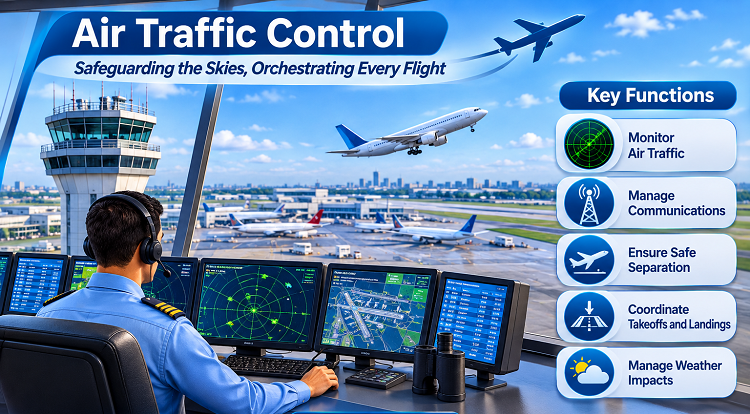
Air Traffic Control training is demanding, selective, and deeply practical. Candidates study aviation law, meteorology, navigation, and radar simulation for months. Trainees practice under watchful instructors until calm decision-making becomes second nature. Certification requires passing rigorous written, oral, and live-traffic evaluations.
The global Air Traffic Control Market is poised for steady, technology-driven expansion over the next decade as aviation authorities and airport operators accelerate the modernization of legacy airspace infrastructure. According to the latest market forecast, the Air Traffic Control Market was valued at US$ 15.14 Billion in 2025 and is expected to reach US$ 24.21 Billion by 2034, reflecting a CAGR of 5.35% during the forecast period of 2026–2034.
Rising commercial passenger traffic, expanding regional airport networks, and urgent mandates to replace aging radar and communication infrastructure are serving as primary catalysts for market growth. As global flight volumes climb, air navigation service providers (ANSPs) are prioritizing integrated Communication, Navigation, and Surveillance (CNS) systems alongside automated decision-support tools to maximize airspace capacity and maintain stringent safety standards.
Key Market Drivers and Technological Shifts
The transition from traditional ground-based radar and voice-centric operations to digitized, satellite-enabled airspace management is reshaping procurement priorities worldwide. Key industry trends driving capital expenditure include:
-
Deployment of Digital and Remote Towers: Civil aviation regulators in North America and Europe are increasingly validating optical sensor-based digital and remote tower solutions to manage single and multiple regional airports from centralized facilities, reducing operational overhead while improving situational awareness.
-
Automation and AI-Assisted Decision Support: Artificial intelligence, predictive trajectory modeling, and Controller-Pilot Data Link Communications (CPDLC) are gaining rapid traction to alleviate controller workload, minimize radio frequency congestion, and optimize four-dimensional flight paths.
Get a PDF Sample- https://www.theinsightpartners.com/sample/TIPRE00005420
-
Sustainability and Fuel Efficiency Mandates: Alignment with international decarbonization frameworks such as ICAO’s Carbon Offsetting and Reduction Scheme for International Aviation (CORSIA) is compelling ANSPs to adopt precision navigation and flow management software that reduce holding patterns, flight delays, and aviation fuel burn.
-
Cybersecurity and Navigational Resilience: Heightened geopolitical tensions and risks of GPS interference have elevated investments in encrypted data links, resilient satellite navigation, and hardened ATM software architectures.
Competitive Landscape and Key Players
The global air traffic control market is characterized by high technological barriers to entry and long-term government and defense contracts. Industry leaders are focusing on strategic partnerships, software-centric upgrades, and next-generation surveillance deployments to strengthen their global footprint. Prominent players operating in the market include:
-
Adacel Technologies Limited
-
BAE Systems plc
-
Harris Corporation
-
Honeywell International Inc.
-
Indra Sistemas, S.A.
-
Leonardo S.p.A.
-
Lockheed Martin Corporation
-
Northrop Grumman Corporation
-
Raytheon Company
-
Thales Group
Regional Dynamics
North America continues to command a leading share of the global air traffic control market, underpinned by extensive federal modernization initiatives such as the U.S. Federal Aviation Administration’s (FAA) ongoing upgrades to terminal radar approach control (TRACON) facilities, control towers, and workforce simulation technologies. Europe remains a major hub for collaborative airspace innovation through frameworks like SESAR, focusing heavily on cross-border traffic synchronization and green aviation corridors. Meanwhile, the Asia-Pacific region is projected to register the fastest growth rate through 2034, propelled by greenfield airport construction, rapid fleet expansion, and large-scale satellite navigation rollouts across India, China, and Southeast Asia.
Future Outlook
Looking ahead to 2034, the air traffic control industry will undergo a structural shift from hardware-heavy installations toward software-defined, cloud-compatible, and interoperable airspace ecosystems. Beyond traditional commercial and military aviation, the commercial scaling of Unmanned Aircraft Systems (UAS) and Advanced Air Mobility (AAM) vehicles will necessitate unified Unmanned Traffic Management (UTM) frameworks capable of seamlessly integrating low-altitude drone operations into controlled airspace. Vendors that deliver scalable automation, space-based Automatic Dependent Surveillance-Broadcast (ADS-B) tracking, and cyber-resilient platforms will be best positioned to capture long-term value as global aviation enters a new era of connected airspace.
Related Reports-
Air Traffic Management Market Size, Demand & Growth by 2034
Air Traffic Control Equipment Market Share, Size & Forecast by 2037
About The Insight Partners
The Insight Partners is a leading market research and consulting firm delivering actionable insights through in-depth industry analysis and strategic intelligence. The firm supports clients across various industries in making informed decisions by providing comprehensive market forecasts, competitive assessments, and growth opportunities.