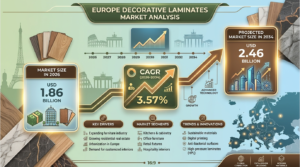
The Europe decorative laminates market is witnessing steady growth driven by rising construction and renovation activity, a large furniture manufacturing base, and increasing demand for sustainable, eco-certified and design-led surface solutions. The market grew from USD 1.76 Billion in 2025 to USD 1.86 Billion in 2026 and is projected to reach USD 2.46 Billion by 2034, growing at a compound annual growth rate (CAGR) of 3.57% during 2026-2034. EU sustainable renovation policy, the shift towards modular furniture and custom interiors, and advances in digital printing and surface textures are creating consistent consumption patterns for high pressure and low pressure laminates across the region. This market is strategically important to Europe’s built environment and furniture value chain, as it directly supports residential, commercial, hospitality, healthcare and transportation interiors.
The Europe decorative laminates market is poised for steady expansion, driven by renovation-led construction demand, a strong furniture manufacturing base and the rapid adoption of sustainable and digitally printed laminates. With a projected CAGR of 3.57% through 2034, the market presents significant opportunities for established manufacturers and new entrants focused on premium, customized and eco-certified surface offerings.
EUROPE DECORATIVE LAMINATES MARKET SUMMARY
The Europe decorative laminates market encompasses a wide range of surface materials designed to deliver aesthetics, durability, hygiene and ease of maintenance across furniture, cabinetry, flooring and wall applications. Key highlights of the market are summarized below:
- Market Scope: Thermosetting phenolic and melamine resin-based decorative surfaces, including high pressure laminates (HPL) and low pressure laminates (LPL), used in interiors and fit-outs.
- Key Segments: Product type (HPL, LPL), application (furniture and cabinets, flooring, wall panels, others), end use (residential, non-residential, transportation), texture (matte/suede, glossy), pricing (premium, mass) and sector (organised, unorganised).
- Dominant Segments: High pressure laminates account for approximately 65.0% of the market in 2025, while furniture and cabinets lead applications with a 55.0% share.
- Leading Country: Germany leads the regional landscape with approximately 30.0% share, followed by France (17.0%), the UK (15.0%), Italy (13.0%) and Spain (10.0%).
- Market Ecosystem: Raw material suppliers (phenol, melamine and décor paper), laminate manufacturers, distributors, furniture makers, fabricators, architects and end users.
- Key Players: Abet Laminati S.p.A., EGGER Group, Formica Group, FunderMax GmbH and Pfleiderer GmbH.
PORTER’S FIVE FORCES ANALYSIS – EUROPE DECORATIVE LAMINATES MARKET
The competitive dynamics of the Europe decorative laminates market can be analyzed using Porter’s Five Forces framework.
Porter’s Five Forces Analysis – Europe Decorative Laminates Market
- Competitive Rivalry: Moderate to High. Established European manufacturers compete on décor design, surface texture, certified sustainability credentials and distribution reach rather than on price alone. Business implication: players must invest consistently in surface design development and digital printing capability to differentiate their collections.
- Supplier Power: Moderate. Prices of phenol, melamine and paper substrates are volatile, which gives input suppliers some leverage over manufacturer margins. Business implication: manufacturers should pursue vertical integration, long-term supply agreements and bio-based resin alternatives to protect margins.
- Buyer Power: Moderate. Large furniture manufacturers, kitchen makers and commercial fit-out contractors purchase in volume and can compare multiple collections, while specification-led projects (hospitality, healthcare, retail) favor certified premium brands. Business implication: suppliers must strengthen specifier relationships, coordinated décor ranges and service levels to retain key accounts.
- Threat of Substitutes: Moderate to High. Engineered stone, ceramic tile, vinyl and solid surface materials compete with decorative laminates in worktops, flooring and wall cladding. Business implication: laminate producers must highlight cost-performance advantages, design variety, antimicrobial properties and large-format offerings against these alternatives.
- Threat of New Entrants: Low to Moderate. Capital-intensive pressing and printing lines, brand reputation, distribution networks and tightening EU environmental and chemical compliance create meaningful barriers, although niche and regional players can enter through digital short-run production. Business implication: incumbents should build defensible positions through scale, certification and proprietary design libraries.
Competitive Rivalry – Moderate to High (Healthy)
- Competition in the Europe decorative laminates market spans market leaders in premium HPL and vertically integrated wood-based panels (Abet Laminati, EGGER), strong challengers with broad ranges and pan-European distribution (Formica Group, Pfleiderer) and innovators in compact HPL and exterior cladding (FunderMax) – driving differentiation through design, surface technology and sustainability credentials.
- Recent launches such as EGGER’s Decorative Collection 26+, Formica’s FENIX NTX with up to 90% bio-based content and Abet’s photorealistic stone and concrete digital print décors reflect active product-led competition that is strengthening the overall market ecosystem.
Request for Sample Report: https://www.imarcgroup.com/europe-decorative-laminates-market/requestsample
MARKET GROWTH DRIVERS:
Rising Construction, Renovation and Furniture Manufacturing Activity
Several key factors are propelling the expansion of the Europe decorative laminates market. Rising construction and renovation activity, supported by EU sustainable renovation policy, is a powerful demand driver for laminates used in kitchens, interiors, wall cladding and flooring. Europe’s large furniture manufacturing base further supports volumes, as the growth of modular furniture and custom interiors increases laminate use across cabinets, worktops and fit-out joinery. Together, furniture and cabinets (55.0% share) and flooring (25.0% share) account for the bulk of application demand.
MARKET GROWTH DRIVERS:
Sustainability Demand, Digital Printing and Advanced Surface Technologies
The Europe decorative laminates market is also benefiting from evolving customer expectations and technology adoption. Demand for sustainable, eco-certified laminates (low VOC, recycled content, FSC/PEFC certified) is rising, with such products commanding an estimated 8-12% price premium. Digital printing and advanced surface textures allow manufacturers to deliver photorealistic wood, stone and concrete décors, short customized runs without tooling costs and highly tactile finishes. Furthermore, innovation in resin systems and surface coatings, including lower-formaldehyde and bio-based resins and nano-ceramic and nano-silica scratch- and fingerprint-resistant surfaces, is expanding the performance envelope of laminates and supporting premiumization.
MARKET RESTRAINTS AND CHALLENGES
Despite positive momentum, the Europe decorative laminates market faces several headwinds:
- Raw Material Price Volatility: Volatile prices of phenol, melamine and paper substrates pressure manufacturer margins.
- Competition from Alternative Materials: Engineered stone, ceramic tile, vinyl and solid surface materials compete in worktop, flooring and wall applications.
- End-of-Life Recycling: Recycling thermosetting HPL resins is difficult under evolving EU waste rules.
- Regulatory Compliance: Tightening EU environmental and chemical regulations burden smaller manufacturers the most.
- Energy Intensity: Energy-intensive production exposes manufacturers to energy price volatility.
MARKET OPPORTUNITIES
- Commercial and Institutional Construction: Growing hospitality, retail, healthcare and other commercial projects create demand for durable, hygienic and design-led surfaces.
- Eastern European Markets: Countries such as Poland, the Czech Republic and Romania offer room for expansion through local distribution and production.
- Premium and Customized Lines: Anti-fingerprint matte finishes, large-format panels and coordinated décor ranges allow manufacturers to capture higher-value demand.
EMERGING TRENDS AND TECHNOLOGY LANDSCAPE
- Synchronous / Embossed-in-Register (EIR) Textures: Replicate wood, stone and fabric surfaces authentically and carry an estimated 15-25% price premium.
- Large-Format and Thin-Gauge HPL (0.5-1.2 mm): Increasingly used in furniture overlays and wall cladding.
- Antimicrobial Laminates: Silver-ion and copper-based treatments are gaining traction in healthcare, education and food service environments.
- Digital Inkjet Printing: Industrial digital printing integrated with press lines, supported by colour management, enables short, customized runs without tooling costs.
- Circular-Economy Measures: Closed-loop water recycling, solvent recovery, recyclable thermoplastic formulations and EPD certification are becoming competitive differentiators.
EUROPE DECORATIVE LAMINATES MARKET SEGMENTATION
Segmentation analysis provides a detailed view of the Europe decorative laminates market by category:
- Product Type Insights: High Pressure Laminates (HPL), Low Pressure Laminates (LPL).
- Application Insights: Furniture and Cabinets, Flooring, Wall Panels, Others.
- End Use Insights: Residential, Non-Residential, Transportation.
- Texture Insights: Matte/Suede, Glossy.
- Pricing Insights: Premium, Mass.
- Sector Insights: Organised, Unorganised.
- Regional Insights: Germany, France, United Kingdom, Italy, Spain, Others (Netherlands, Poland, Belgium, Scandinavia and others).
High pressure laminates lead the product type segment with approximately 65.0% share (2025), while low pressure laminates hold about 35.0%. By application, furniture and cabinets lead with 55.0%, followed by flooring (25.0%), wall panels (12.0%) and others (8.0%).
COMPETITIVE LANDSCAPE
The Europe decorative laminates market features a competitive landscape made up of market leaders, strong challengers and specialist innovators with pan-European reach. Key companies operating in the market include:
- Abet Laminati S.p.A.
- EGGER Group
- Formica Group
- FunderMax GmbH
- Pfleiderer GmbH
Strategic developments are shaping the competitive arena, notably EGGER’s launch of Decorative Collection 26+ with 12 new thermally fused laminate (TFL) decors and the ST17 Omnipore Oiled texture (2026), Formica Group’s introduction of FENIX NTX with up to 90% bio-based content and an ultra-matte, soft-touch finish (2026), and Abet Laminati’s addition of photorealistic stone and concrete décors to its digital print collection for premium hospitality and retail fit-outs (2025). Leading manufacturers reportedly spend 10-18% of revenue on surface design development.
REGIONAL ANALYSIS:
Regional dynamics within the Europe decorative laminates market are shaped by differing furniture manufacturing strength, construction activity and design culture:
- Germany (approx. 30% share): Europe’s largest furniture manufacturer and a major construction market, with strong HPL adoption.
- France (approx. 17% share): Driven by residential renovation, interior design culture and premium kitchen and hospitality demand.
- United Kingdom (approx. 15% share): Supported by commercial construction, hospitality and healthcare demand.
- Italy (approx. 13% share): A design-focused, export-oriented furniture producer with strong demand for premium décors.
- Spain (approx. 10% share): Demand linked to construction and tourism infrastructure recovery.
- Others (approx. 15% share): Eastern Europe and Scandinavia (including the Netherlands, Poland and Belgium) are growing with urbanization and furniture production.
RECENT INDUSTRY DEVELOPMENTS
2026: EGGER launched Decorative Collection 26+, featuring 12 new thermally fused laminate (TFL) decors and the ST17 Omnipore Oiled texture.
2026: Formica Group introduced FENIX NTX, with up to 90% bio-based content, an ultra-matte finish and a soft-touch surface, launched after NeoCon 2026.
2025: Abet Laminati added photorealistic stone and concrete décors to its digital print collection, targeting premium hospitality and retail fit-outs.
Key Aspects Required for the Europe Decorative Laminates Market
- Market Performance: USD 1.76 Billion in 2025, growing to USD 1.86 Billion in 2026 with a projected trajectory to USD 2.46 Billion by 2034.
- Market Outlook: A 3.57% CAGR during 2026-2034 indicates steady growth across furniture, cabinetry, flooring and wall panel applications, with an interim value of USD 2.10 Billion by 2030.
- Growth Drivers: Rising construction and renovation activity; EU sustainable renovation policy; a large furniture manufacturing base; demand for eco-certified laminates; digital printing and advanced surface textures.
- Competitive Landscape: Market leaders and strong challengers including Abet Laminati, EGGER Group, Formica Group, FunderMax and Pfleiderer, competing on design, sustainability and distribution reach.
- Value Chain Analysis: Raw material procurement, resin impregnation, laminate pressing, surface finishing and quality control, distribution and end use.
- Industry Trends: Synchronous/EIR textures, large-format and thin-gauge HPL, antimicrobial laminates, digital inkjet printing and circular-economy measures.
- Strategic Recommendations: Focus on premium, certified HPL for BREEAM- and DGNB-driven commercial specifications; expand into Eastern European markets through local distribution and production; develop premium and customized lines (anti-fingerprint matte, large-format, coordinated décor); and secure raw material supply while advancing bio-based resin and recyclable formulations.
Note: If you need any specific information that is not covered currently within the scope of the report, we will provide the same as a part of customization.
Request Customization: https://www.imarcgroup.com/request?type=report&id=3598&flag=E
- Report Format, Delivery, and Customization Details
- Report Format Mode: PPT, PDF, and Excel
- Report Delivery Mode: Online Delivery, Physical Delivery
- Report Delivery Time: Report Delivered Over Email within 24 to 48 hours. If requested by the client, a physical copy will be delivered within three to ten days.
- Report Confirmation Mode: Yes via Email
- Report Customization Mode: Yes via Email / Call
- Report Table of Content: Yes
- Report List of Figures: Yes
- Report Methodology Mode: Yes
- Request For Sample Report: Yes