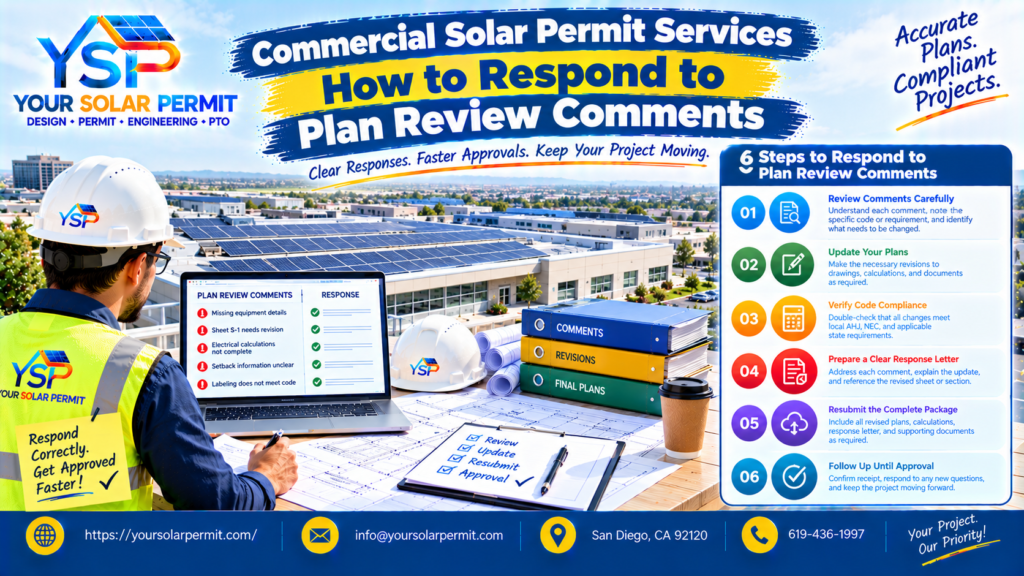
Commercial solar permit services reviewing commercial rooftop solar plans
Commercial solar permit services can help project teams deal with a frustrating moment: the permit application has been submitted, but the building department sends it back with comments. Some notes may point to missing information. Others may ask for clarification about equipment, roof access, electrical connections, or supporting calculations.
It doesn’t always mean the whole design is wrong. Often, the next step is to understand each comment, identify the document it affects, and provide a clear response supported by the revised plans.
A good response should address the reviewer’s actual question rather than simply state that a correction has been made. The process varies by jurisdiction, but a consistent approach can help teams manage revisions and prepare a clearer resubmission.
What Are Commercial Solar Permit Review Comments?
Review comments are questions, requested corrections, or instructions issued while an authority having jurisdiction (AHJ) evaluates a permit application. They may concern the drawings, equipment information, code requirements, calculations, or missing application details.
The comments don’t all carry the same meaning. One reviewer may ask for a dimension to be added, while another may request supporting information to evaluate a proposed electrical or structural arrangement. The project team needs to distinguish a drafting correction from a technical issue that requires further evaluation.
Commercial solar permit services may support document coordination and revision management, depending on the agreed scope. The applicant and responsible design professionals must still verify the technical response and meet the reviewing authority’s requirements.
1. Read Every Comment Before Editing the Drawings
The first reaction may be to open the drawings and start making changes. Resist that urge for a moment.
Read the entire comment letter first. A reviewer may refer to a detail on one sheet that affects information elsewhere in the package. If the team corrects only the first visible issue, another inconsistency may remain.
Create a list of the comments and record the relevant sheet, drawing detail, or application section for each one. Keep the original wording available so the response addresses what the reviewer actually requested.
For example, a comment asking for clarification of equipment placement is different from a comment questioning the proposed installation method. The first may need clearer documentation; the second may require technical review before anyone changes the plans.
2. Separate Drawing Corrections From Technical Questions
Not every review comment should be handled by the person editing the drawings. Some requests involve presentation, while others concern the design itself.
A missing label or unclear reference may be a documentation issue. A question about structural capacity, conductor sizing, equipment ratings, or a code-related configuration may require review by the appropriately qualified professional.
Commercial solar permit services can help identify which sheets need updating and organize the response package. However, the team shouldn’t make a technical change just to make a comment disappear. The revised design must remain accurate and comply with applicable requirements.
When the comment is unclear, ask the AHJ for clarification through its accepted process. A short, specific question is more useful than guessing what the reviewer intended.
3. Match Each Response to the Exact Review Comment
A response letter should make it easy for the reviewer to see what changed and where to find it. Avoid vague statements such as “fixed” or “updated” without identifying the relevant drawing or document.
A useful response generally includes the comment reference, a concise explanation, and the sheet or detail where the change appears. If no drawing change was necessary, explain the basis for the response and provide supporting information when appropriate.
The solar permit design documentation should support the explanation rather than contradict it. If the response describes a revised equipment location, for example, the affected drawing should show that location clearly.
Keep the wording factual. The purpose isn’t to argue with the reviewer; it’s to demonstrate how the comment has been addressed or ask for clarification where needed.
4. Coordinate Revisions Across the Entire Drawing Set
One change can affect more than one page. Moving an inverter may affect the equipment layout and electrical documentation. Changing the module arrangement may affect panel counts and other related project details.
Before revising a sheet, identify which other documents depend on the same information. Then compare the updated drawings to make sure they describe one consistent proposed system.
Commercial solar permit services can help coordinate these revisions when the project scope includes plan-set review and documentation updates. The responsible design professionals should verify any technical changes and approve the information within their scope.
This is also a good time to remove outdated details. A resubmission should not contain one revised drawing beside another sheet that still describes the previous design.
5. Check Whether Engineering Documentation Is Needed
Some comments request calculations or technical evidence that wasn’t included in the original application. Others raise questions about a design assumption that needs to be reviewed.
The project team should first identify what the reviewer is asking for and determine who is qualified to provide it. Structural questions may require a structural professional, while electrical questions may require review by the responsible electrical designer or another qualified professional.
Where signed and sealed engineering documents are required, PE stamping services may be relevant to work within a licensed engineer’s scope. The engineer must review the actual project information and determine the appropriate technical response.
Don’t assume that an old calculation or a document from a similar building answers the comment. The supporting information should apply to the specific installation being reviewed.
6. Review the Local Requirements Before Resubmitting
A response that resolves one comment may not complete the application. The AHJ may also require revised sheets, additional documents, updated forms, or a particular resubmission format.
Check the comment letter and current instructions carefully. Confirm whether the reviewer wants a revised full plan set, selected replacement sheets, a written response, or other supporting material.
For larger projects, commercial solar permit services may help organize the drawings, response notes, and related documentation into a consistent package. The exact support required depends on the project and the service scope.
The applicant should follow the building department’s accepted submission process. Requirements can differ between jurisdictions, so don’t assume that the procedure used on another project will apply here.
7. Use a Final Quality Check Before Resubmission
A quick final review can catch problems introduced during revisions. Check the response letter against the latest drawings and make sure every comment has a clear status.
Use this checklist before sending the package back:
- Every reviewer comment has been addressed or clearly identified for clarification.
- Each response points to the relevant revised sheet or supporting document.
- Updated drawings reflect the same equipment and system configuration.
- Related sheets have been reviewed for changes caused by the correction.
- Required calculations or engineering documents are included where applicable.
- Sheet references and revision information are consistent.
- The resubmission follows the AHJ’s current instructions.
If a comment remains unresolved, don’t hide it behind a general statement. Identify the outstanding issue and follow the appropriate process to resolve it.
Common Mistakes That Can Complicate a Resubmission
Some avoidable problems make a response harder to review. Teams may answer a comment without changing the relevant drawing, revise one sheet while leaving conflicting information elsewhere, or submit technical explanations without the requested supporting documents.
Another mistake is treating every comment as a simple drafting task. If a reviewer questions a design assumption, the team should verify the issue rather than change the wording alone.
Finally, avoid making unrelated revisions without checking their effects. If the project changes during the correction process, review the affected drawings and application details before resubmission. A clear record of what changed helps everyone work from the same version.
Frequently Asked Questions
Do review comments mean a commercial solar permit has been rejected?
Not necessarily. Review comments often identify questions or corrections that must be resolved before the review can continue. The project’s status and next steps depend on the AHJ’s notice and procedures.
Who should respond to commercial solar permit review comments?
The applicant usually coordinates the response, while the responsible designer or qualified professional addresses technical matters within their scope. The exact responsibilities depend on the project arrangement and local requirements.
Should the whole plan set be resubmitted after corrections?
That depends on the reviewing authority. Some departments require a complete revised package, while others accept selected replacement sheets and a response letter. Follow the current submission instructions.
Can a team reuse calculations from another solar project?
Only if the responsible professional determines that the information is appropriate for the current project. Building conditions, equipment, layouts, and design assumptions may differ, so previous calculations shouldn’t be treated as automatically applicable.
How can commercial solar permit services help with review comments?
Depending on the agreed scope, they may help organize comments, track affected sheets, coordinate document revisions, and check consistency across the resubmission package. Technical decisions must still be made or verified by the appropriately qualified professionals.
When a permit review generates comments, start by understanding each request and mapping it to the document it affects. Your Solar Permit is a starting point for exploring solar permit design and documentation support for commercial projects.